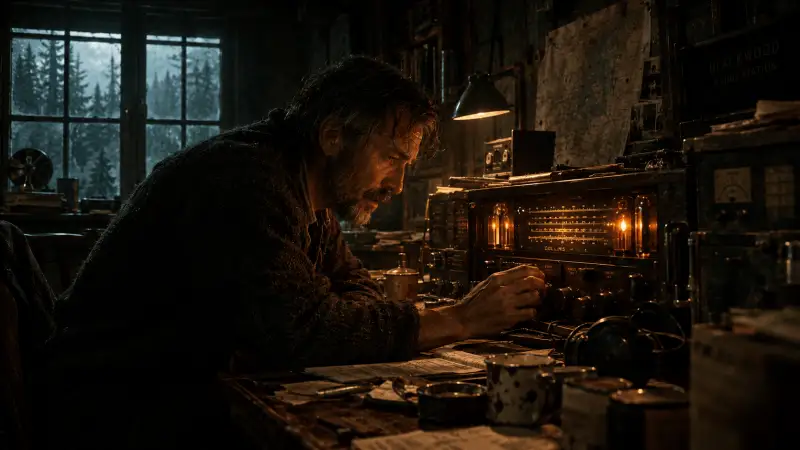
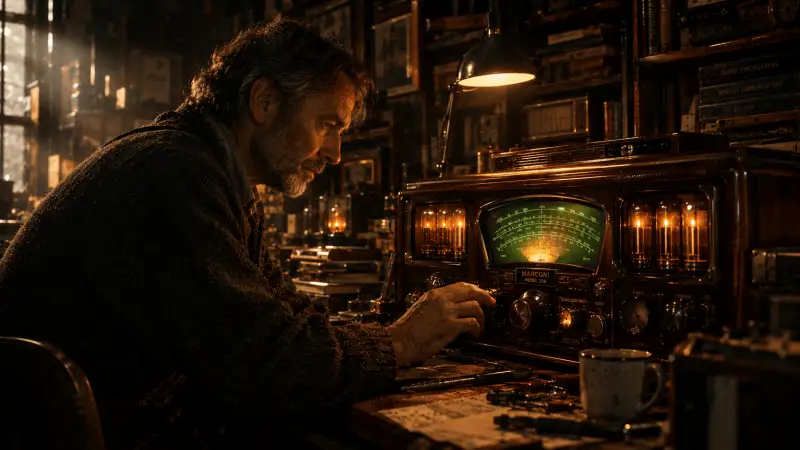
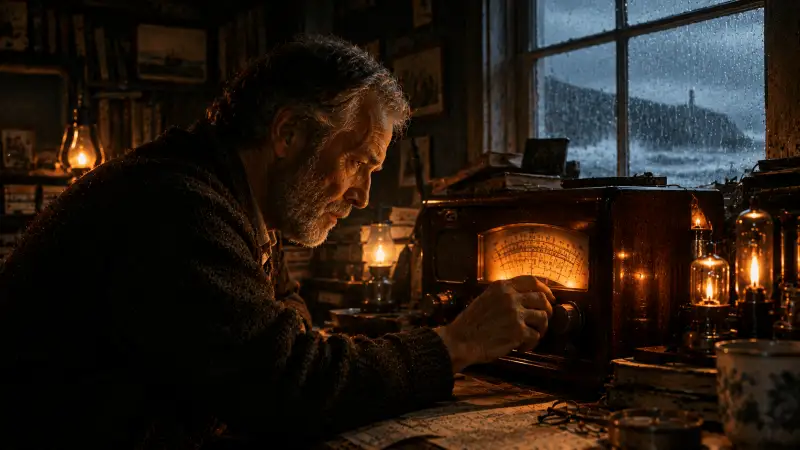
In a sleepy 1950s town, a lonely late-night radio host finds his monotonous life irrevocably altered by a nightly, cryptic caller who seems to know more about him than he knows himself, plunging him into a quiet mystery that threatens his grasp on reality.
Table of Contents
- Chapter 1: The Static and the Silence (Listener Who Called Every Night Origins)
- Chapter 2: The Unseen Confidant (Listener Who Called Every Night Connection)
- Chapter 3: Whispers of the Past (Listener Who Called Every Night Mystery)
- Chapter 4: The Looming Shadow (Listener Who Called Every Night Tension)
- Chapter 5: Echoes in the Airwaves (Listener Who Called Every Night Resolution)
Chapter 1: The Static and the Silence (Listener Who Called Every Night Origins)
The mysterious story of the listener who called every night began during a relentless rainfall at station WCRN.
The rain had been a constant companion for Arthur P. Finch for three days now, a relentless percussion against the soundproofed walls of station WCRN. It was 11:47 PM, and the city, a collection of tired brick and simmering secrets, was sinking into its nightly slumber.
Arthur, however, was just coming alive, or at least, beginning his performance of it. He adjusted the heavy, chrome microphone, its surface cool beneath his fingertips, a familiar anchor in the vast, echoing silence of the studio.
The faint hum of the broadcast equipment was the only other sound, a mechanical heartbeat in the otherwise desolate room.
His show, "Nocturne Whispers," was an exercise in melancholy, a curated collection of jazz standards and classical pieces punctuated by Arthur's own soft, resonant voice. He spoke of distant stars, forgotten dreams, and the quiet beauty of a world asleep.
It was a role he played with an authenticity born of personal experience. Arthur was, fundamentally, a lonely man. His apartment, a collection of worn books and stale pipe tobacco, mirrored the studio's solitary embrace.
He preferred the company of shadows and the hushed tones of late-night radio to the cacophony of daylight.
Tonight, a particularly mournful rendition of "Smoke Gets in Your Eyes" faded out, leaving a tender ache in the air. Arthur leaned into the microphone, his voice a balm against the late-hour anxieties.
"And so, another day folds itself into the long tapestry of time," he began, the words rehearsed, yet imbued with genuine sentiment. "May your dreams be gentle, and your waking moments filled with the quiet grace this night affords."
He paused, a customary beat before the next musical selection, allowing the silence to hang, pregnant with unspoken thoughts.
It was then, amidst the comfortable hush, that the red light on the call board flickered. It was a rare occurrence. Most calls to "Nocturne Whispers" were complaints about the music choice or a request for a dedication, usually from insomniacs or shift workers.
Arthur frowned, a slight crease forming between his brows. He hesitated, then pressed the "On Air" button for the line. "WCRN, Nocturne Whispers, Arthur P. Finch speaking. You're on the air."
There was only static. A low, persistent hiss, like the distant breath of the ocean. Arthur waited, his heart giving a small, unexpected lurch.
He could hear no voice, no rustle, no background noise, just the endless, whispering static. "Hello?" he tried again, a touch of impatience creeping into his tone. Still nothing.
The red light remained stubbornly lit. He held the line for nearly thirty seconds, an eternity in live radio, before sighing and disconnecting. Learn more about historical AM radio station operations.
"Apologies, listeners," he murmured into the mic, his voice regaining its practiced composure. "Technical difficulties, it seems. We return now to the soothing sounds of Chet Baker."
The music swelled, filling the void, but the encounter had rattled him. It wasn't just the static; it was the duration of the static, the unwavering presence on the line.
It felt deliberate, like a silent, observational vigil. He glanced at the call board again. The red light was off.
He tried to shake off the unease, telling himself it was just a dropped line, a faulty connection in the persistent rain. But as he settled back into his routine, a subtle chill lingered, a premonition of something new, something that had quietly intruded upon the predictable rhythm of his solitary nights.
Chapter 2: The Unseen Confidant (Listener Who Called Every Night Connection)
The presence of the listener who called every night grew stronger on the following evening.
The following night, the rain had softened to a persistent drizzle, a melancholic backdrop to Arthur's broadcast. He had tried to dismiss the previous night's silent caller as an anomaly, a phantom of the electrical grid.
Yet a sliver of anticipation, a strange, nervous energy, had settled within him. He found himself glancing at the call board more frequently, his fingers hovering near the "On Air" button with an uncharacteristic tension.
Just as the final notes of a Duke Ellington piece faded, the red light glowed once more. Arthur's breath hitched. He pressed the button, a tremor running through him.
"WCRN, Nocturne Whispers, Arthur P. Finch speaking. You're on the air." The static was there again, a familiar, comforting hiss this time, less threatening, more like a presence.
And then, a voice. It was faint, almost a whisper, raspy as if unused for years, but distinctly female. "Arthur," it breathed, a single word, stretched and fragile.
Arthur froze, his hand still on the button. "Who is this?" he asked, his voice a little louder than intended, breaking the composed façade.
There was a long pause, filled only by the static. "The listener," the voice finally replied, a dry rustle of sound. "I listen every night."
"You called last night, too?" Arthur pressed, a sudden surge of adrenaline quickening his pulse. "Yes," she affirmed, the word barely audible. "But I couldn't speak then. The storm."
He felt a strange mix of relief and intrigue. A real person. Not a prank, not a malfunction. Just a listener.
"Well, it's good to hear from you," he said, trying to sound professional, but a genuine warmth bled into his tone. "Do you have a song request tonight, 'The Listener'?"
Another long silence. The static seemed to hum with unspoken depth. "No song," she said. "Just I like your voice. It makes the night less long."
Arthur was momentarily speechless. No one had ever called to simply commend his voice, to acknowledge the profound emptiness he tried to fill for others, and for himself, with his broadcasts.
It was an intimacy he hadn't realized he craved. "Thank you," he managed, a genuine, unbidden smile touching his lips. "That means a great deal."
The conversation, if it could be called that, continued in fits and starts over the next few weeks. Every night, without fail, the red light would glow.
The Listener never asked for a song. She rarely offered more than a few words: "The stars are bright tonight, Arthur," or "I saw a lonely cat on Elm Street today," or "Your story about the old clock tower resonated."
Her voice remained a dry, papery whisper, a sound that seemed to emanate from another time, another dimension.
Arthur found himself dissecting her words, searching for clues, for a hint of her identity, her life. Was she old? Young? Where was she?
The calls became the focal point of his nights, eclipsing the music, the news, even his own prepared monologues. He started addressing her directly through the airwaves, "To my faithful listener, wherever you are."
He felt a strange kinship with this unseen confidant, a connection forged in the crucible of solitude. He talked more, shared more of himself, his observations, his quiet philosophies.
The studio, once an echo chamber of his own loneliness, now felt less empty, inhabited by an unseen presence, a shared secret. He even began to wonder if she knew him, truly knew him, in a way no one else ever had.
The thought was both exhilarating and terrifying. Explore our full archive of mysterious radio signals and nocturnal broadcasts.
Chapter 3: Whispers of the Past (Listener Who Called Every Night Mystery)
The nature of the calls from the listener who called every night took a deeply personal turn during the fourth week.
The subtle shift in the calls began in the fourth week, a barely perceptible change in The Listener's already cryptic pronouncements. It was no longer just observations about the night or quiet affirmations of his voice.
Now, her words carried a weight, a strange resonance that seemed to tap into forgotten corners of Arthur's own past.
One night, after a particularly poignant piece of classical music, the red light pulsed. "WCRN, Nocturne Whispers," Arthur answered, his voice now imbued with an almost frantic readiness.
"Arthur," the whisper came, "the scent of petrichor is strong tonight. It reminds me of the old garden near the creek, the one with the broken birdbath."
Arthur's hand tightened on the microphone. The creek near the old garden, that was the overgrown patch behind his childhood home, a place he hadn't thought about in decades.
The broken birdbath, half-submerged in weeds, was a vivid image from a forgotten summer. A chill traced its way down his spine, despite the warmth of the studio.
"How do you know about that?" he asked, his voice barely above a whisper himself.
A long silence, punctuated only by the crackle of the line. "Some things they linger," she replied, her voice seeming to carry an ancient sadness. "Like echoes in a well."
He tried to rationalize it. Perhaps it was a common enough description, a lucky guess. But the specific detail of the broken birdbath gnawed at him.
He spent the rest of his broadcast in a daze, his gaze constantly sweeping the dark studio beyond the glass, half-expecting to see a shadowy figure.
The incidents escalated. Another night, she mentioned the "yellowed photograph tucked beneath the loose floorboard in the attic." Arthur felt a cold dread settle in his stomach.
He had, indeed, hidden an old photo of his deceased parents there after their passing, unable to look at it directly. It was a secret he had kept even from his closest, albeit few, friends. This was beyond coincidence.
His apartment, usually a haven of quiet solitude, began to feel like a cage. Every creak of the floorboards, every gust of wind against the window, seemed to carry a hint of surveillance.
He started checking the locks twice, peering through the peephole before opening his door. The mundane became menacing. The comforting hum of the refrigerator sounded like a low growl; the ticking of his grandfather clock, once a soothing rhythm, now felt like a countdown.
Sleep became elusive. He would lie awake, staring at the ceiling, replaying her words, trying to decipher their meaning. Was she a ghost? A deranged stalker?
Or something far more unsettling, a manifestation of his own deep-seated anxieties, given voice by the static and the lonely hours? He found himself talking to his reflection, asking questions, seeking answers in the weary eyes that stared back.
"Who are you?" he would whisper to the glass, the words hanging heavy in the still air of his apartment.
The radio station, once his sanctuary, now felt like a trap. The microphone, once his companion, now felt like an unwitting conduit for an unseen presence.
He considered telling someone, his station manager, the police, but what would he say? "A woman calls my show every night and whispers things about my past"? They would think him mad, or worse, making it up for attention.
And a part of him, a dark, fascinated part, didn't want the calls to stop. He was terrified, yes, but also utterly captivated.
The Listener, whoever she was, had shattered the comfortable predictability of his life, and in doing so, had made him feel more alive, more seen, than he had in years.
The silence of his world had been broken, replaced by the unsettling symphony of her whispers, each one a thread tightening around his fragile sense of self.
Chapter 4: The Looming Shadow (Listener Who Called Every Night Tension)
Tension mounted as the listener who called every night brought up memories Arthur had buried long ago.
The air in the studio grew heavy, thick with unspoken tension, each night a battle of wills between Arthur and the unseen Listener. His broadcasts, once smooth and effortless, became strained.
His voice, usually a comforting murmur, now carried an undercurrent of barely suppressed anxiety. He would startle at the slightest sound: the squeak of his chair, the rustle of a script page, the distant wail of a siren slicing through the night.
One evening, as a melancholic piano concerto concluded, the red light flared, brighter, more insistent, than ever before. Arthur took a deep, shuddering breath, his palm slick with sweat as he pressed the button.
"WCRN, Nocturne Whispers." He couldn't bring himself to add his name.
"Arthur," The Listener's voice came, clearer tonight, less static-laden, as if she were closer. "The old lighthouse on Blackwood Point, they say it still holds the light."
Arthur's heart hammered against his ribs. The Blackwood Point lighthouse was where his older brother, Thomas, had vanished during a storm almost twenty years ago, presumed lost at sea.
It was a wound that had never truly healed, a grief he rarely spoke of. "What are you talking about?" he demanded, his voice cracking, forgetting he was on air. "What about the lighthouse?"
"He was waiting," she whispered, her words chilling him to the bone. "Waiting for the signal. But it never came."
"Who was waiting?" Arthur pressed, his mind reeling, a torrent of desperate questions flooding his thoughts. "My brother? What do you know about Thomas?"
"The code," she continued, ignoring his frantic pleas. "The numbers in the music. You always played them. He heard them."
Arthur felt a cold wave wash over him. The numbers in the music.
For years, as a private tribute, he had subtly woven specific numerical sequences into his song choices: track numbers, album release dates, a personal code only he and Thomas, who had shared a passion for puzzles, would recognize. It was a secret he had never, ever revealed.
"How do you know about the code?" he whispered, his voice barely audible, his world tilting on its axis. "Tell me who you are!"
"The signal, it was a warning," she said, her voice growing weaker now, fading like a dying ember. "He tried to tell you not to trust the message."
The static surged, overwhelming her words, a violent roar that filled the studio. Arthur slammed his hand on the console, trying to clear the line, to hear more.
"Tell me! What message? Who are you?" he screamed into the microphone, his professionalism shattered, his composure irrevocably broken.
The red light vanished. The line went dead. The studio plunged into an unnerving silence, broken only by the frantic thumping of Arthur's own heart.
He sat there, trembling, staring at the blank call board, the words "the code," "the signal," "the message" echoing in his mind. He was no longer just a lonely radio host.
He was a man embroiled in a terrifying, deeply personal mystery, one that reached back into the darkest corners of his past, threatening to unravel the very fabric of his reality. He knew, with a terrifying certainty, that he could not let this go.
He had to find her. He had to understand. The ghost of his brother, and the chilling words of The Listener, demanded it.
Chapter 5: Echoes in the Airwaves (Listener Who Called Every Night Resolution)
The final chapter in the story of the listener who called every night brought a heartbreaking revelation.
The following morning, the world seemed sharper, colours more vibrant, sounds more piercing. Arthur walked through his days like a ghost, the words of The Listener a constant, deafening hum in his skull.
The "numbers in the music," the "signal," the "message," they gnawed at him, twisting his grief for Thomas into something sinister and unresolved.
He spent his daylight hours poring over old family photographs, maps of Blackwood Point, and even his old record collection, searching for a pattern, a hidden clue he might have missed.
He confided in no one, the fear of appearing mad outweighing his desperate need for help. The station manager, Mr. Henderson, noticed Arthur's gaunt appearance and distracted air.
"Everything alright, Finch?" he had asked, his voice laced with concern. Arthur had simply nodded, offering a strained smile, a lie he could taste on his tongue.
That night, he approached his broadcast with a grim determination. He wouldn't wait for her call. He would send his own message.
As the clock ticked past midnight, Arthur leaned into the microphone, his voice resonating with an uncharacteristic urgency. "To my faithful Listener," he began, "I heard you. I understood. And I'm searching. If there's a message, if there's a signal, tell me. Please. Don't leave me in the dark."
He then played a specific track, a jazz standard that had been Thomas's favorite, its track number a significant digit from their shared childhood. He waited, breath held, for the red light to appear.
An hour passed. Then two. The night wore on, filled only by the carefully chosen music, each note a question, each silence a void. The red light remained stubbornly dark.
The phone board was silent, a stark contrast to the nightly ritual that had consumed his life. Arthur felt a crushing wave of despair, a profound sense of loss, as if he had been abandoned again. He had pushed too hard, perhaps. He had scared her away.
As the first hint of dawn painted the sky outside the studio window in bruised purples and greys, Arthur played his final piece. It was a slow, mournful symphony, a lament for lost things.
Just as the last, lingering note faded, and before he could offer his customary goodnight, the red light flickered.
His heart leaped, a frantic bird against his ribs. He pressed the button, his hand trembling. "Listener?" he whispered, hope and dread a potent cocktail in his throat.
There was no static. Only a faint, almost imperceptible click, and then, a dial tone. The call had ended.
But before the line fully disconnected, Arthur heard something else, something brief and fleeting, a sound almost swallowed by the dial tone's mechanical drone. It was a recording, barely a second long, of a child's laughter.
Thomas's laughter. From an old home movie, perhaps.
Arthur stared at the now-dark call board, the dial tone buzzing in his ear long after he had released the button. The laughter. Thomas's laughter.
He closed his eyes, a tear tracing a path down his cheek. The listener was gone. Or perhaps, she had delivered her final, most potent message.
The truth about Thomas, the code, the message, it wasn't a warning about some external threat. It was a cry from the past, a plea for remembrance, a final, poignant connection to a brother he had grieved but never truly understood.
Arthur P. Finch finished his broadcast, his voice hoarse, but with a newfound clarity. The calls had changed him, stripped away the veneer of his solitary existence, forcing him to confront not a mystery of the living, but the lingering echoes of the dead.
He walked out of the studio into the pale light of dawn, the city slowly awakening around him, a changed man. The silence of his world was no longer empty; it was filled with the spectral whispers of a listener, and the haunting, beautiful sound of a child's forgotten laughter.
The mystery wasn't solved, but the connection had been made, and that, he realized, was enough.