In the echoing silence of a 1950s midnight radio booth, a melancholic DJ's carefully constructed world unravels when a cryptic caller forces him to confront a town's buried tragedy and his own complicity in its long-forgotten shadow.
Table of Contents
- Chapter 1: The Static and the Solitude (Midnight DJ and the Mysterious Caller Origins)
- Chapter 2: Echoes from the Past (Midnight DJ and the Mysterious Caller Secrets)
- Chapter 3: Unveiling the Shadow (Midnight DJ and the Mysterious Caller Investigation)
- Chapter 4: The Confession on the Air (Midnight DJ and the Mysterious Caller Confession)
- Chapter 5: Dawn and Disclosure (Midnight DJ and the Mysterious Caller Resolution)
Chapter 1: The Static and the Solitude (Midnight DJ and the Mysterious Caller Origins)
The atmospheric tale of the midnight DJ and the mysterious caller began late at night in a quiet radio station studio.
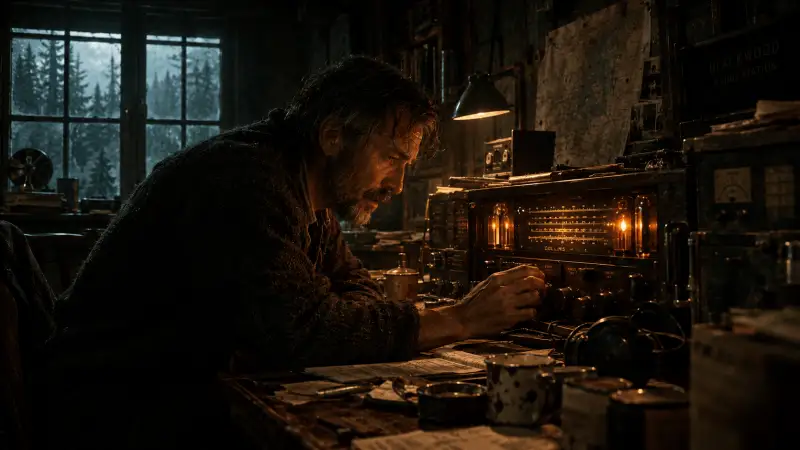
The clock on the studio wall, a silent, unforgiving sentinel, edged past midnight. Elias Thorne, a man sculpted by the late hours and the quiet hum of antiquated machinery, adjusted the volume on the turntable, the crackle of vinyl a familiar, comforting static against the vast, empty canvas of the night.
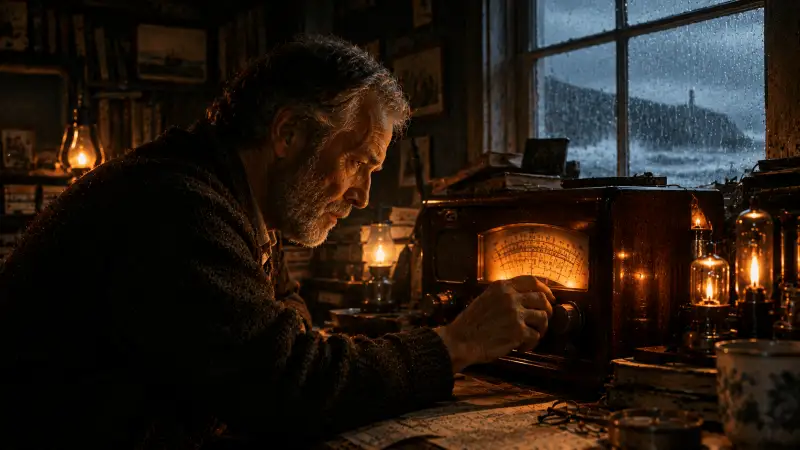
Outside, the city of Havenwood was a hushed tableau, its rain-slicked streets reflecting the distant glow of streetlights, each drop a tiny, fleeting mirror. Inside Station WHTN, however, the air was thick with the scent of ozone, stale coffee, and the faint, metallic tang of old dreams.
Elias was a creature of habit, a nocturnal anchor for the insomniacs and the lonely. His voice, a low, resonant baritone, was as much a part of Havenwood's midnight tapestry as the mournful hoot of an owl or the distant wail of a train.
For twenty years, he had spun records: jazz, blues, the occasional melancholic ballad, interspersing them with gentle pronouncements on the weather or philosophical musings gleaned from dog-eared paperbacks. Tonight, like most nights, the playlist was a carefully curated descent into the bittersweet depths of human experience, a balm for the weary soul.
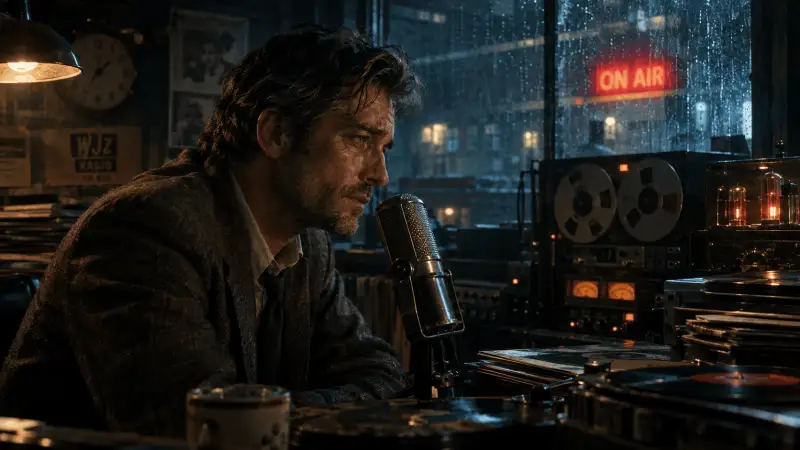
He leaned into the microphone, its chrome gleaming under the single, focused beam of his desk lamp. "Good evening, Havenwood. Or perhaps, good morning, depending on your particular brand of sleeplessness. This is Elias Thorne, guiding you through another long night. May your thoughts be kind, and your coffee strong."
His words, smooth as polished river stones, flowed effortlessly, a practiced cadence that masked the profound solitude that was his constant companion. He glanced at the empty chair opposite, a ghost of conversations past, of producers who had long since retired or moved on. Now, it was just him, the records, and the vast, listening dark.
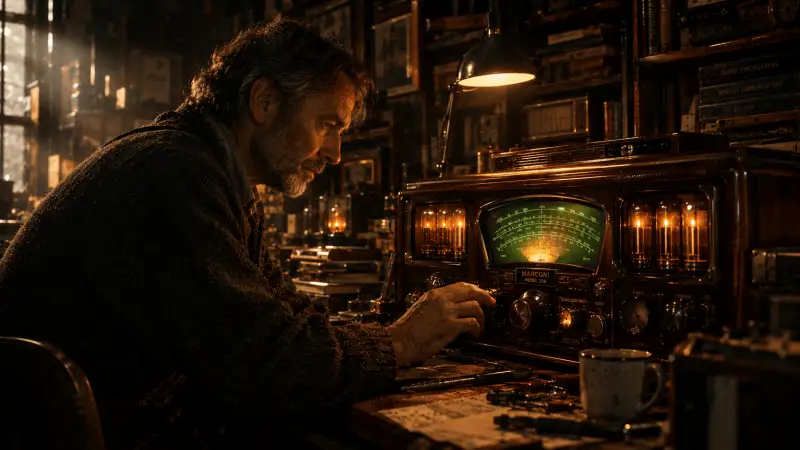
The studio itself was a relic, a testament to an earlier, less frenetic age. Knobs and dials, each with a satisfying resistance, adorned the hefty mixing board.
Reel-to-reel tape machines whirred softly in the background, their spools turning with an almost meditative rhythm. The walls, paneled in dark, sound-absorbing wood, seemed to absorb not just sound, but time itself, holding decades of voices, whispers, and forgotten melodies within their fibers.
Elias often felt like a keeper of this sonic mausoleum, a living echo of a world that was slowly fading. Learn more about vintage radio broadcasting history and technology.
Tonight, however, a subtle dissonance began to prick at the edges of his practiced calm. A low-pressure system had settled over Havenwood, the kind that pressed down on the spirit, making the air heavy with unspoken things.
He felt it in his bones, a dull ache that resonated with the city's own quiet unease. He selected a Miles Davis track, letting the mournful trumpet fill the space, a wordless expression of the very feeling that had taken root within him.
The phone, a clunky, rotary model, rang. It was an anomaly. Most listeners preferred to send letters or dedications via postcard, a charmingly anachronistic ritual.
Live calls were rare, reserved for emergencies or the truly deranged. Elias eyed it, a flicker of something akin to apprehension stirring within him. He usually let it ring a few times, a silent test of the caller's resolve, before reluctantly picking up.
"WHTN, you're on the air with Elias Thorne." His voice, though professional, carried a subtle edge of wariness. There was a faint hiss on the line, like distant ocean waves, then a voice, soft and breathy, emerged from the static. It was female, surprisingly young, yet imbued with an ancient weariness.
"Elias," she began, her tone a mere whisper.
Chapter 2: Echoes from the Past (Midnight DJ and the Mysterious Caller Secrets)
Unsettling memories resurfaced for the midnight DJ and the mysterious caller as long-buried secrets connected back to the Sterling Mill.
The rest of that night dissolved into a blur of nervous record changes and forced pronouncements. The caller had not spoken again, but her spectral voice clung to Elias like the humid summer air.
He found himself replaying her words, the strange intonation, the way his name had been stretched, almost tasted. It was not a threat, not a plea, but something far more unsettling: an intimation, a promise of revelation.
The feeling persisted through the meager hours of his sleep, a restless tossing and turning on sheets damp with sweat, the hum of the city outside replaced by the insistent echo of her voice.
He returned to the station the following night, his usual composure frayed at the edges. The stale coffee tasted bitter, the records felt heavier in his hands.
He tried to dismiss it, to rationalize it as a prank, a lonely soul seeking connection, but the words were too specific, too personal to be random. "The dust remembers, Elias. And so do the walls of the old mill." The old mill. The Sterling Mill. A place steeped in Havenwood's industrial past, and its darkest secret.
For nearly a decade, the Sterling Mill had been a gaping wound in the town's collective memory. A factory fire, over twenty years ago, had claimed lives, mostly immigrant workers.
The official report blamed faulty wiring, an act of God. But whispers, hushed and quick to dissipate, had always spoken of negligence, cost-cutting, and a swift, brutal cover-up.
Elias had been a young reporter then, fresh out of journalism school, eager to make his mark. He had chased the story, fueled by righteous indignation, but had hit a wall of silence, fear, and institutional obstruction.
Eventually, his editor, a pragmatic man named Arthur, had pulled him off the assignment, citing lack of evidence and the need to "move on." Elias had moved on, but the story had never truly left him, a persistent, low-frequency hum beneath the surface of his life.
He spun a mournful blues track, letting the wail of a saxophone fill the silence, a perfect counterpoint to the turmoil within him. His fingers, usually nimble and precise, fumbled slightly as he cued up the next record.
He felt a prickle of sweat at his temples, a nervous energy thrumming through his veins. Then, the phone rang again. One ring. Two. Three. It felt deliberate, a signal.
He inhaled deeply, the metallic tang of old equipment filling his lungs, and picked up.
"WHTN, you're on the air." His voice was tighter than he intended, a slight tremor betraying his unease. The same hiss, the same soft, almost apologetic voice. "Elias," she said again, a breath across the wires. "Did the music bring you back? To the dust?"
He gripped the receiver, his knuckles white. "Who is this? What do you want?" He tried to infuse his voice with authority, but it cracked slightly. He felt exposed, stripped bare by the unseen gaze of this woman.
"Want?" she mused, the word a delicate, almost playful note. "Perhaps what was always owed. What was never given. A voice, Elias. A memory." Her words were like tiny shards of glass, piercing through the carefully constructed layers of his denial. She was talking about the Sterling Mill. There was no longer any doubt.
He remembered the smell of the smoke, acrid and heavy, hanging over Havenwood for days. He remembered the faces of the families, their grief a silent scream, their pleas for answers met with bureaucratic stone walls.
He remembered Arthur's weary sigh, his hand on Elias's shoulder, telling him to let it go. "Some stories," Arthur had said, "are just too big for one man to tell."
Elias had believed him, or perhaps, he had wanted to believe him. He had convinced himself that discretion was wisdom, that moving on was a form of resilience.
But the truth was, he had been afraid. Afraid of the power of the corporate machine, afraid of losing his job, afraid of the dangerous depths the truth might lead him to.
"What do you know about the mill?" Elias demanded, his voice a hoarse whisper. He was no longer on air, having instinctively cut the microphone.
This was personal, an excavation of his own buried past. The sound of the reel-to-reel tape continued its rhythmic whir, a steady heartbeat against the rising tide of his panic.
"Enough," she replied, her voice gaining a subtle firmness, like a stream carving its way through rock. "I know of the warnings unheeded. Of the safety measures bypassed. Of the lives deemed expendable. And I know of the silence that followed. The great, heavy silence that swallowed everything whole."
She paused, and Elias could almost feel her presence, a spectral hand reaching across the decades. "You were there, weren't you, Elias? In the aftermath. You saw the faces. You heard the whispers. And then, you turned away."
The accusation, though softly spoken, landed with the force of a physical blow. He felt a cold dread seep into his bones, a recognition of a truth he had meticulously buried.
He had turned away. He had rationalized it, compartmentalized it, buried it under layers of jazz and philosophical musings.
But the caller, this phantom voice, was digging it all up, piece by agonizing piece. He looked at his hands, suddenly foreign, trembling slightly.
The warmth of the studio, usually so comforting, now felt oppressive, the walls closing in. He was caught, trapped between the present and a past he could no longer outrun.
The static on the line intensified, a rising tide of white noise threatening to engulf him, threatening to drown out everything but the clamor of his own guilt.
He closed his eyes, bracing for the next shard, the next echo from the past that she was so intent on resurrecting. He was no longer just a DJ; he was an archaeologist of his own forgotten sins, and she, the relentless excavator. Explore more vintage audio stories and classic mysteries.
Chapter 3: Unveiling the Shadow (Midnight DJ and the Mysterious Caller Investigation)
Driven by the broadcast, the midnight DJ and the mysterious caller found their past converging at the ruins of the Sterling Mill.
Sleepless nights blurred into restless days. The air in Elias's small apartment, usually a haven of quiet contemplation, now felt stale and suffocating.
The caller had stopped for two nights, a calculated silence that was more unnerving than her persistent calls. It was a silence that allowed his own thoughts to amplify, to become a tormenting chorus.
He saw the faces of the mill workers, the soot-stained walls, the grieving families, images long suppressed, now vivid and relentless.
He knew what he had to do. The compulsion was no longer a gentle nudge but a relentless tide.
One overcast afternoon, a day that perfectly mirrored the gloom in his soul, Elias drove his aging sedan out of Havenwood, past the manicured suburbs and into the forgotten industrial outskirts.
The road grew rougher, the trees taller and denser, their branches entwined like skeletal fingers. He knew the way by instinct, a path etched into the deeper strata of his memory.
The Sterling Mill wasn't just abandoned; it was a ruin. Nature had begun its slow, relentless reclamation.
Ivy clawed its way up crumbling brickwork, green tendrils weaving through shattered windows. The skeletal remains of the factory's tall smokestack stood like a broken monument against the bruised sky, a silent testament to a forgotten tragedy.
The air here was heavy, not just with damp earth and decaying concrete, but with a palpable sense of sorrow, a lingering whisper of lives abruptly extinguished.
Elias parked the car and stepped out, the gravel crunching under his worn shoes. The silence was profound, broken only by the distant caw of a crow and the rustle of dry leaves caught in a phantom breeze.
He walked slowly, carefully, avoiding jagged shards of glass and twisted metal. The main entrance, a gaping maw of rusted iron gates, was half-collapsed, its once formidable presence reduced to a skeletal grin.
He pushed through it, the metal groaning in protest, a sound that resonated with the ache in his chest.
Inside, the vast factory floor was a cathedral of decay. Light filtered in through the broken roof and shattered windows, casting long, distorted shadows that danced like ghosts across the debris-strewn floor.
Rust-colored dust coated everything, a fine, pervasive layer that seemed to cling to his very breath. He could almost smell the old machinery, the sweat of the workers, the desperate panic.
He saw the outlines of where looms and presses once stood, now just empty spaces, monuments to absence.
His eyes fixed on a section of the wall, blackened by fire, still stained with the indelible mark of that terrible day. He remembered it vividly now: the heat, the smoke, the desperate cries.
He had been there, a young, naive reporter, notebook in hand, trying to make sense of the chaos. He had seen the frantic efforts of the firefighters, the grim faces of the police, and the stony expressions of the mill owners, already rehearsing their carefully constructed narrative of misfortune and unforeseeable accident.
He ran a trembling hand over the cold, scarred brick. He remembered the face of a young woman, no older than himself, her eyes wide with terror, pleading for help.
He hadn't been able to do anything. He had been a witness, yes, but an impotent one. And then, the fear had set in. The threats, subtle at first, then more overt.
Arthur's warning: "They'll crush you, Elias. This town runs on Sterling money." He had retreated, convinced himself it was for the best.
He had chosen self-preservation over justice, silence over truth. The shame of that choice, once a dull ember, now flared into an inferno.
As he stood there, lost in the suffocating embrace of memory, his phone, which he had forgotten in his pocket, vibrated. He pulled it out, his heart hammering against his ribs. It was her. The caller.
He didn't even hesitate this time. He pressed the receiver to his ear, his hand clammy.
"You're there, aren't you, Elias?" Her voice, though still soft, now carried an undeniable current of triumph. "At the altar of our forgotten dead."
"Who are you?" he managed, his voice raw, his eyes scanning the cavernous space, half-expecting her to materialize from the shadows.
"A voice from the ashes, Elias. A fragment of what was lost. I am the memory that refuses to die, the truth that demands to be unearthed." Her words were not angry, but imbued with an almost divine sorrow.
"They said it was an accident. An unfortunate tragedy. But it was a crime, Elias. A crime against humanity, against decency. And you, with your journalist's pen, you could have been the one to shout it from the rooftops. But you chose to whisper. And then, you chose to be silent."
The accusation was a razor's edge, slicing through his carefully constructed defenses. He felt tears sting his eyes, hot and unwelcome.
"What do you want from me?" he choked out, the words tasting like ash.
"Justice, Elias. Not for the living, perhaps, but for the dead. For their stories to be told. For the weight of their silence to finally be lifted. You have the platform. You have the voice. It is time, Elias. Time to finally speak."
The line went dead, leaving Elias alone in the echoing ruins, the ghosts of the past pressing in around him, demanding their due.
The oppressive silence that followed was no longer empty, but filled with the deafening clamor of his own complicity, and the chilling certainty of what she was asking him to do.
Chapter 4: The Confession on the Air (Midnight DJ and the Mysterious Caller Confession)
Confronted live on air, the midnight DJ and the mysterious caller pushed toward a shocking public disclosure of corporate negligence.
The following nights were a crucible for Elias. Sleep was a distant memory, replaced by a constant, feverish replaying of the caller's words, the images of the mill, and the suffocating weight of his own inaction.
He moved through his days in a haze, the mundane tasks of life feeling utterly alien. Food tasted like ash, the morning sun felt like an unwelcome interrogation lamp.
The studio, once his sanctuary, now felt like a cage, the microphone a silent accuser. He was an exposed nerve, raw and trembling, waiting for the inevitable.
He knew she would call again. He felt it in the charged air, in the persistent thrum of his own heartbeat. The pressure was immense, a crushing weight that threatened to splinter him.
He considered fleeing, simply disappearing into the anonymity of another town, but where would he go? The past, he now understood, was not a place but a shadow, always following, always catching up. He could not run from himself.
Tonight, as the rain hammered against the soundproof windows, creating a hypnotic rhythm, Elias felt a strange sense of resolve solidify within him.
It wasn't courage, not exactly. More like the weary acceptance of a condemned man. He had played his part in the silence for too long. It was time for a different role.
He cued up a somber orchestral piece, its swelling strings a dramatic prelude to the confession he knew was coming.
He leaned into the mic, his hand shaking imperceptibly. "Good evening, Havenwood. This is Elias Thorne, and tonight tonight is different."
His voice, usually so smooth, had a gravelly edge, a strained quality that spoke of long-held burdens. "For twenty years, I've shared music, shared thoughts, shared the quiet companionship of the night. But there are some nights, some truths, that demand more than just quiet companionship."
He paused, letting the music swell, letting the silence build. He could almost feel the weight of his listeners, the few scattered souls out there in the dark, tuning in, perhaps sensing the shift in his tone.
He pictured the caller, out there somewhere, listening. He was speaking to her, yes, but also to himself, to the ghosts of the mill, to the conscience he had tried to bury.
"Many of you remember the Sterling Mill fire," he continued, his voice gaining a fragile strength. "A tragedy, we were told. An accident. And for many years, I believed that. Or perhaps, I chose to believe it."
He closed his eyes for a moment, picturing the faces of the victims, their names now bubbling up from the depths of his memory. "But the truth, like water, always finds its way to the surface. It may be slow, it may be painful, but it will surface."
The phone rang. A single, sharp, insistent ring that cut through the music and Elias's monologue like a knife. He looked at it, then back at the mic.
He had a choice. He could ignore it, try to push through his prepared words, or he could take the call.
He picked up the receiver, his heart pounding a frantic rhythm against his ribs. "You're on the air," he said, his voice barely a whisper.
Her voice, now, was not soft, not breathy. It was clear, resonant, imbued with a quiet power that sent a shiver down his spine.
"Finally, Elias. Finally. The air can only hold so many lies before it chokes."
He felt a strange surge of adrenaline, a mixture of terror and exhilaration. "What else do you know?" he asked, the words tumbling out.
"What else needs to be said?" He was no longer just responding; he was actively seeking, compelled by a force greater than himself.
"I know," she replied, her voice steady, "that the wiring wasn't faulty. I know that the fire exits were chained. I know that the owners knew. They knew the risks, they knew the dangers, and they chose profit over human life. And when the ashes settled, they bought the silence of the town. They bought the silence of the authorities. And they bought the silence of a young reporter, who was too afraid to speak."
The words were a gut punch. Each accusation, a hammer blow against his soul. He wanted to deny it, to defend himself, but the truth of her words was undeniable.
He had been bought, not with money, but with fear, with the promise of a quiet career, with the subtle pressure of a powerful establishment.
"I I was young," he stammered, his voice cracking, the microphone still open, broadcasting his raw, unfiltered shame to the handful of listeners who were undoubtedly glued to their radios.
"I was scared. They they threatened me. They threatened my family." He was exposing himself, laying bare his deepest cowardice, his most profound regret. The weight of it was suffocating.
"Fear is a powerful master, Elias," she conceded, her voice softening, a hint of understanding in its depths. "But silence is its most devoted servant. And twenty years of silence is a lifetime of complicity."
She paused, and he could hear her breath, a faint, ragged sound. "But it's not too late, Elias. Not entirely. There are still those who remember. Those who grieve. Give them a voice, Elias. Give them the truth. Tell them about the sealed reports. Tell them about the missing safety inspections. Tell them about the names. The names of the dead. The names of those who covered it up."
He felt a wave of nausea, his vision blurring. The names. He knew some of them. The powerful families of Havenwood, the pillars of the community.
To expose them would be to shatter the very foundations of the town. He looked at the "ON AIR" sign, its red glow suddenly ominous, a beacon of impending destruction.
He gripped the mic, his knuckles white, his breath coming in ragged gasps. He was on the precipice, poised to either plunge into the abyss or finally take flight.
The decision, agonizing and terrifying, hung in the humid, static-filled air of the studio. The silence that followed her words was deafening, amplified by the open microphone, waiting for his answer, waiting for his confession.
Chapter 5: Dawn and Disclosure (Midnight DJ and the Mysterious Caller Resolution)
As morning arrived, the midnight DJ and the mysterious caller inspired a long-overdue reckoning for the town of Havenwood.
The line went dead, leaving Elias alone in the studio, the last vestiges of the orchestral piece fading into a melancholic hum.
The "ON AIR" sign still glowed, a silent witness to his near-confession, his public unraveling. He slumped back in his chair, utterly spent, the adrenaline draining from him like sand through an hourglass.
His shirt clung to him, damp with sweat, his mind a chaotic maelstrom of fear, relief, and a strange, nascent sense of liberation.
He had not given the names. Not yet. But he had laid the groundwork. He had cracked open the long-sealed tomb of Havenwood's darkest secret, and the stench of buried truth was now permeating the airwaves.
He knew there would be repercussions. The powerful families, the ones who had pulled the strings for decades, would not take kindly to their carefully constructed reputations being threatened.
His job, his quiet life, everything was on the line.
But as the first faint hint of pre-dawn light began to seep through the studio window, painting the sky in bruised purples and grays, Elias felt a clarity he hadn't experienced in twenty years.
The fear was still there, a cold knot in his stomach, but it was overshadowed by something else: a fierce, burning resolve. He had carried the burden of his silence for too long.
It had twisted him, made him a ghost of his former self. Now, he would speak. He would tell the whole story, not just for the caller, not just for the dead, but for himself.
He began to gather his notes, the scraps of paper where he had jotted down names, dates, fragments of interviews from two decades ago.
He remembered a name, a young woman who had worked at the mill, a witness who had disappeared shortly after the fire. Maria Rodriguez.
Her family had received a payout, a pittance, and had been quickly sent away, their silence bought and enforced. It was her, he realized. Or her daughter. The caller.
A daughter seeking justice for a mother whose truth had been buried.
He found a dusty folder in the bottom drawer of his desk, a relic from his reporting days. Inside, yellowed newspaper clippings, his own handwritten notes, and a copy of the official Sterling Mill fire report.
Tucked discreetly within was a separate, unsigned report, an internal memo detailing ignored safety violations, faulty equipment, and a deliberate decision to keep the exits chained during peak production hours.
This was the smoking gun, the document that had been suppressed, the truth that had been deemed too damaging to see the light of day. He had kept it, hidden it away, a testament to his own cowardice, and now, ironically, his salvation.
As the sun finally broke through the clouds, casting long, golden fingers across his cluttered desk, Elias picked up the phone again.
He dialed a number he hadn't called in years, the Havenwood Gazette, his old newspaper. He asked for the current editor, a young, ambitious woman named Sarah Jenkins.
His voice, though still weary, was steady, firm, imbued with a newfound authority.
"This is Elias Thorne," he began, "and I have a story. A very old story, but one that needs to be told, finally. It's about the Sterling Mill fire. And it's about the truth that was buried along with the victims."
He laid out the broad strokes, the cover-up, the suppressed report, his own role in the silence. He could hear the excitement, the disbelief, then the calculated journalistic hunger in Sarah's voice.
She asked for details, for proof. He told her he had it all, and that he would be bringing it to her directly.
Before he left the station, before he faced the inevitable storm, Elias walked back to the microphone. The "ON AIR" sign was off now, the studio quiet save for the hum of the power grid.
He leaned in, speaking not to a listening audience, but to the empty booth, to the ghosts of the past, to the woman who had forced him to remember.
"I hear you," he whispered, his voice catching slightly. "I finally hear you. And I will make sure everyone else hears too."
He looked around the studio one last time, at the familiar dials, the spinning tapes, the stacks of records. The weight was still there, the profound sadness of a truth delayed for so long, but it was no longer crushing.
It was a weight he could now carry, openly and honestly. He switched off the main power, plunging the studio into darkness, then walked out, locking the door behind him.
The cool morning air, fresh and clean after the night's rain, felt like a benediction. He stepped into the nascent light of dawn, a man finally unburdened, ready to face the difficult, uncertain path of disclosure, and the long-delayed reckoning that awaited Havenwood.