When an isolated hollow's failing AM radio station refuses to turn off at midnight sign-off, its glowing vacuum tubes begin broadcasting the collective, unvoiced memories of the living and the dead.
Chapter 1: The Sign-Off That Refused the Toggle (Night the Radio Never Went Silent Origins)
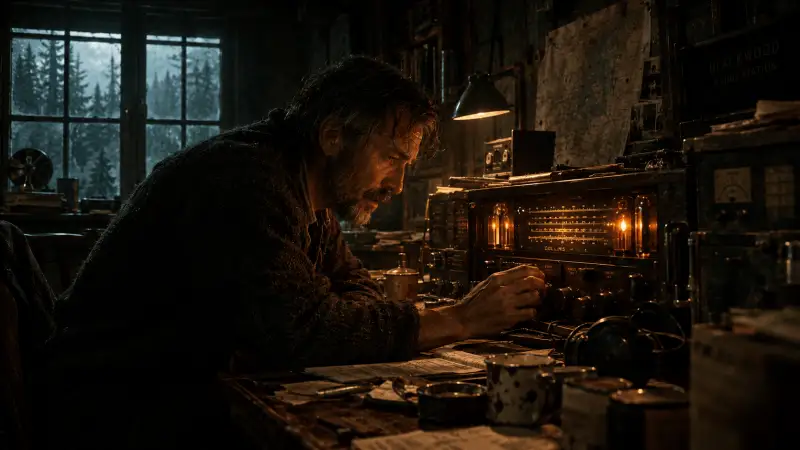
The night the radio never went silent began high atop Marrow Ridge with an eerie hum. The broadcast booth smelled of hot dust, solder, and rain-soaked spruce needles tracked in on the heels of Ellis Thorne's work boots.
For eleven years, since the commercial towers down in the low valley had abandoned Marrow Ridge to the deer trails and low-hanging fog, Ellis had manned the midnight shift at WMRW 940 AM.
The station was little more than a clapboard cabin perched upon a cedar-post foundation that creaked whenever the mountain wind drew breath through the gulley.
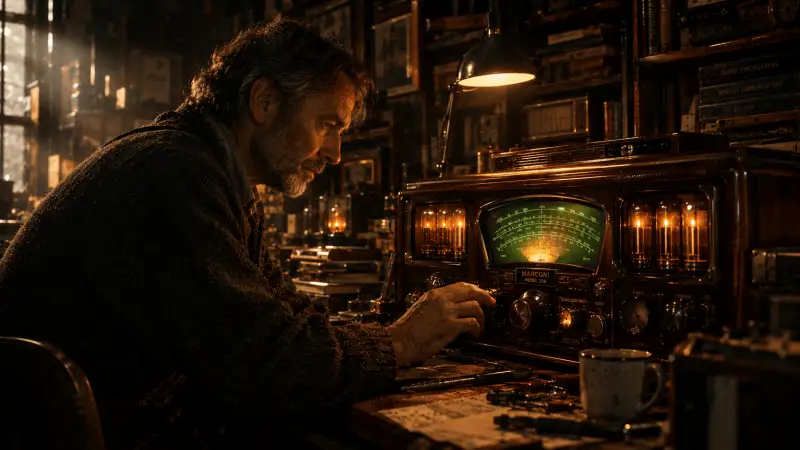
Its heart was a towering transmitter cabinet named Goliath, a 1958 RCA rack with mercury-vapor rectifiers that cast an unearthly violet glow against peeling floral wallpaper.
At one minute to two in the morning, the ritual was as automatic as the pulse in Ellis's wrist. He lowered the rotary fader on the turntable, lifting the needle from the spinning vinyl disc of the national anthem.
The brass needle hissed softly against the runout groove, a tiny rhythm of scratch-and-tumble that was Ellis's favorite sound in the world.
He opened the heavy desk microphone, clearing his throat of stale black coffee. "This concludes our regular broadcast day at WMRW, Marrow Ridge, operating under authorization of the Federal Communications Commission on nine-hundred and forty kilocycles," he murmured, his voice lowered to match the deep, rumbling register of an owl across the creek.
"Good night to the hollow, good night to the ridge, and peaceful sleep to all within the sound of my voice."
He dropped the toggle. He reached for the master power blade on the wall board, grasping the vulcanized rubber handle, and hauled it downward until the iron jaws clacked open. But Goliath did not click off.
The cabinet did not die. The twin rectifier tubes did not extinguish their violet halos; if anything, their internal grids flared with a sudden, molten brilliance, shifting from sleepy amethyst to the hot, living amber of a woodstove draft.
On the mixing board, the twin needle meters pinned themselves hard against their red plastic stops with two distinct taps.
Ellis stood frozen, his hand still resting on the dead breaker handle. The ceiling fan had stopped turning; the tiny refrigerator under the counter had ceased its hum; the desk lamp had gone pitch-black.
Yet the transmitter cabinet thrummed, vibrating through the pine floorboards into the soles of his boots with a dry, bone-deep resonance.
Through the broadcast monitors, usually muted by the power cut, came no blare of static, no hiss of celestial radiation, but an intake of breath, long, wet, and drawn through leaves. Read more about early AM radio broadcasting technology.
Chapter 2: Frequencies of Soil and Copper (Night the Radio Never Went Silent Expansion)
During the night the radio never went silent, Ellis took three measured steps backward, the floorboards groaning beneath his weight as the silence of the hollow folded inward against the cabin.
Outside the salt-filmed window, the red beacon atop the sixty-foot mast was dark, severed from municipal current, yet a strange, pearlescent haze flickered up and down the guy-wires like Saint Elmo's fire running through the shroud of a ship.
The sound coming through the booth speakers was no longer an intake of air; it had resolved into a tone, pure and uncalibrated, vibrating at precisely forty-seven hertz, the frequency at which damp limestone vibrates when underground aquifers carve through shale.
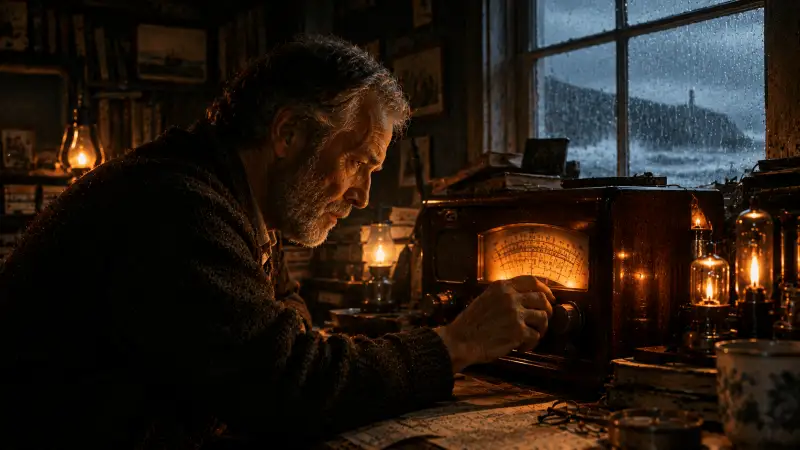
Ellis touched the Bakelite tuning dial of the station receiver. The knob was scorching hot, smelling faintly of toasted bread and ancient resin.
As he nudged the dial a hair to the left, the tone gave way to voices, neither shouting nor singing, but overlapping like water spilling over flat slate.
"The corn did not freeze that November," an old woman's voice said, the cadence soft, nasal, belonging to the high gaps where electricity had arrived forty years late. "I hid three jars of peach brandy beneath the floor of the smokehouse before the bailiff walked up the gravel."
Ellis knew that voice; it had belonged to Martha Caudill, who had been buried in the churchyard at the gap since the spring the timber mill shut down.
Behind her came the sharp, percussive clinking of horse-drawn trace chains, the sigh of an infant waking in an uninsulated attic, and the distinct, wet tearing of green tobacco leaves hung to cure in summer.
None of these sounds had ever been pressed to lacquer or cut to magnetic tape. They were transmissions without a microphone, carrier waves without a dynamo.
The ground cable running from Goliath's base through a drilled hole in the floorboards was glowing, a dull cherry-red copper rod sinking straight down into the cold mud and the limestone aquifer beneath Marrow Ridge.
The mountain itself had become the plate, and the transmitter was merely the speaker cone through which its forgotten years were bleeding back into the night air. Check out our vintage audio phenomena archive.
Chapter 3: The Insomniacs of Marrow Ridge (Night the Radio Never Went Silent Broadcast)
News of the night the radio never went silent spread quietly through the valley. Five miles down the switchback road, in a clapboard farmhouse with peeling trim, Clyde Miller sat bolt upright in his iron bedstead.
The bedside table held his spectacles, a glass of water, and an ancient Philco tabletop radio whose fabric grille had been shredded by barn kittens long ago.
The Philco had been plugged into a wall outlet that had died at midnight when the transformer at the bridge blew its fuse, yet from behind its tarnished brass dial, Martha Caudill was talking about peach brandy.
Clyde did not turn on his flashlight. He slid his bare feet onto the linoleum, listening with his chin tilted toward the ceiling.
Across the ridge, on the screened-in porch of the general store, old Harlan Vance woke with his hand still resting on the dial of a pocket transistor radio he had carried in his breast pocket since Korea.
The tiny mono earphone was wedged into his ear, and through it he heard his own brother's laugh, dead thirty-one years at sea, but here chuckling over a split fence rail in the spring of fifty-four.
Throughout the valley, kitchen windows began to glow with kerosene and candlelight, not in alarm, but with the cautious, reverence-laden quiet of people who feared that sudden motion might break a bubble of spun glass.
Nobody called the sheriff; nobody drove down to the firehouse. Instead, pickup trucks were nudged into driveways, their battery gauges low, doors left ajar as drivers sat on running boards with their heads lowered into their collars.
The broadcast was reaching every unused coil of wire, every rusted set of bedsprings, every barbed-wire fence strung along the cattle pastures.
Farmers later swore that if you walked along the east pasture with your ear near the fence wire, you could hear every lullaby sung to a sick child between 1890 and the flood of seventy-two, braided together like wool into a blanket that kept the frost off the young clover.
Chapter 4: The Wire into the Sinkhole (Night the Radio Never Went Silent Mystery)
Inside the cabin on the night the radio never went silent, Ellis felt the walls sweat. Drops of condensation ran down the acoustic tiles, tasting of zinc and sulfur when one rolled into the corner of his dry mouth.
He could have fled; his truck keys sat on the scarred plywood desk next to the coffee mug, but the broadcast had begun to narrow its focus, winnowing through the chorus of dead loggers and forgotten midwives until only a single frequency remained.
It was a whistle, three notes, rising at the tail, the peculiar way his mother used to summon him from the blackberry thickets when the dusk turned purple and the copperheads came out to lie on the road.
Ellis gripped the rim of the console, his knuckles turning ivory. His mother had died in an institutional bed in Knoxville three years before, her mind an empty pantry, her words reduced to bird-pecks before she stopped speaking altogether.
He had not answered her last letter, having convinced himself that silence was less painful than decay.
"Ellis," the speaker whispered. It was not a ghost; it lacked the dreadful chill of a specter.
It was merely her voice as it had been preserved in the magnetic memory of the iron-bearing stone beneath the shack, an electromagnetic imprint that the mountain had kept safe until the vacuum tubes provided an aperture.
Ellis stepped out the cabin's rear door onto the wet pine needles. The night air was freezing, thick with river-mist that smelled of birch smoke and cold clay.
He followed the grounding wire, which ran like an illuminated thread of orange silk through the briars, down a steep bank where the black earth gave way to a collapsed limestone sinkhole.
The wire did not end in a copper rod; it plunged directly into a fissure where underground water churned against pale boulders.
And from that dark throat came not water-sounds, but the warm, steady acoustic of her breath, counting the buttons on his winter coat before sending him out to catch the school bus.
Chapter 5: The Resonant Dawn (Night the Radio Never Went Silent Legacy)
As the night the radio never went silent drew to a close, he did not kneel, nor did he weep; instead, Ellis sat down upon a wet limestone shelf at the lip of the sinkhole, his hands buried deep inside his flannel pockets.
For two hours, as the earth rolled toward the eastern light, the radio shack up the hill broadcast her voice and the voices of all who had left their breath in the soil.
She spoke of ordinary things: the way the rain tasted different when the wind came off the coal piles, the blue pitcher that had cracked when the spring house froze, and the apology she had never figured out how to write on lined paper.
Ellis listened until the sky turned from coal-grease black to the pale, bruised lilac of an Appalachian sunrise.
The mountain did not ask for his pardon, nor did it demand an answer; it simply offered the broadcast as a river offers water to anyone who stoops to drink.
As the first crest of direct sunlight cleared the hemlock ridge and struck the top of the radio mast, a loud, metallic clack sounded from the shack above.
The mercury-vapor tubes inside Goliath flared violet one final time, sighed with the sound of an iron skillet cooling on a stove lid, and went black. The grounding wire cooled from orange to dull green verdigris.
Silence returned to Marrow Ridge, not the hollow, empty silence of an abandoned place, but the rich, companionable quiet of a room after the last guest has bid goodnight and walked down the steps.
Ellis climbed back up the bank, his boots caked with red mountain mud.
In the control room, he switched off the manual faders, uncapped his thermos to pour the dregs of cold chicory coffee, and opened the booth window to let the damp pine morning air chase out the scent of ozone.
When he walked down the road that evening to get butter from Vance's store, no one spoke of the transmission, but every person he passed nodded to him with soft, unblinking eyes, their shoulders lowered as if carrying a burden that had suddenly become light enough to bear.