During a graveyard broadcast in the bitter winter of 1978, a reclusive radio host answers an unpatched line to find the voice of his wartime sweetheart broadcasting from a collapsing shelter in 1940.
Table of Contents
- Chapter 1: The Needle in the Dust (Radio Presenter Who Received a Call From the Past Origins)
- Chapter 2: The Acoustic Ghost (Radio Presenter Who Received a Call From the Past Discovery)
- Chapter 3: The Cathode Archive (Radio Presenter Who Received a Call From the Past Connection)
- Chapter 4: A Frequency of Cordite and Rain (Radio Presenter Who Received a Call From the Past Confrontation)
- Chapter 5: Out of the Carrier Wave (Radio Presenter Who Received a Call From the Past Resolution)
Chapter 1: The Needle in the Dust (Radio Presenter Who Received a Call From the Past Origins)
The haunting tale of the radio presenter who received a call from the past began deep underground in a Bristol broadcasting studio on a rainy night in November 1978.
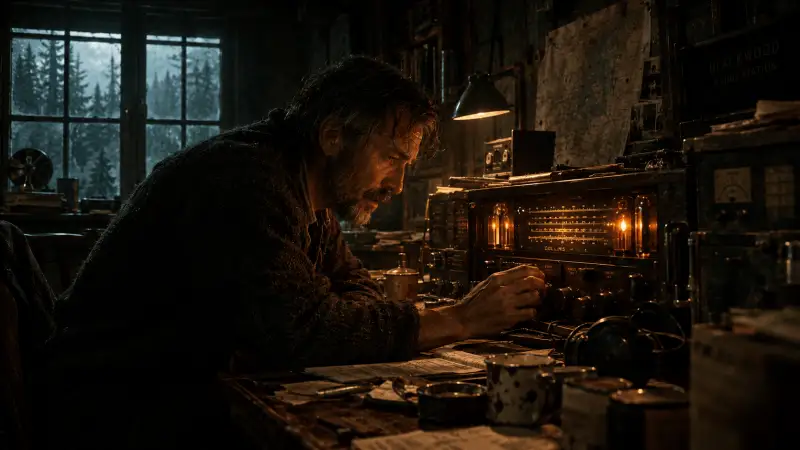
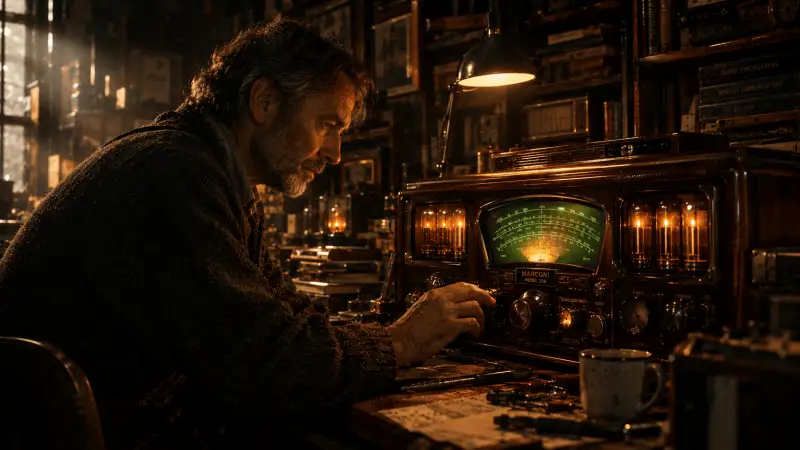
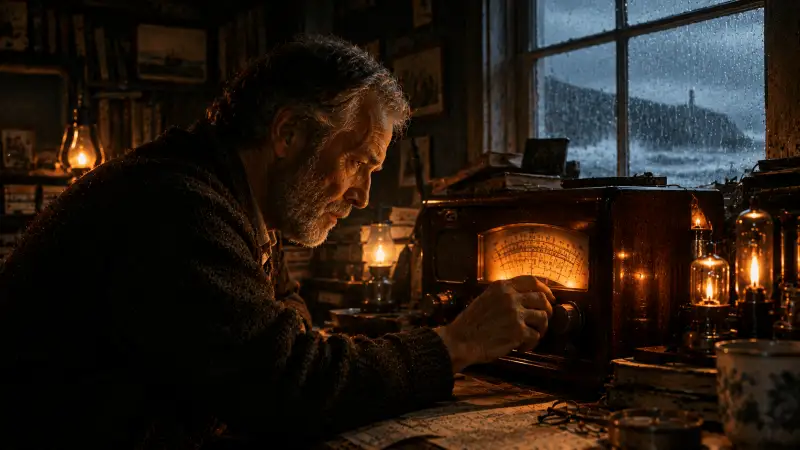
The broadcast room smelled of damp mackintoshes, scalded instant coffee, and the hot lacquer of glowing vacuum tubes. At two in the morning on a sodden Tuesday in November 1978, the city of Bristol was a charcoal smudge beneath an Atlantic low-pressure front.
Arthur Pendelton sat behind the curved mahogany console of Severn Estuary Regional Radio, his fingers yellowed from forty years of Player's Navy Cut cigarettes.
Before him, the twin circular dials of the VU meters twitched like nervous eyelids, their amber backlights throwing long, trembling shadows across the acoustic horsehair tiles lining the walls.
For twenty-two years, Arthur had been the custodian of the dead hours between midnight and dawn, hosting "The Quiet Tide," a nocturnal program of light classical overtures, shipping forecasts, and the low, gravelly cadence of his own voice reading regional obituary notices and tidal charts.
His voice was celebrated among night-shift dockers, long-distance haulers on the M4, and insomniacs as an instrument of sedative permanence. It was a voice that smoothed down the ragged corners of wakefulness.
Yet behind his heavy spectacles, Arthur was an archivist of quiet decay. His wife had been gone twelve years; his son had emigrated to Melbourne and sent brief aerograms twice annually.
What remained of Arthur's living world was contained within this subterranean vault beneath Queen Square, anchored by two Studer reel-to-reel tape decks, a turntable spinning a worn pressing of Frederick Delius's "The Walk to the Paradise Garden," and an auxiliary switchboard whose Bakelite jackfield had fallen largely out of service since the station converted to automated rotary patches.
The needle reached the run-out groove of the Delius record, emitting three rhythmic, dusty thumps. Arthur lifted the tonearm with the trembling precision of a jeweller, flipped the fader up, and drew the heavy ribbon microphone toward his mouth.
"The time is fourteen minutes past two," he murmured, his voice resting deep in his chest. "The barometric pressure at Avonmouth is nine-hundred and ninety-two millibars and falling. Winds south-southwest, force six, veering westerly by daybreak. To those on the road, take heed of standing water near the Cumberland Basin."
As he reached to start the next reel of magnetic tape, an anomaly occurred on the switchboard panel to his far right. The fourth lamp on the auxiliary bank, a frosted glass jewel marked with peeling white tape that read "TR-4 Remote Aux," ignited with a sudden, dull crimson glow.
Arthur paused, his hand hovering over the take-up spool. TR-4 had been dead since the post office lines were rewired in 1965. It was an abandoned trunk line that led nowhere, connected to no trunk exchange in the modern postal system.
He ignored it, assuming a short circuit caused by the storm water pooling in the exterior junction boxes on the street. But then the internal solenoid clicked.
It was a dry, heavy mechanical clatter from inside the chassis, followed by the thin, high-pitched warble of a bell ringer vibrating against brass. It did not sound like the electronic warble of the modern Post Office Telecommunications network; it sounded ancient, percussive, and hollow, like a telephone ringing in an unfurnished drawing room.
Arthur leaned forward, the creak of his swivel chair swallowed by the thick silence of the acoustic foam. He stared at the crimson jewel.
It pulsed with an erratic cadence, dimming and brightening not with electrical stability, but as though the current carrying it were drifting across miles of turbulent open air. Learn more about vintage radio broadcasting history and technology.
Chapter 2: The Acoustic Ghost (Radio Presenter Who Received a Call From the Past Discovery)
An impossible transmission from wartime Bristol reached the radio presenter who received a call from the past, bridging decades of silence.
The red indicator bulb continued its erratic pulse, mirroring the syncopation of an unstable transmitter. Arthur felt the hairs on his forearms stiffen against the wool of his cardigan.
In twenty years of broadcasting, errant electrical pulses were common enough. Coastal stations along the Severn were notorious for picking up cross-channel maritime chatter, pirate radio vessels adrift in the North Sea, and Parisian weather stations when high atmospheric ionization bounced signals across the troposphere.
But an incoming call on an isolated impedance-balanced circuit was a technical impossibility. He pressed his headphone cup tighter against his left ear, reached for the heavy toggle switch beneath the TR-4 indicator, and flipped it downward into the monitor position.
He did not route it to the broadcast antenna; professional instinct preserved his listeners from dead air or unmonitored profanity. He opened the channel privately into his own ears.
At first, there was only the sound of rushing grease, the thick white noise that lives between shortwave frequencies. Then, layered beneath the static, came a texture Arthur recognized with sickening clarity: the dry, bacon-fat sizzle of genuine carbon-granule microphones, accompanied by the hollow acoustics of a vaulted brick subterranean chamber.
"Hello?" Arthur said, his natural broadcaster's projection dropping into an uncertain rasp. "This is Severn Sound overnight. Caller, you are through to the technical monitor."
Through the receiver came the sharp intake of a breath. It was young, damp with cold, and punctuated by a rhythmic, metallic thudding that sounded like distant pile-drivers.
"Is that is someone on this line?" The voice was female, modulated with the crisp, mid-Atlantic theatrical vowels typical of BBC announcers before the war, yet frayed at the edges by profound exhaustion.
"Exchange? We have lost the line to the central dispatch at Central Police Station. The cable through St. Philip's Marsh is severed. If you have an open relay to the auxiliary fire service, please log: three incendiaries through the roof of the sugar refinery on Welsh Back."
Arthur stopped breathing. His heart gave a sluggish, painful thud against his ribs. The words were nonsensical in the calm drizzle of 1978.
Welsh Back was a quiet strip of converted warehouses, houseboats, and a floating restaurant; the sugar refinery had ceased to exist decades ago, flattened during the worst raids of the winter of 1940.
"Caller," Arthur said carefully, his voice dropping an octave as though soothing a lunatic. "You have dialed an internal studio line. If you are in need of emergency services, you must hang up and dial 999. You are speaking to regional radio."
A silence stretched across the line, during which the background noise resolved itself into terrifying specificity: the groaning whistle of air being displaced through shattered window glass, the distinct, syncopated rumble of dual-engine Junkers 88 bombers throttling down in cloud cover, and the flat, percussive thumps of 3.7-inch anti-aircraft batteries positioned on Clifton Down.
"What did you say?" the girl asked. Her voice was smaller now, shivering. "Nine-nine-nine? Is this an RAF relay? Who are you? This is Auxiliary Station 4-C, St. Peter's churchyard basement. We are taking water from the main fracture and the telephone operator said this loop was patched through to the harbor master. Look, please, the smoke is coming down the ventilation shaft. My name is Clara. Clara Vane. If Arthur is at the transmitter post on Kingsdown, tell him the line to his house is down, but I am still here. Tell him I have the tea tin he left."
The room seemed to tilt beneath Arthur's feet. The Studer tape reel beside him reached its tail end, the brown plastic ribbon flapping rhythmically against the metal guide post, slap, slap, slap, in the warm 1978 air.
Clara Vane had been nineteen years old when she died in the cellar of St. Peter's on the night of November 24th, 1940.
Arthur had spent thirty-eight years carrying her photograph in the interior lining of his wallet, behind his union card and his expired driving license. Explore our full archive of classic radio stories and mysterious audio broadcasts.
Chapter 3: The Cathode Archive (Radio Presenter Who Received a Call From the Past Connection)
Reviewing a photograph from 1939, the radio presenter who received a call from the past realized he was speaking to a ghost across ionospheric wire.
Arthur did not drop the headphones. A lifetime of studio conditioning forbade him from tearing off the cans, no matter what horrors poured into them.
Instead, his hand clamped down upon the edge of the mahogany desk until the knuckles shone white through paper-thin skin.
"Clara?" The word was an exhalation, stripped of all broadcast timbre.
"Arthur? Is that Arthur?" The voice leaped up in pitch, crackling against the diaphragm of her carbon telephone mouthpiece.
In the background, a man's voice shouted hoarsely about sand buckets, followed by the dull, concussive shudder of a high-explosive bomb detonating half a mile away, deep in the alluvial mud of the floating harbor.
"Arthur, your voice sounds so strange. It sounds like you are speaking through a tin pipe from the other side of the river. Where are you? The boys said Kingsdown was strafed twenty minutes ago. They said the wireless mast collapsed."
Arthur stared blindly through the triple-glazed observation window into the dark, empty master control room. There, green phosphor monitors hummed silently, displaying modern frequency readouts and UHF carrier loops.
He reached into his breast pocket with a mechanical, detached motion, drawing out the scarred leather wallet.
He pulled from its pocket the small, square photograph, its scalloped edges softened to velvet by the friction of four decades.
Clara sat on the wall above the Avon Gorge in the summer of 1939, wearing a linen summer dress, her dark hair pinned up with tortoiseshell combs, squinting cheerfully against the midday sun.
"Clara," he said, his mouth dry as flour. "Listen to me very carefully. You must leave the cellar of St. Peter's. You must leave it right now. Do not wait for the harbor master's runner. Do not wait for the auxiliary fire pumps."
Across the temporal gulf, the receiver sizzled with a sudden spike of solar static. In November 1978, the sun was at the peak of an eleven-year solar cycle, bleeding enormous ribbons of energized plasma into the upper atmosphere, causing the northern lights to be sighted as far south as the English Channel.
Decades earlier, in the freezing skies of 1940, the same ionospheric mirror had caught the massive shortwave communications of two warring nations, bouncing and trapping signals inside subterranean cable networks that ran alongside the iron conduits of the old city.
"Arthur, don't be daft," she said, though her breath was shallow, hitching against an edge of panic. "The street is completely on fire. Wine Street is a chimney. The warden said if we go up into the churchyard now, the shrapnel will cut us in two. We have three feet of stone above us and sandbags on the pavement gratings. It's safe here until the all-clear sounds. Why aren't you at the transmitter? Why does your wireless set sound like this? You sound you sound like an old man, Arthur."
Tears, hot and stinging with salt, broke over the rims of Arthur's eyelids and tracked through the deep creases beside his mouth.
"I am an old man, Clara," he whispered into the mesh of the ribbon microphone. "I am sixty-two years old. It is nineteen-hundred and seventy-eight. You are speaking across thirty-eight years of copper wire and cold dirt."
For several seconds, there was no sound from the other end except the deep, primeval hiss of the earth's electromagnetic field.
Then, Clara gave a small, nervous laugh that caught in her throat. "That's a cruel joke, Arthur Pendelton. That is a thoroughly rotten joke to play on a girl when the roof is shaking dust into her hair."
Chapter 4: A Frequency of Cordite and Rain (Radio Presenter Who Received a Call From the Past Confrontation)
As the blitz raged through the telephone line, the radio presenter who received a call from the past desperately urged Clara to escape the collapsing crypt.
Outside the soundproofed walls of the 1978 studio, the Bristol rain washed quietly over the modern asphalt of Queen Square, where sodium streetlamps cast long, sickly orange reflections across the wet tarmac.
Inside Arthur's headphones, the world smelled of pulverized limestone, sulfur, and burning coal tar.
"It is not a joke, Clara," Arthur pleaded, leaning so close to the microphone that his lips grazed the protective silk screen.
"Listen to what I tell you. You are in the cellar beneath the south aisle of St. Peter's Church. In your pocket, you have the brass key to your mother's larder in Redland. You are wearing my heavy fleece-lined RAF watch-coat because your cardigan was torn on the bicycle chain this morning. The time on your wristwatch is roughly twenty minutes before three in the morning."
There was a sharp gasp over the wire. "How how could you know about the key? I didn't tell you about the key."
"Because they found it," Arthur said, the agony breaking through his voice, stripping away every vestige of reserve.
"They found it three days later in the rubble, Clara. A parachute landmine is going to hit the nave directly above you. The blast will bring down the four Norman arches and crush the vaulted ceiling into the crypt. The cellar won't hold. If you stay there, you will die before the sun comes up."
A massive roar shuddered through the line. The sound was so violent that the VU meter on Arthur's console slammed against the red peg with a sharp metallic clack, threatening to blow the circuit fuses.
Clara screamed, a short, sharp sound cut off by the rattle of dislodged mortar stones cascading onto floorboards overhead.
"Clara!" Arthur shouted, forgetting his broadcast decorum, forgetting the handful of solitary listeners on the road who might at any moment wonder why the late-night classical hour had collapsed into hysterical weeping.
"Clara, answer me!" Through the hiss came her voice, coughing violently, thick with lime dust.
"Arthur! The ceiling the beam cracked. The sandbags are sliding down the stairs. Mr. Henderson went up to clear them and he hasn't come back."
"Get up the stairs, Clara! Climb over the debris. Do not go toward the nave. Crawl through the coal chute on the north wall, into the alley behind the apothecary. The alley is clear. You must run north toward the park!"
"I can't!" she cried, her crisp diction dissolving into the terrified whimpers of a girl facing obliteration.
"My ankle is wedged behind the water tank. Arthur, it's so dark. The auxiliary lamp smashed. The air smells like fireworks and burning lard. Why aren't you here? Why did you leave me down here?"
"I didn't leave you," Arthur sobbed, his forehead resting on the cool mahogany board, his spectacles askew against his nose.
"I was five miles away on the hill. I was watching the skyline burn like an open furnace and they wouldn't let me down the road because the gas mains were exploding. I spent my whole life on this frequency, Clara. Every night. Every night for twenty years I've sat in this dark room talking into a metal grille, hoping that somewhere between the carrier waves and the static, I would find the line that went back to you."
The line wavered, the signal thinning as the ionospheric layer shifted under the high-altitude winds forty miles above the earth.
Clara's breathing became faint, rhythmic, mingling with the white noise of the radio receiver.
"Arthur?" she whispered. The terror seemed to slip away from her, replaced by the profound, disorienting calm that precedes shock.
"The fire is very bright through the floorboards. It looks like gold leaf on the ceiling. Like the church at Christmas."
"Clara, please move," Arthur whispered into the foam. "Try to pull your foot free. Please."
"Did you did you have a good life, Arthur? In that year you're in?"
Chapter 5: Out of the Carrier Wave (Radio Presenter Who Received a Call From the Past Resolution)
After the line finally snapped into silence, the radio presenter who received a call from the past stepped out into the rain, unburdened and ready for dawn.
The question hung in the subterranean damp of the 1978 studio, heavier than the concrete and iron above Arthur's head. Did he have a good life?
He thought of the forty years of grey mornings, the cold teacups left on corner tables, the mechanical routine of queuing for ration books and later for supermarket tins, the quiet, loveless marriage entered into out of mutual exhaustion, the silence that had settled into his bones until his only intimacy with human beings was this one-way transmission through an electromagnetic cone.
"No," Arthur said honestly, his voice barely louder than the hum of the cooling fans. "I survived you, Clara. That was all. I sat in the corner of the world and kept the machines running."
A soft sigh traveled over thirty-eight years of copper and ionosphere. "That's silly of you," Clara murmured. Her voice was growing distant now, drifting down the slope of a dying carrier wave, competing with the sudden whistle of falling ordnance, a high, pure, descending note that tore through the atmospheric hiss like silk being ripped in two.
"You always were too fond of your quiet corners, Arthur Pendelton. If you're really an old man you mustn't spend the rest of it sitting in the cellar with the ghosts. It's dreadfully dusty down here."
"Clara" "Tell me what the city looks like," she whispered, her voice competing with the terrifying rumble of falling stone.
"Tell me quickly. Is the river still there?" "Yes," Arthur said, the tears streaming freely down his neck into his wool collar.
"The river is still there. The bridge still stands. They built wide streets where the old shops were, and in the springtime, the whole bank along the gorge is covered in yellow gorse and bluebells. There are lights along the water that stay on all night. Nobody turns them off. There is no blackout. Children grow up without knowing the sound of a siren."
"Lights all night," she said softly. The whistling reached its crescendo, an ear-splitting shriek that shook the diaphragm of the line.
"That sounds lovely. Arthur, I" The connection did not end with an explosion. It ended with a clean, sharp snap, like an elastic band breaking against wood.
The red TR-4 jewel on the console flickered once, flared with brilliant amber light, and died completely. The solenoid inside the switchboard released with a dull, hollow thud.
Silence rushed back into the broadcast booth, not the fertile, crackling silence of the 1940 airwaves, but the sterile, dead silence of modern electrical circuits operating without input.
Arthur sat motionless for a long time. The clock on the wall crept from three in the morning to three-thirty, its second hand sweeping forward with mechanical indifference.
Slowly, with hands that felt carved from river clay, Arthur reached out, adjusted his spectacles, and lifted the headphone band from his head.
He laid the headphones on the green felt blotting pad. He picked up the faded photograph of Clara Vane from the console, looked at her face for one final, long moment, and did not put it back into his wallet.
Instead, he propped it gently against the base of the microphone, where the studio light could fall upon her smile.
He stood up, walked to the record shelf, and selected a pristine vinyl copy of Ralph Vaughan Williams's "The Lark Ascending."
He placed the needle upon the vinyl, unmuted the main broadcast channel, and switched the transmitter to full regional power.
As the sweet, soaring violin line rose out of the dust and entered the cold night air of 1978, broadcasting across the damp docks, the quiet motorways, and the sleeping hills of Somerset, Arthur Pendelton leaned into the microphone.
"This is Severn Sound," he said, his voice steady, warm, and cleared of all hesitation. "To all those listening in the dark: the night is passing. Keep your lamps lit. The dawn is coming on."
He pulled back the fader, opened the studio door, and walked up the concrete steps into the rain, leaving the music playing to the empty air.