Late on a storm-lashed November night in 1983, a solitary radio engineer at a remote Suffolk transmitter catches a live transmission from a WWII bomber navigator who went missing over the North Sea forty years before.
Table of Contents
- Chapter 1: The Drift of the Needle (Radio Station That Broadcast a Voice from 1943 Origins)
- Chapter 2: Harmonics of the Fen (Radio Station That Broadcast a Voice from 1943 Discovery)
- Chapter 3: The Navigator's Log (Radio Station That Broadcast a Voice from 1943 Archives)
- Chapter 4: Ground Wave Propagation (Radio Station That Broadcast a Voice from 1943 Confrontation)
- Chapter 5: Static Across the Salt Marsh (Radio Station That Broadcast a Voice from 1943 Resolution)
Chapter 1: The Drift of the Needle (Radio Station That Broadcast a Voice from 1943 Origins)
The haunting tale of the radio station that broadcast a voice from 1943 began on a stormy November night in Suffolk, England, at St. Jude's Relay Station.
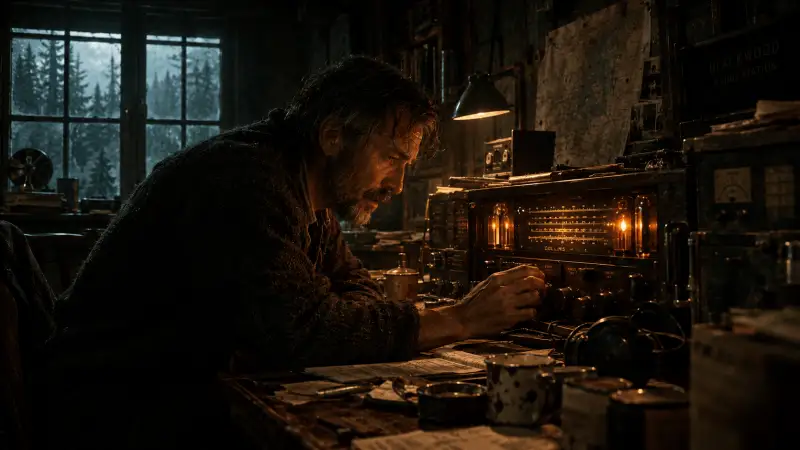
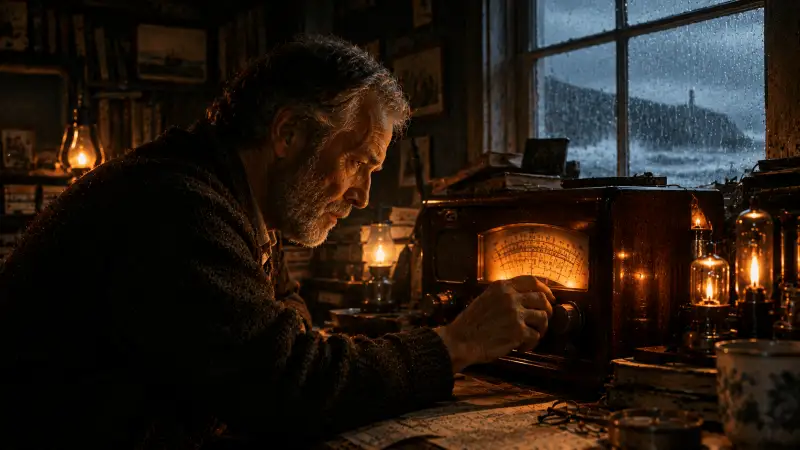
The shingle bank of Orford Ness smelled perpetually of brine, rusted iron, and the cold tallow of damp sheep fleece. By midnight on the fourteenth of November, 1983, the East Anglian wind had sheared the last yellow leaves from the hawthorn bushes beside the track, driving salt spray directly against the leaded panes of St. Jude's Relay Station.
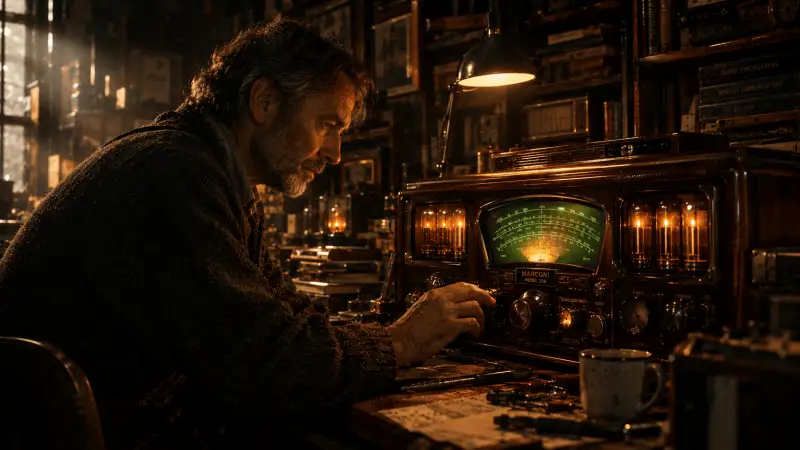
Inside the transmitter room, the air was warm and smelled of bakehouse bread, an illusion born of fifty vacuum valves glowing inside their perforated steel cages.
Arthur Finch adjusted his spectacles, the wire frames biting familiar grooves behind his ears, and watched the amber needle of the Marconi audio monitor tremor like a captured moth.
Arthur was fifty-four, an engineer who had spent twenty-five years watching other men speak into microphones across the provinces. He had developed a reverence for the physical heft of electrical silence, the low, velvety thrum that lived between midnight station closedowns and the crackle of coastal shipping forecasts.
He was not a superstitious man; his father had been a clockmaker in Lowestoft who believed that ghosts were simply gear teeth cut half a millimeter too coarse. But tonight, the transmitter was unsettled.
A stubborn cross-modulation fluttered across 1341 kilohertz, where the regional home service should have yielded to pure carrier hum.
Arthur reached for the grooved Bakelite dial of the Eddystone communications receiver, thumbing the fine-tuning vernier with practiced gentleness.
The static did not hiss in the flat, white grain of thermal noise. It breathed. It had a hollow, vaulted acoustic, like air rushing down a wet chimney.
Through the monitor speakers, layered beneath the Atlantic shipping chatter and the faint, melancholic waltz of an unauthorized pirate station drifting off the Dutch coast, a voice emerged. It was clipped, frantic, and unmistakably human.
"Port inner is feathered," the voice rasped, the vowels hardened by the soot of a Yorkshire upbringing. "Skipper, the compass glass is frosted clear over. I've no stars. Mark our fix twenty miles east of the Gabbard Sand. Starboard tank is dry."
Arthur froze, his thumb pressed against the dial until the Bakelite dug into his flesh. The voice was not coming from a prerecorded magnetic tape; there was no print-through, no low-end flutter of a worn capstan.
The modulation bore the raw, biting friction of a carbon throat microphone pressed against skin slick with sweat. Arthur leaned forward, his heart knocking against his ribs with the slow cadence of a fog bell.
He reached for the heavy red lever of the Ferrograph reel-to-reel recorder, seating the pinch roller with a dull, hydraulic clunk.
The reels began to turn, brown ribbons of ferric oxide drawing through the guides like dried blood across an altar. Learn more about vintage radio broadcasting history and technology.
Chapter 2: Harmonics of the Fen (Radio Station That Broadcast a Voice from 1943 Discovery)
Analyzing the impossible signal, the technician at the radio station that broadcast a voice from 1943 discovered anomalous acoustic profiles and wartime echoes.
By three in the morning, the transmission had degraded into a rhythm of pulsing clicks, like a Morse key tapped by a numb hand.
Arthur sat under the bare incandescent bulb, the green circular cathode screen of his oscilloscope shivering with serrated peaks.
He ran the recorded tape backward, then forward, slowing the capstan with the flat of his thumb. The acoustic profile was anomalous.
Modern broadcasts had a clipped dynamic range, smoothed by compressors and post-war broadcast standards. This signal, however, was ragged, full of wide-spectrum engine roar, four Rolls-Royce Merlins vibrating through an airframe made of thin duralumin and linen doped with fire-retardant varnish.
"Starboard tank is dry," the voice repeated in Arthur's headphones, every syllable etched with the crisp, dry terror of youth. "Jack to base. St. Jude's homing beam, do you read? Give us the flare path. God's sake, Jack calling St. Jude's."
St. Jude's had not possessed a homing beam since the spring of 1945. During the war, the station had been designated RAF Outpost 82, an auxiliary signal site equipped with an experimental blind-landing system designed to guide crippled bombers out of the Ruhr through the North Sea pea-soupers.
Arthur knew this because the decommissioned gear still inhabited the basement: wooden crates stenciled with the broad arrow of the Air Ministry, porcelain insulators wrapped in moldy straw, and wiring looms wrapped in black varnished cambric.
He lit an untipped cigarette, the blue smoke swirling into the intake fan of the Marconi rack. Could it be a harmonic leak from a museum display, or perhaps a rogue ham operator playing wartime acetates across the band?
It was possible, yet the voice answered questions no tape should have anticipated. When Arthur had accidentally tapped his heavy brass screwdriver against the receiver chassis, a sharp metallic click had echoed through the circuit; an instant later, the voice had paused, drawing a sharp, ragged breath: "Skipper? Did you hear that? They're tapping the line. The homing beacon's alive."
Arthur stared at his own trembling fingers. The shingle outside ground under the surf like millstones.
He felt the cold iron of the station around him, not as a shell of masonry, but as an open ear pressed against the dark belly of forty years ago. Explore our full archive of classic radio stories and mysterious audio broadcasts.
Chapter 3: The Navigator's Log (Radio Station That Broadcast a Voice from 1943 Archives)
Consulting local parish records, staff at the radio station that broadcast a voice from 1943 uncovered the tragic history of Lancaster ED-421.
Dawn brought no sunlight, only a pale curdling of mist along the reed beds of the Alde estuary. Arthur drove his battered Morris Minor into the village of Aldeburgh, his eyes hot and dry with exhaustion.
In the back room of the town library, where parish registers were kept alongside coastal survey maps, he met Margaret Cleary.
Margaret was seventy-one, with hands spotted like trout skin and the razor-sharp memory of someone who had watched three generations of fishing boats fail to return.
"Jack," she said quietly, her glasses dangling by a ribbon against her wool cardigan as Arthur described the transmission.
She did not mock him; people who lived on the edge of the North Sea knew better than to argue with what the winter winds dragged inland.
"You're speaking of Jack Renwick. He wasn't from here, Yorkshire lad, Doncaster. Navigator on Lancaster ED-421. They called her O-Oboe."
She pulled a cloth-bound register from the shelf, its spine split and mended with brown parcel tape. "November 1943. Night of the big raid on Berlin. Twenty-four aircraft lost from the group. ED-421 lost two engines over the Frisians. They turned for the coast, trying to make the emergency strip at Woodbridge, but the weather shut down the estuary. Zero ceiling. They were supposed to pick up the radio beacon from St. Jude's."
She looked up, her gaze steady and heavy with old sorrow. "The beacon failed, Arthur. The generator at St. Jude's seized at ten past two in the morning. The crew ditched somewhere off the Whiting Bank. The pilot washed ashore near Thorpeness three days later. The navigator was never found. Jack was nineteen years old. His mother sent letters to the stationmaster every Christmas until she passed in sixty-eight."
Arthur touched the yellowed ink of the flight log. In the margins, someone had penciled a note: "Carrier signal observed off frequency; assumed lost at sea."
The cold inside him deepened. The voice on the tape had not been an echo; it had been an unfulfilled coordinate, a boy circling in the mist forty years prior, waiting for an electric lighthouse that had gone dark before he could find the shore.
Chapter 4: Ground Wave Propagation (Radio Station That Broadcast a Voice from 1943 Confrontation)
Reactivating wartime copper wiring, the radio station that broadcast a voice from 1943 bridged the temporal chasm using raw electrical power.
When Arthur returned to St. Jude's that afternoon, the barometric pressure had plummeted. The shingle banks were turning gray-white under the frothing swell of a rising nor'easter.
He did not go to his usual engineering logbook. Instead, he took a lantern and descended the brick stairs into the station's damp vault.
Beneath decades of cobwebs and coal dust, the wartime transmitter sat like an iron sarcophagus: a T1154 transmitter unit, its massive copper inductance coils untouched since the day Churchill's ministry had padlocked the bunker.
Arthur wiped the thick grease from the lead terminals with an oily rag. He was operating on an instinct older than his engineering degrees, the belief that copper retained the shape of the currents that once passed through it.
He spliced heavy rubber-insulated cables into the modern secondary busbar, bypassing the safety breakers that kept the commercial regional relay compliant with the Independent Broadcasting Authority.
His hands moved with ferocious precision, stripping insulation, twisting copper strands, soldering connections with a smoking iron until the room filled with the sharp, clean stench of heated rosin.
If time had buckled under the weight of an anomalous magnetic storm, if the cold salt water of the Whiting Bank was acting as a massive ground plane, then the circuit had to be completed.
At ten past ten, the storm struck in earnest, rattling the slate tiles overhead like loose teeth. Arthur sat back at the console, donning the dual-cup leather headphones.
He didn't just listen; he reached behind the desk and unclipped an old carbon studio microphone, its heavy brass cage stamped with the BBC emblem.
The frequency had opened again. The roar of the Merlins filled his ears, so close he could hear the distinct metallic chatter of a failing exhaust manifold.
"Base, this is Jack," the boy wept through the static. The sound was faint now, drowned in the wet roar of sea-spray and the groan of aluminum rivets straining under a glide.
"We're down to two hundred feet. Altimeter is hunting. I can't see the water. If anyone hears this mother, I'm sorry. We can't find the light."
Chapter 5: Static Across the Salt Marsh (Radio Station That Broadcast a Voice from 1943 Resolution)
Guiding the lost bomber home through the ether, the radio station that broadcast a voice from 1943 finally brought peace to the stormy North Sea.
Arthur did not stop to think about physics, or the impossibility of bridging the gulf between an old man in 1983 and a doomed teenager in 1943.
He pressed the transmit key, the big mercury-arc rectifiers in the cabinet behind him erupting into a violent, brilliant azure glow.
The entire room hummed, the floorboards trembling as hundreds of watts surged up the mast toward the black sky.
"Jack," Arthur said into the microphone. His voice was steady, thick with the tears he had refused to shed since his own brother had drowned off Dover twenty years before.
"Jack, this is St. Jude's. Do you read me, son?" For five agonizing seconds, there was only the wild, hollow whistle of the ionosphere.
Then, the boy's voice cracked through, startlingly close, stripped of its panic: "St. Jude's? We see you. God Almighty, skipper, the light's on. The needle's centered."
"Jack, listen to me," Arthur said, leaning his forehead against the damp steel rack. "You're over the bank. Throttle back. Hold her level. You're coming in."
"The fog's parting," Jack whispered. The roar of the engines did not diminish, but it smoothed out, the harsh mechanical clatter transforming into a long, resonant hum that sounded less like machinery and more like church organ pipes echoing down an empty nave.
"I can see the shoreline, Arthur. The shingle is glowing white."
Arthur felt the skin on his arms prickle with ice. He hadn't told the boy his name. Through the speaker, the roar slowly withdrew, not like a plane descending into water, but like a train passing through a tunnel into distance.
The needle on the monitor ceased its violent shudder, settling down, notch by notch, into the smooth, velvet bed of the quiet night.
"We're down safe," came the final, faint modulation, so thin it was scarcely louder than the wind against the leaded glass. "Thank you for the light."
Arthur did not touch the dial. He sat in the chair as the storm spent itself outside, the high-voltage transformers cooling with soft, rhythmic clicks.
The needle sat motionless at zero. Outside, across the shingle of Orford Ness, the clouds tore open to reveal a sky powdered with stars, cold and immutably distant, shining down on the empty water where, forty years late, a forgotten plane had finally found its harbor.