Table of Contents
The Boy Who Tuned into Worlds: An Introduction
The Boy Who Tuned into Worlds is a novel-length atmospheric piece across five distinct chapters. It tells the magical story of Elara, a young boy living in the quiet village of Oakhaven, who discovers that an antique radio holds the power to connect distant realities and forgotten realms.
Chapter 1: The Static and the Silence
The village of Oakhaven was a place where time itself seemed to hum with a low, almost imperceptible frequency, a steady drone beneath the rustling leaves and the distant bleat of sheep. For Elara, who had known no other world, this quiet hum was the soundtrack to his solitude.
His days unfolded in a rhythm as old as the cobblestones outside his grandmother’s cottage: dawn, chores, lessons, and then the long, stretching afternoons filled with the quiet companionship of books and the ceaseless whisper of the wind through the eaves.
He was a boy built for introspection, his eyes holding a depth that belied his tender years, often lost in the intricate patterns of sunlight on the wooden floor or the slow drift of clouds across the sky.
His grandmother, a woman whose hands knew the intimate language of the earth and whose eyes held the wisdom of countless sunsets, was his only true companion. She moved through the cottage with a grace born of purpose, her footsteps soft on the worn rugs, the scent of lavender and freshly baked bread her constant companions. She understood Elara’s quiet nature, never pressing him for words, but always offering a comforting presence, a knowing glance, a warm cup of herbal tea.
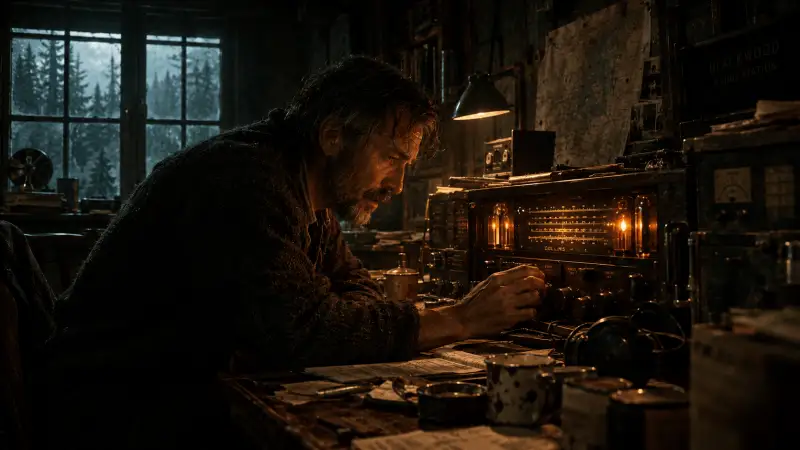
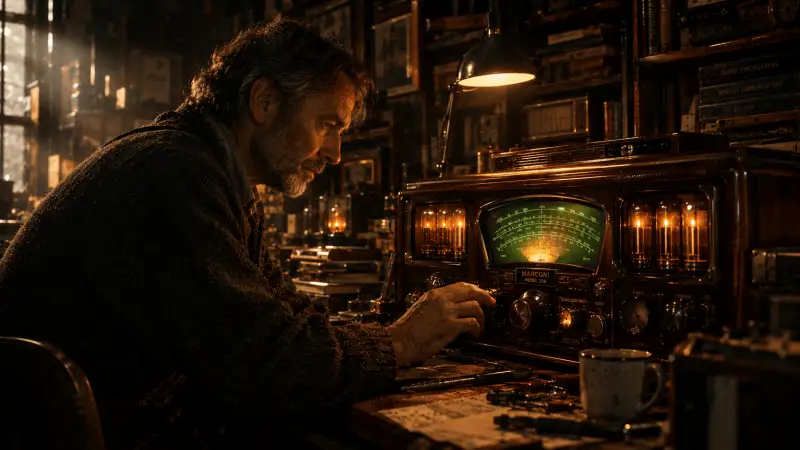
The heart of their small world, however, lay not in the hearth or the garden, but in the parlor, upon a small, lacquered table. It was an antique radio, a behemoth of polished wood and gleaming brass, its dial a constellation of cities and frequencies Elara had only ever read about.
It had belonged to his grandfather, a man Elara had never known, but whose presence lingered in the faint scent of pipe tobacco that still clung to the fabric of the armchair beside the radio. The radio itself was a relic, a silent sentinel that Elara had always regarded with a mixture of reverence and detached curiosity. It was a beautiful object, certainly, but in Oakhaven, where the nearest town was a day’s journey by cart and the outside world felt as distant as the moon, it seemed a mere ornament.
Discovering the Antique Radio in The Boy Who Tuned into Worlds
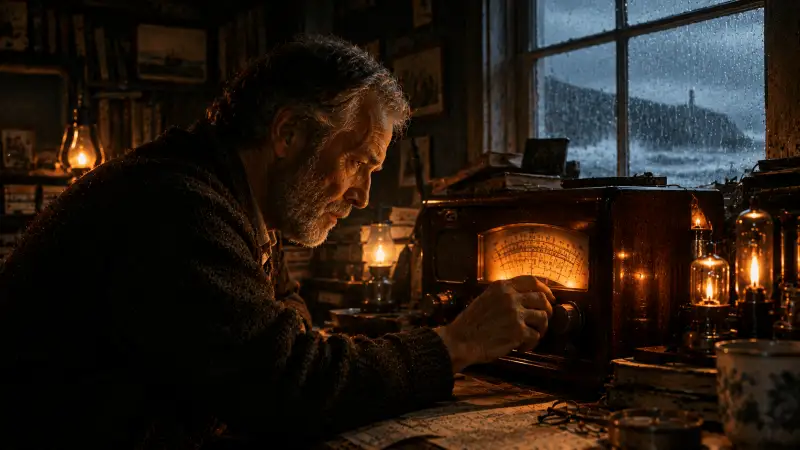
One blustery autumn afternoon, a storm, uncommon in its ferocity, swept through Oakhaven. Rain lashed against the windowpanes, and the wind howled like a hungry wolf, tearing at the thatched roof. The electricity flickered and died, plunging the cottage into a comforting gloom lit only by the dancing flames of the fireplace.
Grandmother, humming a forgotten tune, lit an oil lamp, its soft glow painting long shadows on the walls. Elara, huddled by the fire with a book, felt a strange pull towards the silent radio. Perhaps it was the storm’s energy, or simply the amplified quiet of the cottage, but the antique box seemed to thrum with an unspoken potential.
“Grandmother,” he asked, his voice a soft murmur against the storm’s roar, “does the radio still work?”
She paused in her knitting, her needles clicking softly. “It might, dear. It runs on a different sort of power, sometimes. Batteries, or perhaps… a bit of the old magic.” She smiled, a crinkle at the corners of her eyes that Elara had come to associate with her most profound, yet often unspoken, truths.
Emboldened, Elara approached the radio. Its cold brass knobs felt ancient beneath his fingertips. He remembered his grandfather’s stories, whispered by his grandmother, of how he would spend hours with the machine, listening to voices from across oceans. He turned the largest knob, feeling the satisfying thunk of the switch.
A low, almost inaudible hum began, a faint glow emanating from a small window in the dial. Then, static. A crackling, hissing symphony of white noise, like the sound of the thousand tiny insects trapped within the wooden casing. He turned the smaller tuning knob, slowly, meticulously, watching the needle drift across the frequencies.
Most were just static, an endless desert of sound. But then, a fleeting whisper, a fragment of music, a voice, barely discernible, before it was swallowed again by the hiss.
He spent the rest of the afternoon, and indeed, many afternoons thereafter, lost in this ritual. The static became a familiar friend, a canvas upon which fleeting sounds painted themselves. He learned the subtle nuances of the dial, how a millimeter’s shift could bring a distant choir into brief, glorious focus, or morph a news report into an indecipherable garble.
He began to discern patterns in the static itself, almost hearing a rhythm in its chaos. It was a meditative practice, a quiet quest for connection in a world that offered so little.
One evening, as the last slivers of twilight bled from the sky, and the air grew thick with the scent of damp earth, Elara was at his post. His grandmother was in the kitchen, preparing their simple supper. He turned the dial, his fingers accustomed to its weight, its subtle resistance. The static was particularly loud tonight, a wild, untamed roar.
He almost gave up, his hand hovering over the off switch, when a sound, unlike any he had heard before, cut through the din. It wasn’t a human voice, nor music, but something far more ancient, more resonant. It was the sound of a forest breathing, the deep, guttural sigh of ancient trees swaying in an unseen breeze, followed by the crystalline tinkle of a hidden stream.
Then, the distinct, rhythmic beat of a drum, slow and resonant, accompanied by what sounded like a chorus of ethereal, wordless voices, weaving a tapestry of sound that seemed to pull at the very fabric of the air around him.
Elara froze, his breath catching in his throat. This was not a broadcast. This was not the sound of human instruments or newsreaders. This was something else entirely. The air in the parlor grew heavy, charged with an invisible energy. He felt a prickling sensation on his skin, a shiver that had nothing to do with the chill of the evening.
The sounds swelled, filling the room, painting vivid images in his mind: towering trees with bark like old men’s faces, glowing moss clinging to ancient stones, the scent of damp earth and pine needles. He could almost feel the cool, misty air on his face, hear the distant hoot of an owl.
Then, as quickly as it had arrived, it faded. The forest sounds receded, the drums softened, the ethereal voices dissolved into the pervasive hiss of static. Elara stared at the radio, his heart thrumming a frantic rhythm against his ribs.
He reached out a trembling hand and touched the polished wood. It felt warm, almost alive. He knew, with a certainty that settled deep in his bones, that this old radio, this silent sentinel, was not merely a device for receiving broadcasts. It was a portal, a whispering gateway to worlds unknown, and he, Elara, had just taken his first step through it.
Chapter 2: Echoes from Beyond the Dial
The experience of the forest sounds left an indelible mark on Elara. It was a secret he held close, a precious, shimmering memory that colored his perception of the world. The mundane tasks of Oakhaven – fetching water from the well, tending the small vegetable patch, poring over his grandmother’s worn storybooks – now felt layered with a new, vibrant possibility.
He saw the world not just as it was, but as it could be, brimming with hidden frequencies and unheard melodies.
His ritual with the radio intensified. Every afternoon, after his lessons and chores, he would settle into the worn armchair, his fingers tracing the contours of the polished wood, his ears attuned to the subtle shifts in the static. He approached the radio with a new reverence, a quiet determination to understand its secrets. He learned to listen not just for clear signals, but for the spaces between, for the fleeting anomalies that hinted at something more.
He discovered that the radio was temperamental, capricious even. Sometimes, it would offer nothing but a monotonous hiss, a wall of white noise that seemed to mock his efforts. Other times, with a mere flick of the wrist, it would burst to life.
One sun-drenched afternoon, while the bees hummed lazily in the lavender bushes outside, Elara tuned in to what sounded like a bustling market square. He heard the vibrant chatter of unfamiliar languages, the clatter of carts, the cries of street vendors hawking exotic wares. He could almost smell the spices, taste the sweet, ripe fruits, feel the jostle of the crowd. It was a symphony of life from a place he couldn’t possibly name, a place that felt more real than the quiet, dusty road leading out of Oakhaven. He listened, captivated, until the market sounds faded, replaced by the crackle of a distant storm, then a haunting, wordless lullaby.
Another time, he stumbled upon a monologue delivered in a voice like gravel and old oak, recounting tales of ancient heroes and forgotten battles. The narrator spoke of kingdoms swallowed by the earth, of dragons sleeping beneath mountains, of magic woven into the very fabric of existence. Elara felt a chill run down his spine, not of fear, but of profound recognition. These weren’t the fairytales his grandmother read; these were histories, living chronicles whispered from a time that surely never was. He imagined himself in those crumbling castles, amidst those epic struggles, his own quiet life in Oakhaven feeling impossibly small and yet, strangely, connected.
Fading Edges and Unheard Messages
But it was not always grand adventures or bustling cities. Sometimes, the radio would broadcast something far more personal, more unnerving. He once heard a woman’s soft, melancholic voice, singing a lullaby he faintly recognized from his own infancy. His grandmother had sung it to him, he was sure. How could it be on the radio?
Another time, a man’s voice, raspy with age, spoke of regrets and lost loves, a lament so profound it brought tears to Elara’s eyes. The voice spoke of a specific, unnamed village, of a bakery on a corner, of a river where children played – details that felt intimately familiar, yet utterly alien. He wondered if these were echoes from the past, voices lingering in the ether, or perhaps even glimpses into possible futures, stories waiting to unfold.
The world outside the cottage began to lose its sharp edges for Elara. The faces of the few villagers he encountered seemed less distinct, their voices more muted. Their concerns – the yield of the harvest, the mending of a fence, the price of wool – felt trivial compared to the cosmic dramas and personal revelations unfolding daily on his radio.
He found himself drifting during conversations, his mind replaying snippets of otherworldly music or fragments of ancient wisdom. He’d stare at the familiar landscape, wondering if, just beyond the visible spectrum, there wasn’t another Oakhaven, another layer of reality, shimmering and waiting to be tuned into.
His grandmother, ever observant, noticed the change. She saw the new light in his eyes, the subtle shift in his demeanor. He was more withdrawn, perhaps, but also more vibrant, his quietness now infused with an internal electricity. One evening, as he was about to retreat to the radio, she placed a gentle hand on his shoulder.
“You spend much time with that old box, Elara,” she said, her voice soft, devoid of judgment. “What does it tell you?”
Elara hesitated, a myriad of impossible answers swirling in his mind. How could he explain the forest that breathed, the ancient histories, the lullabies from his own past? He settled for a cautious truth. “It… it tells me stories, Grandmother. Stories I’ve never heard before.”
She nodded slowly, a knowing glint in her eyes. “Stories are important, Elara. They shape us, they show us what is possible. But remember, the world outside, the one you can touch and smell and taste, also has its stories. And its truths.”
She squeezed his shoulder gently, her gaze lingering on the radio. “That old thing… it has always had a way of bringing things closer, things that are far away. Or things that are… just beyond.”
Her words, ambiguous yet profound, offered a strange validation, a subtle confirmation that she, too, understood the peculiar magic that hummed within the old wooden box. It wasn't an escape from reality; it was an expansion of it, a broadening of his understanding of what 'real' could encompass. But the question remained: how much of this new reality could he truly embrace without losing touch with the ground beneath his feet?
Chapter 3: The Call of the Unseen Orchestra
The grandmother’s subtle acknowledgment of the radio’s peculiar nature only deepened Elara’s immersion. Her words felt like a key, unlocking a deeper layer of acceptance within him. He no longer felt the need to question the impossible, but rather to explore it with an open heart. The radio became less a source of escapism and more a conduit for understanding, a teacher of hidden truths.
He began to perceive the world through the lens of its broadcasts, seeing the wind as a conductor of unseen symphonies, the rustle of leaves as whispered secrets, the distant chirping of crickets as the percussion section of a cosmic orchestra.
The radio’s influence grew more potent, more insistent. It wasn't just voices or snippets of music anymore. It began to weave elaborate, multi-sensory experiences. One afternoon, he tuned into what could only be described as a full-blown concert of the elements.
He heard the deep, resonant thrum of the earth’s core, a sound that vibrated through the floorboards and up into his very bones. Then, the rushing, swirling current of an underground river, followed by the crystalline chime of ice formations deep within a cavern. It was a symphony of geological time, a sonic journey into the planet’s heart. He felt the chill of the subterranean air, smelled the mineral tang of rock, saw in his mind’s eye the slow, inexorable march of geological forces.
This level of immersion was exhilarating, yet it also began to create a subtle dissonance between Elara and his immediate surroundings. The faces of the few villagers he encountered in Oakhaven seemed to blur, their voices a faint echo compared to the vibrant narratives of the radio. He’d walk through the market square, his eyes distant, his ears straining for the faint, elusive melodies only he could hear.
His responses in conversation became more abstract, laced with metaphors drawn from the unseen worlds. He was there, physically, but his spirit often resided elsewhere, journeying across impossible landscapes, conversing with spectral entities.
A Warning from the Old Miller
This growing detachment, however, did not go entirely unnoticed. There was Silas, the old miller, whose gruff exterior hid a keen observational eye. He had known Elara’s grandfather, and often spoke of the man’s “wandering mind.” One day, Silas found Elara sitting by the river, seemingly lost in thought, a faint smile playing on his lips.
“Penny for your thoughts, Elara,” Silas grumbled, sitting heavily beside him. “You look like you’re seeing fairies in the water, just like your grandfather used to.”
Elara turned, his smile fading. “I was thinking about the sounds of the deep earth, Silas. And how the water here echoes ancient rivers.”
Silas squinted, then chuckled, a dry, rasping sound. “Aye, the earth hums, boy. Always has. But don’t let it hum so loud you forget the sound of your own voice. Or the voices right here.” He tapped Elara’s knee. “This world, it’s got its own music, too. Different, perhaps, but just as real.”
Silas’s words, though delivered with a pragmatic gruffness, struck a chord within Elara. They were a reminder of his grandmother’s earlier counsel. He recognized the subtle warning, the gentle pull back towards the tangible. His connection to the radio was profound, transformative even, but was he allowing it to overshadow the very world it was meant to illuminate? Was he becoming a mere receiver, rather than an active participant?
The internal conflict began to simmer. He loved the radio, its endless wonders, its boundless knowledge. It had opened his mind, expanded his universe beyond the narrow confines of Oakhaven. But he also felt a growing unease, a sense of being stretched thin between two realities. He would wake some mornings, unsure if the vivid dreams of spectral cities and talking animals were echoes from the night’s broadcast or mere figments of his own imagination. The line blurred, thinned, threatened to disappear entirely.
One particularly potent broadcast brought this conflict to a head. He tuned into a desperate plea, a clear, resonant voice, filled with a profound sorrow. It spoke of a village, much like Oakhaven, facing a looming peril – a blight upon their crops, a drying of their communal well.
The voice pleaded for understanding, for a way to connect with the source of the problem. It described the blight in vivid detail, a creeping grey mold that choked life from the soil, a thirst that parched the land. Elara felt a surge of empathy, a profound desire to help. This wasn’t just a story; it felt like a living, urgent crisis, broadcast from a parallel existence.
He listened intently, his heart pounding. The voice, which seemed to belong to an elder, spoke of a ‘lost song’ – a particular melody or chant that had once protected their land, but which had been forgotten over generations. If the song could be rediscovered and sung, the blight would recede, the well would flow.
The broadcast ended abruptly, fading into a mournful hum that lingered in the air long after the static returned. Elara sat there, stunned, the weight of this unseen village’s plight pressing down on him. This was different from the ancient histories or the market sounds. This was a call to action, a plea for intervention. But how could he intervene in a world that existed only on the airwaves? How could he, a boy in Oakhaven, find a lost song for a village he had only heard about?
The radio had shown him worlds, but now it was asking him to bridge them, to bring the magic into the mundane, or risk losing himself entirely.
Chapter 4: Tuning into Destiny
The plea from the unseen village resonated deep within Elara, a discordant note in the symphony of his life. It was a challenge that transcended mere listening; it demanded action. The comfort of passive reception, of simply observing the wonders of the airwaves, was shattered.
He found himself pacing the small parlor, his gaze flitting from the silent radio to the rain-streaked window, where the familiar landscape of Oakhaven lay shrouded in a perpetual, misty grey. The blight on the crops, the parched well – these were tangible problems, mirroring the very struggles of his own village, though Oakhaven’s challenges were mundane, easily solved with hard work and favorable weather.
He consulted his grandmother, not with direct questions about the radio’s magic, but with hypothetical scenarios. “Grandmother,” he began one evening, as she mended a tear in his tunic, her needle a silver blur in the lamplight, “if a village… a distant village, were to lose its ancient ways, its songs, and suffer because of it, what then?”
She paused, her wise eyes meeting his. “Then, Elara,” she said, her voice soft but firm, “someone must remember. Someone must seek out the lost song, or create a new one, born of the old spirit. For a village without its song is like a river without its source – it will surely dry.” She returned to her mending, but her words hung in the air, heavy with meaning.
Her response, while metaphorical, felt like a direct confirmation. He had to find the lost song. But how? The radio had provided the problem, but no immediate solution. He spent days, then weeks, glued to the dial, hoping for another clue, a specific frequency, a name, anything.
He heard fragments: a fleeting whisper of a name that sounded like 'Aerthos', a description of 'whispering willows' and 'stones that weep'. He began to draw maps, not of Oakhaven, but of the imagined village, sketching the layout described in the broadcasts, trying to visualize its geography based on the snippets of sound. He poured over his grandmother’s ancient books, searching for any folklore that echoed the radio’s tales, any forgotten melodies that might resonate with the plight of Aerthos.
The search became an obsession. He neglected his chores, his lessons, his very presence in Oakhaven becoming a ghost. The other villagers, noticing his gauntness and distracted air, began to whisper. Silas, the miller, shook his head sadly. “Lost in the ether, that one, just like his grandfather. Too much time with that box.” But Elara barely registered their concerns. He was on a quest, guided by an invisible hand, driven by an urgent, unseen peril.
Unlocking the Melody of Aerthos
One stormy night, the wind rattling the windows like a furious spirit, Elara made a breakthrough. He had been meticulously turning the tuning knob, a millimeter at a time, listening to the static’s subtle shifts, when a new frequency, one he had never heard before, began to emerge. It was a faint, wavering signal, difficult to hold, but undeniably distinct.
And on it, a melody. Not a grand, epic tune, but a simple, haunting refrain, almost a lullaby, carried on the wind. It was accompanied by the sound of rushing water, a distinct gurgle, and the soft rustle of leaves – not the ancient forest from before, but something gentler, more intimate.
He recognized it instantly. The lost song. And the sounds, he realized with a gasp, were not just from Aerthos. They were from here. The gurgle was the very stream that ran behind Oakhaven, the one he had played in as a child. The rustle of leaves was the old willow tree by the water’s edge. The radio was not just broadcasting from a distant, parallel world; it was revealing the hidden magic within his own.
The realization hit him with the force of a physical blow. The radio wasn't asking him to abandon Oakhaven; it was asking him to find Aerthos in Oakhaven. The blight, the dying well – these were not just symbolic, but perhaps literal reflections of a forgotten connection to the land, a lost reverence for its spirit, even in his own familiar world. The melody, simple yet profound, seemed to echo a truth his grandmother had always embodied: the magic was not somewhere else, it was everywhere, if one only knew how to listen.
He raced out of the cottage, the storm’s fury mirroring the tempest in his soul. The rain lashed his face, but he barely noticed. He ran to the willow tree by the stream, the very one whose rustling leaves he had heard on the radio. He stood beneath its ancient branches, soaked to the bone, and began to sing.
His voice, usually quiet and reserved, rose above the storm’s roar, fragile at first, then gaining strength, carrying the simple, haunting melody that had emerged from the static. He sang of the earth’s bounty, of the water’s life-giving power, of the interconnectedness of all things. He sang of remembrance, of gratitude, of love for the land.
As he sang, a strange thing happened. The rain, which had been a violent deluge, softened into a gentle drizzle. The wind, which had howled with fierce abandon, quieted into a mournful sigh. The stream, usually swollen and muddy from the storm, seemed to clear, its waters flowing with a renewed vibrancy.
He could almost feel the earth beneath his feet stirring, awakening. He was not just singing; he was performing an act of healing, a bridge between the seen and the unseen, between the world of Oakhaven and the world of Aerthos.
He sang until his voice was hoarse, until the first faint rays of dawn began to paint the eastern sky. Exhausted but exhilarated, he returned to the cottage, the melody still echoing in his mind. The radio, still on, emitted a soft, almost benevolent hum. He knew, with a newfound clarity, that his journey with the radio was far from over. It had guided him, not to escape, but to truly see, to truly listen, and to find his own voice in the symphony of the world.
Chapter 5: The Harmony of Two Worlds
The morning after, a profound sense of peace settled over Elara, a quiet resolution that hummed beneath his skin like a well-tuned frequency. The storm had passed, leaving behind a world washed clean, shimmering with an almost otherworldly clarity.
The air smelled of wet earth and fresh growth, and the sun, breaking through the lingering clouds, cast long, golden fingers across the fields. He found his grandmother in the kitchen, preparing breakfast, a faint smile on her lips. She did not ask where he had been, nor comment on his damp clothes. Instead, she simply handed him a warm cup of tea, her eyes holding a familiar, knowing depth.
“The earth feels lighter today, Elara,” she said, her voice soft as velvet. “As if a great weight has been lifted.”
Elara looked at her, truly looked, and saw not just his grandmother, but a woman who had always been connected to the unseen currents of the world, a quiet guardian of Oakhaven’s own lost songs. “I think… I think it has, Grandmother,” he replied, a genuine smile spreading across his face. “I think I helped to lift it.”
He spent the day moving through Oakhaven with a new awareness. He noticed the vibrant green of the new shoots in the fields, the bustling activity of the bees, the clear, bubbling sound of the stream. He greeted Silas, the miller, with a hearty, unforced enthusiasm, and even offered to help carry a sack of grain.
Silas, surprised by the boy’s sudden vitality, merely grunted, but Elara caught a faint, approving twinkle in the old man’s eye. The world, which had once seemed so muted compared to the radio’s broadcasts, now pulsed with its own vibrant, undeniable magic.
A Bridge Between Two Realities
In the afternoons, Elara still sat with the radio, but his relationship with it had changed. He no longer sought escape, but rather understanding. He still tuned into the whispering forests and the ancient histories, but now he listened with a different ear, searching for echoes of Oakhaven, for the universal truths that bound all worlds together.
He discovered that the same melody he had sung beneath the willow tree could be heard in the rhythmic chirping of the crickets at dusk, or in the gentle sigh of the wind through the tall grass. The lost song was not just a single tune, but a principle, a harmony that permeated all existence.
He learned that the radio’s broadcasts were not meant to draw him away from his reality, but to reveal the profound depths within it. The unseen village of Aerthos, with its blight and its lost song, was a reflection of Oakhaven’s own potential for disconnection, and its capacity for renewal through remembrance and care. The magic of the radio wasn't about transporting him to other realms, but about showing him that his own realm was already steeped in magic, if only he knew how to perceive it.
Elara began to share his discoveries, not with direct tales of impossible broadcasts, but by subtly weaving the wisdom he gained into his everyday life. He spoke of the interconnectedness of nature, of the importance of listening to the land, of the power of ancient stories. He would hum the lost song, a melody that slowly, almost imperceptibly, began to spread through Oakhaven.
Children would pick it up from him, their clear voices echoing it through the fields. Farmers, hearing the familiar yet somehow new tune, would find themselves humming along, a sense of quiet comfort settling over them.
The radio, once a source of intense solitude and secret wonder, became a bridge. Elara learned to balance the two worlds – the vibrant, impossible realm of the airwaves and the grounded, tangible reality of Oakhaven. He understood that neither was complete without the other.
The radio offered perspective, imagination, and profound wisdom, while Oakhaven provided the soil in which to plant those seeds of understanding, the community in which to share the harvest.
As years passed, Elara grew into a man who was both deeply rooted in his village and profoundly connected to something far beyond. He became Oakhaven’s quiet sage, its storyteller, its keeper of subtle magic. The villagers, though they never fully understood the source of his unique perspective, respected his quiet wisdom, his ability to see beauty and meaning in the smallest things.
They noticed that their crops seemed healthier, their well never ran dry, and a sense of quiet harmony permeated their lives. They attributed it to good fortune, or perhaps, Elara’s quiet presence.
The old radio remained in the parlor, a treasured heirloom. Elara still tuned it, occasionally, listening for the familiar crackle of static, for the fleeting whispers of unseen worlds. But he no longer felt the desperate need to cling to every broadcast. He knew now that the most profound harmonies were not just found on distant frequencies, but in the rustle of leaves outside his window, in the laughter of children, in the quiet wisdom of his grandmother’s gaze.
He had learned that the boy who grew up listening to the radio had not escaped his world, but had, in fact, learned to truly live within it, tuning into the endless, interwoven frequencies of magic and reality, creating his own symphony of life, rich and resonant, for all to hear.