High atop an overgrown mountain ridge, an archivist pursues a ghost signal from an abandoned transmission station, only to discover the radio tower is tuned not to the airwaves, but to the living memory of the forest floor.
Table of Contents
- Chapter 1: The Iron Spine in the Bracken (The Forgotten Radio Tower: Secrets of the Abandoned Station Origins)
- Chapter 2: Resonances of Copper and Pine (The Forgotten Radio Tower: Secrets of the Abandoned Station Discovery)
- Chapter 3: The Frequency of Moss (The Forgotten Radio Tower: Secrets of the Abandoned Station Archives)
- Chapter 4: The Midnight Dial (The Forgotten Radio Tower: Secrets of the Abandoned Station Confrontation)
- Chapter 5: Broadcast to the Roots (The Forgotten Radio Tower: Secrets of the Abandoned Station Resolution)
Chapter 1: The Iron Spine in the Bracken (The Forgotten Radio Tower: Secrets of the Abandoned Station Origins)
The mysterious tale of the forgotten radio tower: secrets of the abandoned station began on a misty mountain slope in 1974.
The road had stopped pretending to be gravel two miles before the summit. Arthur Bell walked along what remained of the forestry path, boots sinking into decades of rotting hemlock needles that gave underfoot with the wet consistency of cold tea leaves.
Overhead, the canopy knit so tightly together that the afternoon sun surrendered its angles, diffusing into a flat, zinc-gray glare. A mile back, his handheld spectrum analyzer had begun twitching, its needle flinching against the dead zone like a trapped moth.
Pine Ridge did not register on commercial maps anymore; the forest service had decommissioned the access road in 1974 after the fire tower watchman walked down into the gorge and never came back up.
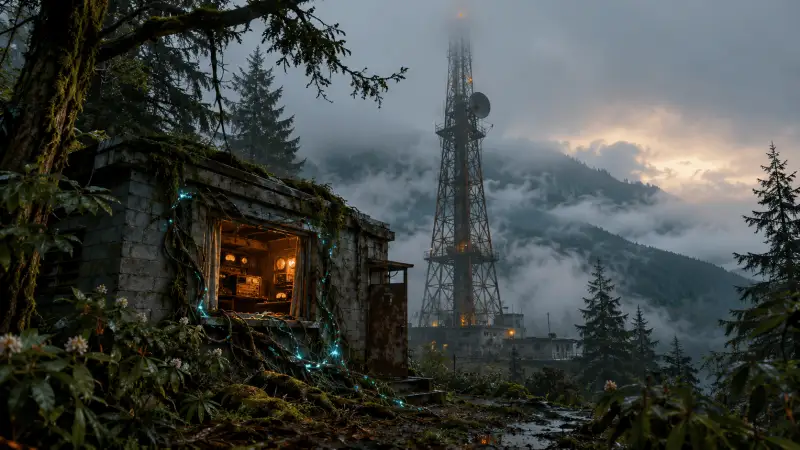
Yet, thrusting above the crown of sweetgum and laurel like the needle of an upturned compass, the broadcast tower pierced the low ceiling of mist.
Arthur paused to adjust the straps of his canvas rucksack, his shoulders aching beneath the weight of a portable Nagra reel-to-reel recorder and three heavy lead-acid batteries.
The air tasted of wet slate and ozone, a phantom electrical charge that made the fillings in his molars throb with a faint metallic sweetness.
His grandfather, Virgil Bell, had served as the night engineer for WSPN from its first broadcast in November of 1948 until the transmission board went dead in the winter of 1963.
For forty years afterward, Virgil sat on the porch of his lowland bungalow with a battery-powered shortwave receiver pressed to his ear, listening through the wash of atmospheric hash for what he called "the subterranean carrier."
Two months ago, Virgil had passed away in his sleep, his hand still curled in a rigor-mortis claw around a dial tuned to 1420 kilohertz.
In Virgil's bedside notebook, under the heading "Station Seven," only three words were scrawled in trembling pencil: It keeps rooted.
Now, stepping through a collapsed perimeter of rusted chain-link fence drowned in wild blackberry briars, Arthur looked directly up at the skeletal tower.
The steel lattice was encrusted in gray lichen, the iron guy-wires strung out into the fog like harp strings anchored to the stone. There was no wind, yet the wires hummed with a low, sub-audible vibration that rattled the base of his skull.
At the foot of the tower sat the transmitter shack: a cinderblock cube draped in Virginia creeper, its single window long shattered, gaping like an eye socket into the dark. Learn more about vintage radio broadcasting history and technology.
Chapter 2: Resonances of Copper and Pine (The Forgotten Radio Tower: Secrets of the Abandoned Station Discovery)
Tuning into the dead frequencies of the forgotten radio tower: secrets of the abandoned station, Arthur heard a telegraph key tapping out mysterious numbers from the underground.
Inside the transmitter shack, dampness reigned supreme. The floor was a carpet of fallen plaster, desiccated pine cones, and shattered vacuum tubes whose fragile glass shells crunched beneath Arthur's boots.
He clicked on his headlamp, slicing a pale cone through dust motes that hung suspended, motionless, as though caught in amber.
Against the back wall stood the primary rack: three tall cabinets of gray-enameled steel housing the dead transmitter. Huge RCA triodes, large as milk bottles, sat in ceramic sockets frosted with mildew.
Between the dials and copper inductors, spiderwebs had accumulated heavy beads of condensation that gleamed like seed pearls.
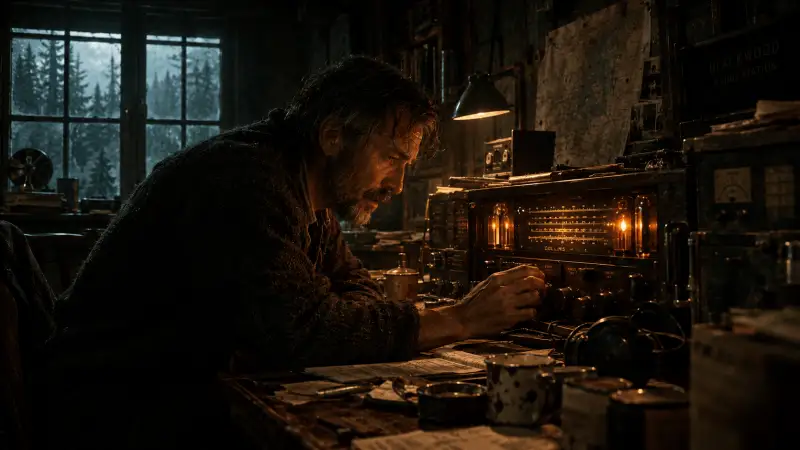
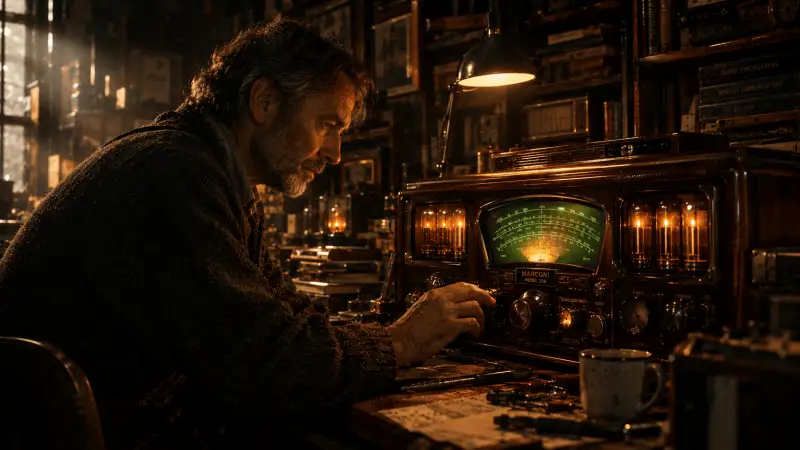
Arthur set his rucksack upon an old mahogany workbench scarred by soldering irons and coffee cup rings. He ran a gloved thumb across the engraved bakelite nameplate: WESTINGHOUSE 5-KW AM TRANSMITTER - PROPERTY OF BLUE RIDGE BROADCASTING CO.
He could hear his own breath, tight and shallow, echoing off the cinderblocks. But beneath his breathing, there was another cadence: a rhythm not unlike water dripping down a deep limestone borehole, perfectly metered, exactly seventy-two pulses per minute.
Arthur unclipped his portable field receiver, snapped the BNC connector of an inductive loop antenna into place, and raised the gain.
The speaker spat a burst of white noise, followed immediately by the warm, textured hiss of thermionic static.
Slowly, his thumb rolled the weighted tuning dial through the AM band. The needle crept past the dead frequencies where modern digital signals usually bled: 1390, 1400, 1410.
Then, at precisely 1420 kilohertz, the roar of static did not increase; it folded back on itself, collapsing into a hollow, resonant silence so deep it felt like stepping into an underground cathedral.
Arthur held his breath. From the depths of the receiver's miniature paper cone, faint and reedy, a chord emerged.
It was not music played on strings or brass, but the slow, agonizing drone of wood expanding in wet ground, layered beneath the distinct click of a mechanical telegraph key tapping out an unspooled sequence of irregular numbers: three, fourteen, twenty-seven, three, fourteen, twenty-seven.
Then, cutting through the numbers with unbearable familiarity, came a sharp intake of breath and a dry, rasping cough that Arthur had heard every evening of his childhood. Explore our full archive of classic radio stories and mysterious audio broadcasts.
Chapter 3: The Frequency of Moss (The Forgotten Radio Tower: Secrets of the Abandoned Station Archives)
Investigating the roots strangling the transmitter cabinet at the forgotten radio tower: secrets of the abandoned station, Arthur discovered a botanical intelligence.
The voice did not speak in sentences; it spoke in textures. It was his grandfather's voice, yes, but stripped of syntax, resembling an audio track that had been played backward through wet silt and re-recorded onto slate.
Arthur fumbled with his patch cables, his fingers shaking so violently he dropped an alligator clip into the debris.
He connected the receiver's headphone output directly to the Nagra's line-in, watching the needle of the VU meter bounce into the red with uncanny vigor.
Where was the power coming from? The mains conduit on the outside wall had been severed decades ago, its armored sheath hanging severed and weeping rust into the mud.
Arthur traced the thick copper grounding strap that ran from the base of the transmitter cabinet down into the floor. The copper rod, thick as a wrist, was supposed to plunge six feet into bedrock to dissipate lightning strikes.
Instead, the concrete around the rod had cracked and buckled upward, pried apart by a massive, pale taproot that snaked directly out of the earth, coiling tightly around the copper bar like an anaconda.
Where root met metal, the wood was blackened and charred, weeping a pale, luminescent sap that smelled of crushed clover and phosphorus.
Arthur knelt down, the beam of his headlamp illuminating the bizarre union of biology and engineering.
Fine capillary roots, gossamer-thin and translucent, had crept upward through the chassis of the transmitter cabinet, weaving themselves between the resistors, through the transformer windings, and into the anode caps of the dead vacuum tubes.
The station had not been abandoned; it had been assimilated. The mountain had not smothered the broadcast; it had adopted it as a tongue.
He touched the root with his bare fingertips. A sharp, painless jolt surged through his forearm, carrying a rapid deluge of sensory memory: the cold pressure of fifty feet of subterranean mud, the slow creep of spring frost thawing through rock, the blind grope of mycorrhizal fungal nets under hemlock groves, and woven through it all, the solitary thoughts of Virgil Bell as he had sat for thirty years in this very chair, smoking Chesterfields and listening to the mountain sleep.
Chapter 4: The Midnight Dial (The Forgotten Radio Tower: Secrets of the Abandoned Station Confrontation)
As night fell over the forgotten radio tower: secrets of the abandoned station, Arthur spoke through the microphone with the spirit of his grandfather.
Dusk fell over Pine Ridge like a wet curtain, plunging the forest into total blackness. Inside the shack, Arthur extinguished his headlamp to save the batteries, sitting in the velvet dark illuminated only by the emerald glow of the Nagra's level meter and the faint, phosphorescent gleam of the root-choked tubes.
Outside, the wind had finally risen, setting the guy-wires to singing a mournful, undulating overtone that matched the frequency in his headphones.
The telegraph key clicks ceased. In their place came a sound like soil shifting in an open trench, followed by speech so clear Arthur felt the hairs on his neck stand on end.
"Artie," the voice whispered through the static, weathered and dry as birchbark. "You brought the machine."
Arthur reached for the microphone he had plugged into the second channel, his mouth dry. "Grandpa?" he croaked, feeling foolish, his heart hammering against his ribs like a trapped bird.
"You're recording water, Artie," the voice drifted back, layered over the trill of subterranean cicadas and the muffled thunder of hidden mountain aquifers.
"Forty years I tried to tell them down in the county seat. This ridge isn't dirt. It's a lung. The tower is the valve. When the lightning hit in sixty-three, it drove the circuit down through the taproot, down into the coal seam where the old things keep their record. It doesn't forget. Nothing that ever died under these pines ever went quiet; they just moved into the grounding wire."
Tears stung Arthur's eyelids, hot and unbidden. "I have your journals," Arthur whispered into the microphone. "I kept your notes. I can rebuild the array, Virgil. I can bring your voice back to the valley."
The receiver let out a sound that was half sigh, half autumn gale stripping leaves from walnut branches.
"Don't store what wants to rot, boy," the transmission replied, its frequency wavering as if being drawn down a narrow pipe. "A sound isn't meant to live in an iron can. Release the spool. Let the tape run free."
Chapter 5: Broadcast to the Roots (The Forgotten Radio Tower: Secrets of the Abandoned Station Resolution)
Releasing the recording tape into the living roots of the forgotten radio tower: secrets of the abandoned station, Arthur set his grandfather's voice free to the mountain.
The dawn broke without warmth, a pale silver seam opening along the eastern ridge behind the iron lattice of the tower.
Inside the shack, the cold had penetrated deep into Arthur's joints. The Nagra reel continued to turn, the seven-inch spool of dark oxide tape spinning with quiet, rhythmic perfection, recording the final dying hiss of the 1420 kHz carrier wave.
Arthur looked down at the machine. On that magnetic ribbon lay proof of everything: the impossible voice, the living circuit, the botanical intelligence humming beneath the Blue Ridge.
It was the crowning discovery of his life, a recording that would vindicate his grandfather's supposed madness and overturn every law of acoustic ecology.
He reached out to press the metal stop lever. His hand hovered over the toggle.
He thought of his grandfather's small bungalow, the smell of damp carpet and stale tobacco, the decades spent with headphones pressed to ears that grew progressively deafer, locked in a sterile, one-way vigil of grief and stubborn preservation.
He looked at the cracked concrete floor where the taproot pulsed with its pale, sap-fed glow. The mountain was not an archive to be pillaged; it was a digestion process, turning lives into loam, voices into moss, and silence into soil.
Slowly, deliberately, Arthur did not press stop. Instead, he unlatched the take-up reel, caught the free end of the glistening brown tape between his fingers, and pulled it free from the capstan.
He walked out of the transmitter shack into the mist. The air was cold and sweet with pine resin.
Walking to the base of the tower, he wrapped the end of the tape around the thickest root where it emerged from the stone, then let the spool tumble from his hands.
The morning wind caught the long, gossamer ribbon of tape, unspooling it into the branches of the laurel bushes, trailing it across the ferns and down into the black water of the drainage trench.
As the tape touched the damp soil, the hum in the air softened, dropping from a metallic whine into a warm, contented purr.
Arthur left the Nagra spinning empty on the desk, shouldered his empty rucksack, and turned down the overgrown trail toward the valley, his ears ringing with an immense, peaceful silence.