In the hushed, static-laden world of late 1960s radio, a solitary presenter stumbles upon an unmarked tape whose chilling contents threaten to unravel a forgotten Cold War secret and dismantle his carefully constructed reality.
Table of Contents
- Chapter 1: The Static and the Solitude (The Radio Presenter and the Unmarked Tape Origins)
- Chapter 2: Whispers from the Past (The Radio Presenter and the Unmarked Tape Discovery)
- Chapter 3: The Echoing Silence (The Radio Presenter and the Unmarked Tape Archives)
- Chapter 4: Unraveling Threads (The Radio Presenter and the Unmarked Tape Confrontation)
- Chapter 5: The Fading Signal (The Radio Presenter and the Unmarked Tape Resolution)
Chapter 1: The Static and the Solitude (The Radio Presenter and the Unmarked Tape Origins)
The atmospheric and haunting mystery of the radio presenter and the unmarked tape began during the late night shift at station WBRD in 1968.
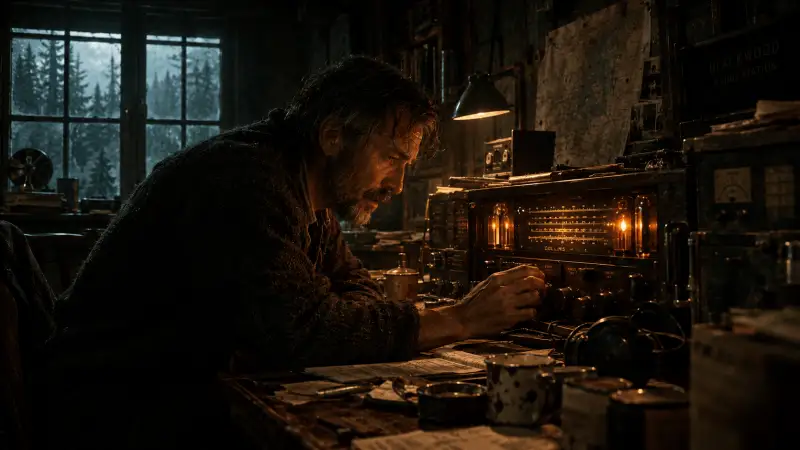
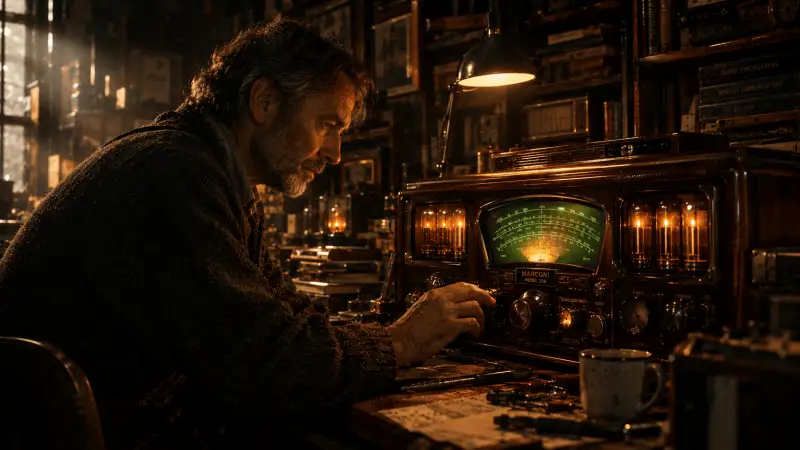
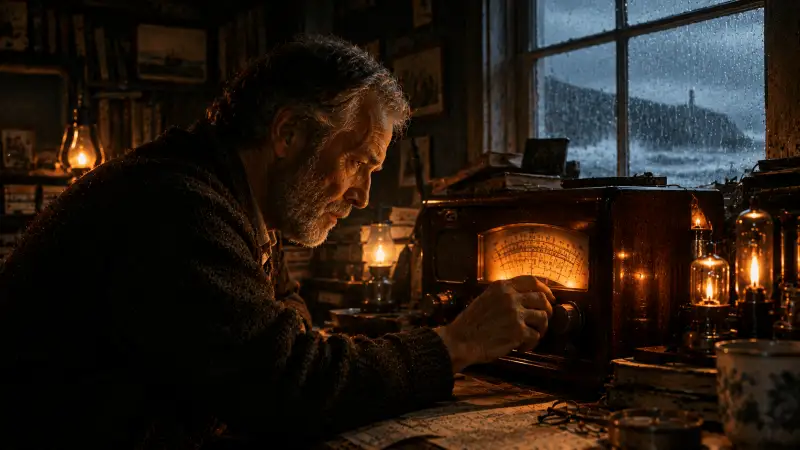
Arthur Finch, a man molded by the relentless hum of vacuum tubes and the ghost whispers of the airwaves, moved through the deserted halls of WBRD like a shadow cast by forgotten suns.
It was late 1968, but within the anachronistic confines of the radio station, time often seemed to warp and fray, clinging stubbornly to a bygone era.
Dust motes, caught in the anemic glow of a single bare bulb, danced in the cavernous main studio, a silent ballet to the rhythm of Arthur's solitary existence.
The building, a squat, brutalist structure on the outskirts of Blackwood Creek, a town that felt perpetually on the cusp of disappearing into the vast, indifferent landscape of rural New England, was his sanctuary and his prison.
The scent of ozone, stale coffee, and aging paper was as familiar to Arthur as the sound of his own breath. Tonight, like every night for the past fifteen years, he was on the graveyard shift, hosting "Nocturne Echoes," a program of classical music, forgotten jazz, and his own laconic observations on the quietude of the night.
His voice, a soothing baritone honed by countless hours of solitude, was the only human sound for miles, a solitary beacon in the pervasive dark.
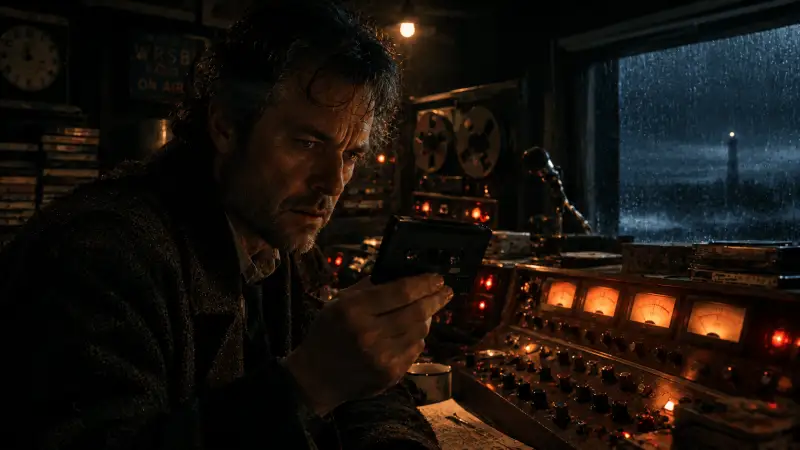
The old Ampex reel-to-reel machine whirred contentedly beside him, the tape spools turning with a hypnotic grace. A chill, more psychological than climatic, snaked through the studio.
Arthur adjusted the volume knob, his fingers, calloused from years of delicate manipulation, moving with an unconscious precision.
The Sibelius piece faded, replaced by the familiar hiss of dead air, a sound he found oddly comforting. It was a blank canvas, pregnant with possibility, awaiting the brushstrokes of his next spoken word or the melodic swell of a new track.
He cleared his throat, the sound amplified and then absorbed by the soundproofed walls. "And that was the haunting strains of Sibelius's 'Valse Triste,'" he murmured into the microphone, his voice a balm against the encroaching night.
"A perfect companion for these quiet hours, wouldn't you agree? It's a quarter past one, and here at WBRD, we continue our journey into the deepest parts of the night."
He leaned back in his worn leather chair, the springs groaning in protest. The control board, an intimidating array of sliders, buttons, and glowing lights, hummed with a low, constant energy.
His gaze drifted across the cluttered desk, past stacks of vinyl records, yellowing cue cards, and a half-empty mug of lukewarm tea.
And then he saw it. It wasn't a record, nor a standard audio reel. It was a small, compact cassette tape, an anomaly in this realm of analog giants.
It lay incongruously atop a pile of recently delivered promotional LPs, its dark plastic casing stark against the colorful record sleeves.
There was no label, no handwritten note, nothing to indicate its origin or content. Just a blank, anonymous rectangle of plastic and magnetic film.
Arthur picked it up, feeling its surprising weight. The plastic felt cool and smooth under his fingertips. He turned it over, examining it from all angles.
Unmarked. Unexplained. A sudden ripple of unease, faint but persistent, stirred within him. Who would leave a cassette here?
WBRD rarely dealt with cassettes; they were primarily a vinyl and reel-to-reel operation. The station manager, a perpetually harried man named Harrison, was meticulous about inventory and deliveries. This tape didn't fit.
His internal monologue, usually a placid stream of observations and musical musings, was abruptly disrupted. A flicker of curiosity, a rare spark in the habitual rhythm of his life, ignited.
He glanced at the clock. Still an hour until the news break. Plenty of time.
He rummaged through a drawer, past old microphones and tangled cables, until his fingers brushed against the small, portable cassette player he kept for personal recordings.
It was an old model, clunky and well-used, a relic from his brief, failed attempt to record the vanishing folk songs of the region.
He plugged it into the auxiliary input of the control board, the small jack clicking into place with a satisfying finality.
His heart, a steady metronome for so many years, began a slightly accelerated rhythm. He slid the unmarked tape into the player, the plastic clicking into position.
He pressed play, his thumb hovering over the pause button, a vague premonition guiding his action. A hiss. Louder than the natural static of the airwaves, more aggressive, almost angry.
Then, a low, guttural murmur. It wasn't music. It wasn't a voice reading a commercial. It sounded raw. Distant. Like a recording made in a vast, empty space, or perhaps, a space filled with something unspeakable.
Arthur leaned closer, his ear almost touching the speaker, the scent of the old electronics mingling with the phantom aroma of dust and ozone.
The murmur resolved into what sounded like wind, a desolate howl cutting through barren terrain. But underneath it, faint, almost imperceptible, was another sound.
A rhythmic thudding. And then, a word. Or a fragment of a word. Garbled, distorted by static, but unmistakably human.
He froze, a prickle of gooseflesh rising on his arms. The studio, usually a sanctuary of controlled sounds, now felt charged with an alien energy.
He glanced around, half-expecting to see another presence, a phantom listener leaning over his shoulder. The bare bulb cast long, dancing shadows that seemed to writhe with a life of their own.
He reached for the volume, turning it up, then immediately down, fearing what might spill out into the quiet homes tuned to WBRD.
His mind raced, trying to contextualize the sound. Was it a prank? A forgotten personal recording? But the quality, the raw, unpolished nature of it, suggested something else.
Something unintentional. Something unearthed. The tape continued, the wind sound dominating, the thudding growing slightly clearer.
It sounded like something hitting frozen earth, or perhaps, a muffled heartbeat. And then, a word, clearer this time, female, urgent, speaking in a language Arthur didn't immediately recognize, but the tone was unmistakable: fear.
And below the fear, a desperate plea. Arthur's breath hitched. This was no ordinary tape. This was a message. A cry. A secret.
He pressed pause, the sudden silence of the studio more jarring than any sound. The tape, now a silent, inert object once more, pulsed with an unquantifiable significance.
His solitude, once a comfort, now felt like a vast, echoing chamber, ready to amplify the whispers of the past.
The night, which he usually commanded with his voice, now felt like an entity watching him, waiting for him to play again, to listen closer.
The unmarked tape had found its unwitting audience. And Arthur, for the first time in a long time, felt truly, deeply, unsettled. Learn more about vintage radio broadcasting history and analog equipment.
Chapter 2: Whispers from the Past (The Radio Presenter and the Unmarked Tape Discovery)
Investigating the distressed Russian voice on the cassette during the radio presenter and the unmarked tape, Arthur became consumed by the unsettling audio clues.
The first rays of dawn, pale and hesitant, began to bleed across the eastern horizon, painting the sky in muted shades of grey and bruised violet.
Arthur, however, remained oblivious to the subtle shift from night to day. He sat hunched over the control board, the small cassette player still connected, the unmarked tape still resting within its cavity.
The classical music he was supposed to be playing had long since given way to the endless, hypnotic hiss of the tape, replaying the same few minutes again and again.
His usual meticulous routine, the precise timing of musical cues and station breaks, had dissolved into a single-minded obsession.
The female voice on the tape was faint, almost swallowed by the relentless wind and the rhythmic thudding.
But Arthur, with his trained ear, had begun to pick out patterns, fleeting inflections, the underlying desperation.
He had rewound and replayed the segment countless times, each listen peeling back another thin layer of distortion, revealing a fraction more of its unsettling truth.
The language, he now suspected, was Russian. A few words, common even to someone with only a rudimentary understanding of global affairs, seemed to surface: "снег" (snow), "холод" (cold), "помощь" (help).
But then, deeper, more guttural sounds, obscured by what sounded like a struggle, or perhaps, a violent impact.
His internal monologue, usually so calm and ordered, was now a frantic kaleidoscope of possibilities. Was this a genuine plea?
A recording of some Cold War espionage? A morbid joke? His journalistic instincts, dormant for years beneath the soothing blanket of classical music, began to stir, demanding answers.
The static seemed to pulse with an almost malevolent energy, a guardian to the secrets contained within the fragile magnetic ribbon.
He shivered, though the studio was comfortably warm. The scent of stale ozone and metallic dust felt heavier, more oppressive.
He ran a hand through his thinning hair, his eyes, usually placid and observant, now wide with a mixture of fear and burgeoning excitement.
This was real. He felt it in his bones, in the way the hairs on his arms stood on end, in the cold knot that had formed in his stomach.
"Arthur, you still in here?" Harrison's voice, booming and entirely too cheerful for this hour, broke the spell.
Arthur jumped, nearly knocking over his lukewarm tea. He quickly pressed stop on the cassette player and yanked out the auxiliary cable, stuffing the unmarked tape into his jacket pocket with clumsy haste.
Harrison, a burly man with a perpetually rumpled suit and a booming laugh, lumbered into the studio, carrying a fresh pot of coffee.
"Morning, old boy! Heard some unusual static at the end there. Everything alright?"
Arthur forced a smile, his heart still hammering against his ribs. "Morning, Harrison. Just a minor technical glitch. Old equipment, you know how it is."
He hoped his voice sounded more convincing than it felt. Harrison grunted, pouring two mugs of coffee.
"Well, try not to break the antiques before I can replace them. Budget's tight." He paused, looking at Arthur more closely. "You look like you've seen a ghost. Rough night?"
"Just tired," Arthur lied, taking the steaming mug. The warmth spread through his hands, but did little to dispel the chill that had settled deep within him.
He felt an intense, irrational urge to protect the tape, to keep its existence a secret. Harrison, for all his good nature, was a pragmatist.
He wouldn't understand. He'd dismiss it, laugh it off, or worse, confiscate it. As Harrison chatted idly about the station's dwindling advertising revenue, Arthur's mind continued to replay the sounds, trying to piece together the fragments.
The wind. The thudding. The terrified Russian plea. It felt like a puzzle, but one with most of its pieces missing, and the remaining ones warped by time and distortion.
He wondered if anyone else had heard it. If the message was meant for him. Or if he was simply the unlucky recipient of a dead man's last transmission.
He finished his shift in a daze, his goodbyes to Harrison automatic, robotic. The sun was fully up now, bathing Blackwood Creek in a deceptive golden light.
The world outside the studio, with its chirping birds and the distant rumble of a delivery truck, felt utterly disconnected from the dark, cold world encapsulated within the unmarked tape in his pocket.
Back in his sparse, book-filled apartment above the town's only general store, Arthur locked the door and drew the blinds.
He set up the cassette player on his kitchen table, a chipped Formica surface that had seen countless solitary meals.
He pulled out the tape, its black plastic casing now seeming to radiate a faint, unsettling energy. He inserted it, pressed play, and turned the volume low, almost to a whisper, as if fearing the walls themselves might be listening.
The hiss began again, followed by the familiar, desolate wind. He listened, not just with his ears, but with every fiber of his being.
He closed his eyes, trying to conjure the scene, to place himself within the recording. He imagined a vast, frozen wasteland, snow whipping around an unseen structure, the biting wind carrying the desperate cries of a woman.
The thudding it was rhythmic, almost mechanical, yet organic. Was it footsteps in deep snow? Or something being dragged? Or perhaps an axe?
A new detail emerged, barely audible: a faint, metallic clang, like a small bell or a piece of equipment being dropped.
And then, a series of quick, sharp snaps, like ice cracking, or a trigger being pulled. His breath caught in his throat.
He paused the tape. His hands trembled slightly. This was no prank. This was no mislaid recording. This was a document of terror.
A historical artifact imbued with the raw, unfiltered essence of a moment of crisis. The Cold War, a distant, abstract concept discussed in newspapers and on news broadcasts, suddenly felt terrifyingly real, its icy grip extending into his solitary life, reaching out from the unmarked tape.
He knew, with a certainty that chilled him to the bone, that he couldn't simply ignore this. The tape had chosen him, or perhaps, he had chosen the tape.
Either way, he was now inextricably bound to its secret. The silence of his apartment, usually so comforting, now felt heavy, pregnant with unspoken questions.
He looked at the cassette player, a simple machine, yet now a conduit to a hidden past, a whispering ghost in the machine.
And Arthur, the quiet radio presenter, was about to become its reluctant medium. The night, he realized, had truly just begun. Explore our full archive of classic radio mysteries and Cold War signals.
Chapter 3: The Echoing Silence (The Radio Presenter and the Unmarked Tape Archives)
Connecting the tape's mysterious hum to local Cold War legends during the radio presenter and the unmarked tape, Arthur plunged deeper into dangerous obsession.
Days bled into nights, the rhythm of Arthur's life utterly consumed by the unmarked tape. His shifts at WBRD became a grueling performance, his mind elsewhere, his eyes betraying a profound lack of sleep.
He would play his classical music, offer his usual dry commentary, but his thoughts were a chaotic symphony of wind, static, and that haunting Russian plea.
The familiar hum of the studio, once a balm, now felt like a constant reminder of the tape's secrets, a background drone against which the unseen drama played out in his mind.
His apartment, usually a haven of quiet contemplation, had transformed into a makeshift research station.
Books on Cold War history, Soviet-era technology, and Russian linguistics lay scattered across every surface, their pages dog-eared, their spines cracked.
The air, usually redolent with the scent of old paper and pipe tobacco, now carried the faint, metallic tang of magnetic tape and the sharper aroma of obsessive endeavor.
He had acquired a better cassette player, one with a cleaner output and more precise controls for playback speed.
He even managed to jury-rig a connection to his old reel-to-reel recorder, hoping to capture the sound at a higher fidelity, to peel back the layers of noise.
Each attempt yielded only marginal improvement, but every subtle nuance, every faint inflection, was a victory.
The female voice, he was now certain, was speaking urgently, almost frantically. He had isolated a few more phrases, painstakingly looking up words in a tattered Russian-English dictionary he had found in a dusty corner of the public library.
"Опасность" (danger), "они идут" (they are coming), "станция" (station). The word "станция" resonated deeply.
Was it a radio station? A research station? A military outpost? The ambiguity was maddening.
His attempts to verify the historical context were met with dead ends. There were no public records of any significant incidents involving Russian women, remote stations, or strange signals in the late 1960s that matched the vague clues on the tape.
The silence from official sources was deafening, almost as if the event had been deliberately erased. This only fueled his paranoia.
Who would want this hidden? And why? The isolation that had always been Arthur's comfortable companion now began to feel suffocating.
He found himself jumping at shadows, attributing every creak of the floorboards, every gust of wind against his window, to an external threat.
He stopped answering his phone, convinced that anyone calling would be linked to the tape, to the secrets he was unearthing.
He ate little, slept less, his waking hours a constant loop of listening, researching, and agonizing.
One particularly desolate night, as a cold, driving rain lashed against the windows of his apartment, Arthur was listening to the tape again, the volume turned up higher than usual.
The static, the wind, the thudding, the desperate voice, they filled the small room, pressing in on him.
He felt as if he wasn't just listening to a recording, but inhabiting the moment, feeling the biting cold, the fear, the desperation.
He closed his eyes, imagining the woman, her face contorted in terror, her breath misting in the frigid air.
Suddenly, a new sound. Beneath the cacophony, a faint, almost subliminal hum, rhythmic and mechanical, like a distant engine or a powerful generator.
It was subtle, almost imperceptible, but once he heard it, he couldn't unhear it. It added another layer of chilling complexity to the already dense audio landscape.
It was consistent, a low thrum that seemed to underline the entire recording, a constant presence. He paused the tape, his breath shallow.
The silence of the apartment, now devoid of the tape's sounds, felt hollow, the rain outside a drumming accompaniment to his racing thoughts.
The hum. What was it? A vehicle? A piece of scientific equipment? The Cold War era was rife with secret bases, covert operations, clandestine experiments.
The pieces, though still disparate, were beginning to suggest a larger, more ominous picture.
He remembered an old, almost forgotten local legend from his youth, whispered around campfires in Blackwood Creek.
Stories of strange lights in the sky, odd tremors, and hushed disappearances near the old, abandoned "listening post" deep in the remote national forest, a site long disused by the military, or so they claimed.
He had always dismissed them as folk tales, the ramblings of superstitious locals. Now, a cold dread began to seep into him.
Could the tape be linked to that? To something happening far closer to home than he had ever imagined?
His hands, usually so steady, now fumbled with a pen and paper. He began to sketch a rough map of the area, marking the station, his apartment, and then, with a hesitant X, the rumored location of the old listening post.
The proximity was unsettling. Blackwood Creek, a town he had always viewed as unremarkable, suddenly felt like a focal point, a silent witness to something terrible.
He looked at the unmarked tape, its innocuous black plastic now appearing menacing, a Pandora's Box he had unwittingly opened.
The pursuit of truth, once an intellectual curiosity, had transformed into a dangerous obsession, pulling him deeper into a world of shadows and whispers.
He was no longer a detached observer; he was a participant, tangled in a web spun decades ago.
The echoes from the tape were no longer just sounds; they were a siren call, drawing him towards an unknown danger, a truth that might be better left buried.
The solitude he once cherished had become a crucible, refining his fear into a grim determination.
He knew, with a certainty that both terrified and invigorated him, that he was getting closer. And that, in this echoing silence, was perhaps the most dangerous realization of all.
Chapter 4: Unraveling Threads (The Radio Presenter and the Unmarked Tape Confrontation)
Deciphering the tape's mechanical hum and discovering the abandoned listening post during the radio presenter and the unmarked tape, Arthur realized he was recording something buried deep underground.
The hum from the tape, once a subtle background element, had become a relentless drone in Arthur's waking hours, an internal echo that seemed to vibrate in his very bones.
His research had intensified, propelled by the growing certainty that the old listening post was connected.
He had driven out there a few times, a nervous pit in his stomach, the dense forest pressing in on his ancient Chevrolet.
The site was overgrown, decaying, yet undeniably imposing, a concrete shell hinting at past activity, its purpose shrouded in official secrecy.
He had found an old, faded newspaper clipping from 1958, tucked away in the archives of the Blackwood Creek Historical Society.
It spoke of a temporary military expansion in the national forest for "strategic defense exercises." No details, just vague assurances of national security.
But a single, blurry photograph showed a group of scientists and military personnel, their faces grim, standing beside what looked like a newly erected antenna array.
One woman in the photo, her hair pulled back tightly, had an intensity in her gaze that struck Arthur.
He couldn't be sure, but a flicker of recognition, a phantom echo of the voice on the tape, seemed to resonate from her image.
He spent hours in the library, poring over microfiche, searching for any mention of a "Dr. Anya Petrova" or similar Russian names associated with Cold War defections or unusual scientific collaborations.
The search was fruitless, a frustrating dance through official redactions and historical omissions. It was as if certain truths had been consciously scrubbed from existence.
His paranoia had reached a fever pitch. Every unfamiliar car that drove past his apartment, every shadow outside his window, every crackle on the radio seemed to be a sign.
He started leaving the lights on, sleeping fitfully, clutching the cassette tape, his evidence, his burden, under his pillow.
The station manager, Harrison, had expressed concern about his deteriorating appearance, suggesting a few days off.
Arthur had vehemently refused. The radio station, ironically, felt like the only place he could maintain some semblance of his old life, a thin veneer of normalcy.
One evening, during a particularly heavy downpour that rattled the studio windows, Arthur was replaying the tape, a faint tremor in his hands.
He had spliced a fragment of the tape onto an old reel, creating a loop of the most critical section: the female voice, the metallic clang, the sharp snaps, and the underlying hum.
He played it on the Ampex, its larger spools turning hypnotically. The fidelity was slightly better, the hum clearer, more defined.
He closed his eyes, letting the sounds wash over him, trying to perceive them not as discrete elements, but as a holistic event.
And then, it hit him. The metallic clang. It wasn't just a dropped object. It was too resonant, too specific.
And the sharp snaps. Not ice, not a trigger. It was a rapid, almost percussive sound.
He opened his eyes, a sudden, blinding flash of insight illuminating the dark corners of his mind. The hum. The thudding. The clang. The snaps.
He remembered reading about early Soviet deep-drilling experiments in the Arctic, a project shrouded in secrecy, rumored to involve exotic materials and advanced sonic technologies.
The thudding could be the drill bit. The hum, the massive generator powering it. The clang, a tool hitting rock or metal.
And the snaps. He thought of geological surveys, of sonic pulses used to map underground strata. Or, more chillingly, of percussive sound weapons, rumored to be under development by both sides of the Cold War.
The desperate Russian voice, "Опасность! Они идут!" (Danger! They are coming!), coming from below?
A cold sweat broke out on his brow. The listening post near Blackwood Creek. "Strategic defense exercises."
What if it wasn't about listening to something in the air, but for something in the earth? What if the tape wasn't a communication from the surface, but to it?
His hands flew across the control board, adjusting filters, boosting frequencies. He focused on the hum, trying to isolate it, to analyze its specific tone.
He remembered a lecture he had attended in college, a visiting physicist talking about resonant frequencies and their ability to induce structural failure.
The hum was too low, too steady to be a simple generator. It had a peculiar, almost hypnotic quality.
He felt a sudden, intense pressure behind his eyes, a dizzying sensation. The studio seemed to spin.
The familiar walls, the comforting equipment, now felt like the interior of a submarine, deep beneath the surface, under immense, crushing pressure.
He was diving into a truth far deeper than he had ever anticipated. He heard a faint click behind him.
He spun around, heart pounding, expecting to see a shadow, a presence. But it was just the ancient clock on the wall, its minute hand advancing.
His nerves were frayed, his mind playing tricks. He knew he couldn't stay in Blackwood Creek.
He had to take the tape somewhere, to someone who could properly analyze it, someone who wouldn't dismiss him as a madman. But who?
And how would he get there without being intercepted? The world, once a simple backdrop to his quiet life, now felt like a vast, interconnected web of suspicion and surveillance.
He thought of the woman in the newspaper photo, her intense eyes seeming to bore into his own, as if she knew his secret.
Was she the voice on the tape? Was she trying to tell him something, even from beyond the grave?
The possibility ignited a desperate resolve within him. He was no longer just curious; he was driven by a sense of duty, a connection to this unseen, unheard victim of a forgotten conflict.
The rain outside intensified, a drumming against the glass that echoed the thudding on the tape.
Arthur looked at the small black cassette, no longer just a piece of plastic, but a living, breathing testament to a hidden tragedy.
He knew he was being drawn into something far larger, far more dangerous than he, a simple radio presenter, could ever have imagined.
The silence of the world outside WBRD no longer felt indifferent; it felt watchful, expectant.
And Arthur, alone in his studio, knew that the time for listening was over. The time for action had begun, however terrifying that prospect might be.
Chapter 5: The Fading Signal (The Radio Presenter and the Unmarked Tape Resolution)
Broadcasting the chilling cassette over the airwaves during the radio presenter and the unmarked tape, Arthur surrendered his quiet life to expose the hidden truth.
The decision, once made, settled in Arthur's mind with a cold, clear finality. He had to leave Blackwood Creek.
The radio station, once a bastion of predictable comfort, now felt like a cage, its airwaves humming with unseen threats.
He wouldn't just abandon his post; he would use it, for one last broadcast, a desperate gambit.
He spent his final shift at WBRD meticulously preparing. He selected a playlist of melancholic classical pieces, Shostakovich, Mahler, pieces imbued with a sense of impending doom and profound loss.
His voice, usually so calm, was now tinged with an almost imperceptible tremor, a vulnerability he rarely allowed to surface.
The night was eerily quiet, the air still and heavy, promising an imminent storm.
At exactly 3:00 AM, the hour of deepest sleep for most of Blackwood Creek, Arthur faded out the last strains of a Mahler symphony.
The studio was bathed in the dim, pulsing glow of the control board, an altar to unseen frequencies.
He took a deep breath, the scent of ozone and old dust filling his lungs, a final, poignant farewell to his familiar world.
"Good morning, Blackwood Creek," he began, his voice low, almost a whisper, yet resonating with an unusual gravitas.
"This is Arthur Finch, host of Nocturne Echoes. Tonight, our usual program of quiet contemplation takes a slightly different turn. For weeks, I have been haunted by a signal, a whisper from the past, encased within an unmarked tape. A signal that speaks of secrets buried deep, of forgotten voices crying out for truth."
He paused, letting the silence hang heavy, pregnant with expectation. He could almost feel the few loyal listeners, insomniacs and shift workers, leaning closer to their radios, confused, intrigued.
He connected the cassette player to the main broadcast input. His hand trembled as he pressed play.
The familiar hiss filled the airwaves, followed by the desolate wind, the rhythmic thudding, the metallic clang, the sharp snaps, and then, the terrified Russian plea.
He let it play for a full minute, broadcasting the raw, unedited horror directly into the quiet homes, shattering the illusion of peaceful night.
"What you are hearing," Arthur continued, his voice now steadier, laced with a quiet defiance, "is a fragment of a truth deliberately obscured. A truth that points to events far more sinister than we, in our sleepy corner of the world, could ever imagine. I believe this tape contains the dying words of a woman, a scientist perhaps, caught in a clandestine operation, perhaps beneath our very feet. A Cold War secret, entombed not just in ice and earth, but in official silence."
He disconnected the cassette player, the sudden silence of the studio almost deafening. He knew this was reckless.
He knew he was putting himself in danger. But the weight of the secret had become too heavy to bear alone.
He had to send it out, into the ether, even if only a handful heard it.
"I don't know the full story," he admitted, his voice cracking slightly. "But I know it deserves to be heard. And I intend to ensure it is. This may be my last broadcast from WBRD. If you have listened tonight, if you have heard this signal, remember it. Remember the fading signal, the unmarked tape. Remember the truth."
He switched off the microphone, the satisfying click a punctuation mark to his declaration.
He looked around the studio, at the familiar equipment, the worn chair, the faded soundproofing. A strange sense of liberation washed over him, mingled with a profound sadness.
He was shedding his old life, stepping into the unknown. He grabbed his bag, the cassette tape a warm, heavy presence in his pocket.
As he walked out of the studio for the last time, the building's usual hum seemed to pulse with a new, urgent energy.
He descended the steps, the heavy steel door clanging shut behind him, severing his ties to WBRD.
Outside, the storm had broken. Rain lashed down, driven by a furious wind, blurring the lines between earth and sky.
Lightning cracked overhead, illuminating the desolate landscape in stark, momentary flashes. The rumble of thunder was a fitting accompaniment to the turmoil in his soul.
He started his old Chevrolet, the engine sputtering to life with a reluctant cough.
As he drove away from Blackwood Creek, the radio station fading into the stormy darkness behind him, he glanced at the dashboard.
The radio was on, tuned to WBRD, but all he heard was static. The signal, perhaps, was already fading.
Or perhaps, it was only just beginning to truly resonate, carried on the wild currents of the storm, out into a world far larger and more dangerous than the one he was leaving behind.
Arthur didn't know what lay ahead. Danger, certainly. Disbelief, most likely. But he carried the truth, or at least, its raw, unvarnished beginning. The signal was out.