In a world where echoes of the past can manifest, a reclusive man stumbles upon a phantom radio station that broadcasts nothing but his long-forgotten favorite song, drawing him into an ethereal journey through memory, loss, and the quiet magic of a love that transcends time.
Chapter 1: The Static & The Echo
The farmhouse sagged into its own shadow, a hunched sentinel against the relentless march of time. Elias, its sole inhabitant, moved with the same weary grace as the building itself, each step a quiet testament to decades spent in solitude. Dust motes, like tiny, forgotten stars, danced in the weak afternoon light that dared to pierce the grimy pane of the kitchen window. Outside, the wind, a ceaseless, mournful presence, whispered through the skeletal branches of the ancient oak, a sound Elias had long ceased to consciously register. His world was one of quiet routine: a pot of weak tea, the crackle of a dying fire, the rustle of newspaper pages, always the same worn-out chair by the hearth. He was a man steeped in the amber glow of nostalgia, though for what, precisely, he could no longer articulate. It was a general yearning, a pervasive sense of something cherished, something lost, that clung to him like the scent of old woodsmoke.
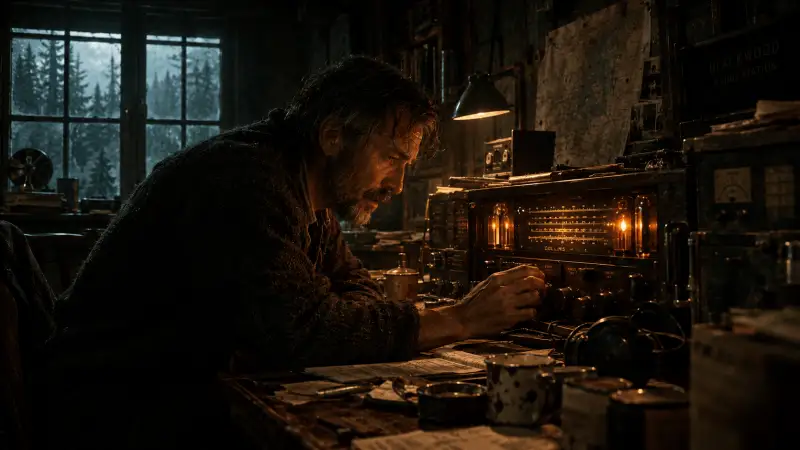
Today, however, a faint tremor of something new, something almost electrical, disturbed the habitual calm. He had been attempting to coax a coherent broadcast from his grandfather's old valve radio, a hulking contraption of polished walnut and Bakelite dials that usually only offered a symphony of hiss and pop. It sat on a small, scarred table in the corner of the living room, a relic from an era when voices traveled on invisible waves, carrying news and music from distant, unimaginable places. Elias rarely bothered with it anymore, preferring the silence, or perhaps, fearing what voices it might dredge up. But a flicker of ennui, a rare, sharp edge to his usual melancholia, had driven him to it today.
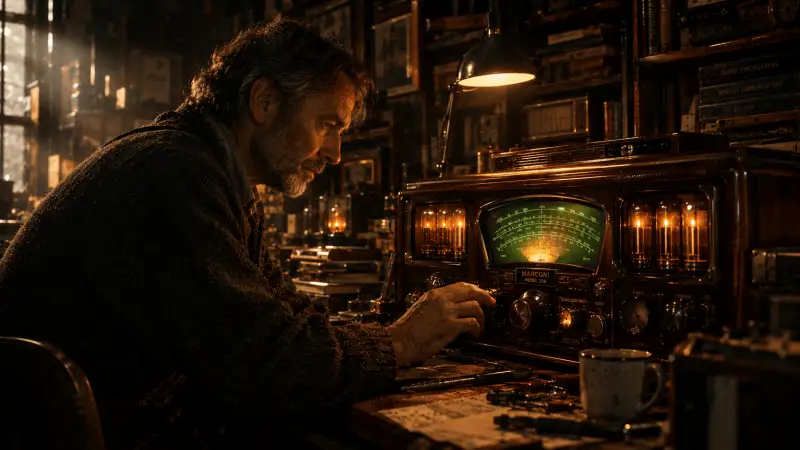
He turned the weighty tuning knob, the plastic warm beneath his fingertips, listening to the familiar cacophony. A cacophony that sometimes, on a clear night, would part just enough to let through a snippet of classical music or a distant news report, only to swallow it back into the ether. His fingers were stiff, arthritic, the delicate movements of tuning a minor challenge. He closed his eyes, his brow furrowed in concentration, listening past the white noise, past the faint hum of the ancient electronics.
Then, amidst the ocean of static, a note. Clear, resonant, impossibly pure. It was a piano, playing a melody Elias had not heard in decades, a melody he hadn't realized he still remembered until it unfurled itself, note by exquisite note, directly into the hollow of his chest. His breath hitched. His eyes flew open. The dial was hovering somewhere between two known frequencies, a no-man's-land of radio waves, yet the music poured forth, vibrant and undeniable.
It was that song. His song. The one he had loved in his youth, the one he had associated with a particular summer, a particular person, a particular feeling that had been so vivid it had almost hurt. He had searched for it for years, in dusty record shops, on forgotten tapes, even, once, in the nascent digital archives of the internet, but it had always eluded him. It wasn't obscure, not truly, but it had slipped through the cracks of collective memory, a minor piece by a minor artist, beloved by few, remembered by fewer still. Yet here it was, perfectly rendered, as if played just for him.
The sound filled the small, quiet room, chasing away the shadows, illuminating the dust motes with a newfound significance. Elias remained frozen, his hand still on the tuning knob, afraid to move, afraid to breathe, lest he shatter the fragile spell. The melody swelled, a bittersweet tide of remembrance. It wasn't just the notes; it was the way the piano keys seemed to sigh, the subtle tremolo in the higher register, the almost imperceptible hesitation before the chorus. Every nuance was precisely as he remembered it, as if plucked directly from his own mind. It was a ghost, a perfect sonic apparition.
He felt a prickle at the back of his neck, a sensation not of fear, but of profound, unsettling wonder. Who was playing it? Where was it coming from? The radio dial remained fixed on that anomalous, unlisted frequency. There was no DJ's voice, no station identification, nothing but the pure, unadulterated music. As the song reached its tender, fading conclusion, a profound silence descended, heavier than before, pregnant with the echoes of what had just been. Elias slowly withdrew his hand, his fingers tingling. The static returned, a gentle, almost reverent hum. The song was gone, leaving behind only the lingering resonance in his heart and the bewildering question: how?
Chapter 2: Frequencies of the Past
The following days blurred into a single, protracted vigil. Elias abandoned his usual routines, his morning tea growing cold, his newspaper unread. His world had shrunk to the antique radio, a glowing, humming oracle that held the key to a truth he couldn't yet grasp. He had spent hours, hunched over the Bakelite casing, his ear pressed close, turning the knob with a surgeon's precision. He searched for the exact frequency, the precise point in the static where the impossible music had emerged. He tried every hour, every minute, his patience a testament to the profound impact that single song had wrought.
The air outside grew colder, the wind sharpening its teeth against the rattling windowpanes. Inside, the only warmth came from the radio's valves, a faint, comforting heat against his fingertips. He felt like a prospector, sifting through endless gravel for a glint of gold, or an astronomer, scanning the vast, indifferent cosmos for a signal. The thought of it being a fluke, a trick of the airwaves, was almost unbearable. He needed it to be real, needed the song to exist, to reaffirm that his memories, however faded, were not mere illusions.
Then, on the third evening, just as the last sliver of twilight bled from the sky and the first stars pricked through the inky canvas, it happened again. He was about to give up, his shoulders aching, his eyes strained. His finger, poised over the tuning knob, hesitated. He heard it, faint, barely perceptible, a whisper within the static. He held his breath, nudging the dial fractionally. The static receded, pulling back like a tide, revealing the familiar, unmistakable piano chords. It was the same song. The very same.
This time, Elias was ready. He sat back in his chair, a tremor running through him, a mixture of awe and trepidation. He closed his eyes, letting the music wash over him, immersing himself in its familiar embrace. Each note was a key unlocking a forgotten chamber of his mind. He saw flashes: sunlight through leaves, the scent of petrichor after a summer rain, a hand in his. A face, indistinct yet achingly familiar, hovered at the edge of his consciousness, like a dream fading upon waking. A smile, a shared glance, the rustle of a dress. It wasn't a clear narrative, but a mosaic of sensations, feelings, and fragmented images, all tied to this singular melody.
The radio, in its antiquated glory, seemed to glow with a faint, internal light, the tuning eye a hypnotic green. It was more than just a device; it was a conduit, a whisper from a bygone era, speaking directly to his soul. There was a peculiar intimacy to it, as if the station knew him, knew his heart's deepest yearnings, and was deliberately playing this one song for him alone. No chatter, no advertisements, no other music, just this singular, perfect rendition. It was a broadcast of pure memory, a frequency tuned to his own internal landscape.
He felt a strange kinship with the station, almost as if it were a sympathetic entity, a gentle guide leading him through the labyrinth of his own past. He started talking to it, softly at first, then with increasing confidence. "You know, don't you?" he would murmur, his voice raspy with disuse. "You know what this song means." He would recount snippets of the fragmented memories that surfaced, the music weaving itself through his words, sometimes seeming to emphasize a particular emotion, a lingering regret. He felt a profound sense of connection, a less solitary existence than before. The wind still howled outside, and the house still sagged, but Elias was no longer alone in his quiet vigil. He had a companion, an unseen broadcaster, playing a symphony of his solitude.
Chapter 3: The Ghost in the Airwaves
The obsession grew, blossoming from a seed of curiosity into a dense, fragrant thicket that consumed Elias's waking hours. He began to anticipate the song, learning its rhythm, its peculiar schedule. It wasn't regular, not truly, but there were patterns: often at dusk, sometimes in the dead of night when the world was utterly silent, occasionally in the hazy quiet of a Sunday morning. Each broadcast felt like a personal message, a deliberate choice by an unseen DJ who knew his heart's rhythm better than he did himself. He started keeping a small, leather-bound journal, meticulously noting the times and dates, the faintest shifts in the radio's hum, the subtle nuances in the song's performance. He even imagined he could discern variations, a slightly longer held note, a softer dynamic in one passage, as if the unseen pianist were breathing life into it anew each time.
His attempts to find any information about the station, or even the song itself, proved fruitless. He tried adjusting the antenna, climbing into the dusty attic to re-position the old wire, hoping to catch a stray word, a station identification. Nothing. The frequency remained stubbornly silent before and after the song. He even ventured into the nearby village, a rare excursion for him, to rummage through the small, cluttered antique shop, hoping for a clue, a record of the song, a mention of a local broadcast. The shopkeeper, a sprightly woman with spectacles perched on her nose, merely chuckled, dismissing his inquiries about "phantom radio stations" as the musings of a lonely old man.
"Old radios do funny things, love," she had said, polishing a chipped teacup. "Pick up strange signals, especially out here. Echoes, that's all they are. Echoes of old broadcasts, bouncing off the hills." But Elias knew it was more than an echo. This was too precise, too personal. It felt alive, vibrant, undeniably present.
One evening, as the song played, a particularly vivid memory surfaced. He saw her, clear as day, leaning against a sun-dappled stone wall, her hair the color of autumn leaves, a smile playing on her lips. Clara. The name, long buried beneath layers of grief and self-imposed amnesia, burst forth from the depths of his mind. Clara. His Clara. The one he had loved with an intensity that had frightened him, the one he had let slip away through fear and youthful pride. The song had been their song, a melody they had discovered together, a private anthem of their nascent love. The memory wasn't just visual; it was olfactory, the scent of lavender and damp earth, the taste of her lips, the feel of her hand in his. It was overwhelming, a torrent of sensation that left him breathless, tears stinging his eyes for the first time in years.
The radio, as if sensing his emotional turmoil, seemed to intensify its broadcast. The piano notes resonated deeper, the subtle static around the edges of the sound seemed to hum with a sympathetic energy. Elias felt a profound, almost telepathic connection. "Clara," he whispered, his voice cracking. "This was for Clara, wasn't it?" The music seemed to answer, a soft, sorrowful swell that filled the room, then gently faded as the song concluded. It was as if the station was guiding him, not just playing a song, but curating his memories, forcing him to confront the ghost he had carefully entombed within his own heart.
He understood then. This wasn't just a mysterious broadcast; it was a personal intervention, a magical conduit to a past he had desperately tried to forget, and now, just as desperately, needed to remember. The ghost in the airwaves wasn't just a song; it was the lingering spirit of a love, waiting to be acknowledged, to be mourned, and perhaps, finally, to be released.
Chapter 4: A Symphony of Solitude
With Clara's name now firmly etched back into his conscious mind, Elias approached the radio with a new reverence, a fresh sense of purpose. Each time the song emerged from the static, it wasn't just a melody; it was a chapter, a fragment of a larger narrative that he was slowly, painfully, reconstructing. The house, once a tomb of silence, now hummed with a different kind of energy, a quiet vibrancy born from resurrected memories. Elias no longer fought the tide of recollection; he surrendered to it, letting the music be his guide through the winding corridors of his past.
He remembered the summer, hot and languid, when he and Clara had first heard the song. They were teenagers, all awkward limbs and burgeoning emotions, perched on a worn bench in a dusty park, sharing cheap ice cream. A busker, an old man with fingers like gnarled roots, had played it on a battered upright piano. Clara's eyes, bright and full of a youthful intensity, had met his, and in that shared moment, the music had woven itself into the fabric of their nascent love. He remembered stolen kisses beneath star-dusted skies, whispered promises in fields of wildflowers, the easy laughter that had come so naturally with her. He remembered the feel of her hand, small and warm, nestled in his, a perfect fit.
But then, the bittersweet notes of the song would shift, subtly, almost imperceptibly, mirroring the turn in their story. He recalled the arguments, small at first, then larger, fueled by misunderstanding and the clumsy pride of youth. His fear of commitment, of being truly known, had driven a wedge between them. He saw himself, young and foolish, pushing her away, convinced he was protecting himself, when in reality, he was tearing a wound in his own soul. The final, painful conversation, the quiet goodbyes, the way her eyes had held a glimmer of unshed tears. He had watched her walk away, convinced she would be back, convinced she had to be. But she hadn't. The song always seemed to linger on these chords, these moments of regret and misunderstanding, drawing them out, making him re-live the ache of his past mistakes.
He would often fall asleep in his armchair, the radio still glowing, the faint hum of the static a lullaby. He would dream of Clara, vivid dreams where she was young and vibrant, her laughter echoing through sun-drenched fields. Sometimes, in these dreams, she would look at him with a knowing sadness, and he would wake with a profound sense of loss, but also, surprisingly, with a flicker of understanding. The radio wasn't just dredging up pain; it was offering a chance for absolution, a path to forgiveness, both for himself and for the ghost of the past.
The isolation of the farmhouse, once a burden, now felt like a sanctuary. He was a solitary figure, yes, but no longer truly alone. The radio, the song, Clara's memory, they were all companions in his symphony of solitude. He talked to the air, to the radio, to Clara, recounting stories, apologizing, expressing the words he had never had the courage to say. The music, in turn, felt like a response, a gentle affirmation, a sorrowful embrace. The more he remembered, the clearer Clara's image became, not just as a lost love, but as a vibrant, complex person, whose memory deserved to be honored, not buried.
He spent hours simply listening, allowing the music to be the soundtrack to his internal unraveling. The house groaned around him, the wind rattled the panes, but inside, a new quiet was settling, a quiet born not of emptiness, but of a profound, reconnected wholeness. He felt the threads of his past, long frayed and disconnected, beginning to reweave themselves, forming a tapestry rich with both joy and sorrow, but undeniably, beautifully, his own.
Chapter 5: Broadcast's End, Memory's Dawn
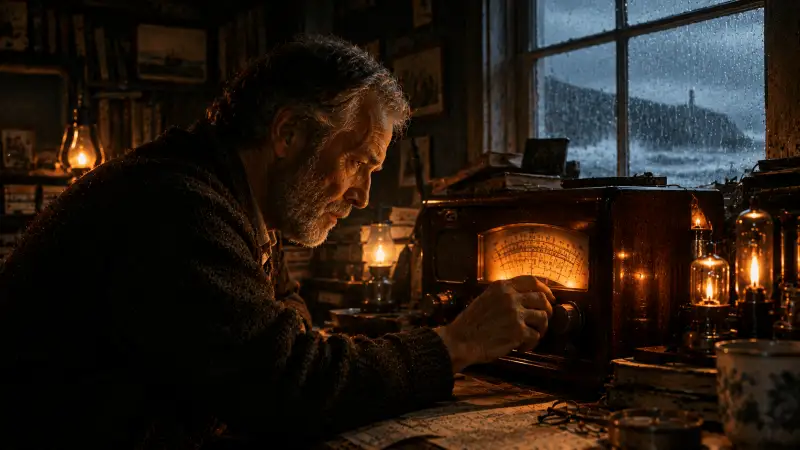
One particularly raw evening, with rain lashing against the windows and the old house creaking like a ship at sea, Elias sat by the radio, a profound sense of peace settling over him. The song had just finished playing, its final notes lingering in the charged air, a gentle exhalation. But this time, something felt different. The usual return of static, that familiar gentle hum, was absent. Instead, there was a profound silence, deeper and more complete than any he had experienced before. The tuning eye, which usually glowed with a faint green light, was dim, almost imperceptible. The valves, usually warm, were cool to the touch.
He waited, his heart thrumming with a strange mixture of apprehension and acceptance. He turned the dial, slowly, deliberately, scanning the frequencies, but there was nothing. No hiss, no pop, no distant voices. Just an absolute, echoing void. The mysterious station, his personal conduit to the past, had vanished. It was gone, as suddenly and inexplicably as it had appeared.
Instead of the sharp pang of loss he might have expected, a quiet calm washed over Elias. He realized, with a clarity that resonated deep within his bones, that the station's purpose had been fulfilled. It hadn't been about endlessly reliving the past, but about understanding it, accepting it, and finally, letting it go. The radio had been a teacher, a guide, forcing him to confront the buried grief and regret, to finally acknowledge Clara, not as a source of pain, but as an integral, beautiful part of his life's tapestry.
He looked at the silent radio, no longer a source of yearning, but a venerable artifact, a vessel that had carried him across the waves of time. He reached out and gently placed his hand on its smooth, cool Bakelite. He remembered Clara's face, her smile, the feel of her hand. The memories were no longer bittersweet stings, but tender recollections, imbued with a quiet affection. He understood now that her memory wasn't something to be hidden away, but cherished, like a precious, well-worn photograph. Her love, though lost to time and circumstance, had shaped him, had made him who he was, and that was a truth he could finally embrace.
The rain outside began to soften, a gentle patter against the roof. A faint glimmer of moonlight broke through the clouds, casting a silvery sheen on the wet garden. Elias rose from his chair, his movements no longer stiff with anticipation, but imbued with a newfound lightness. He walked to the window, gazing out at the familiar landscape, which suddenly seemed imbued with a fresh clarity, a subtle magic that had always been there, just waiting for him to truly see it.
He knew the song would forever be etched in his heart, a melody that had guided him home to himself. He no longer needed a phantom station to play it; its music resided within him, a constant, comforting presence. He had faced the ghost in the airwaves, and in doing so, had found peace with the ghosts of his own past. The broadcast had ended, but the dawn of memory, clear and reconciled, had truly begun. Elias felt a profound sense of gratitude, a quiet understanding that even in solitude, there was connection, and in loss, there was the enduring echo of love, forever resonating in the deepest chambers of the heart.