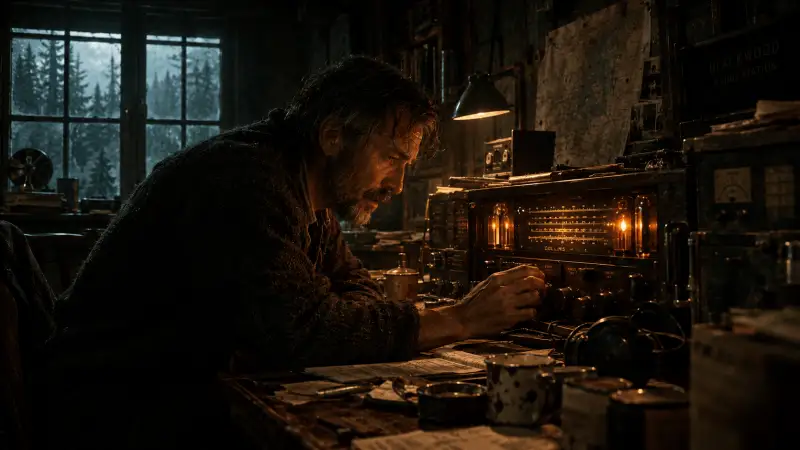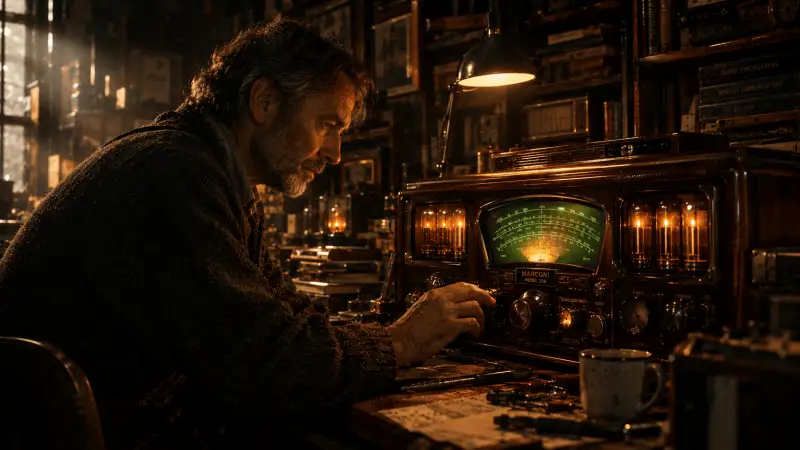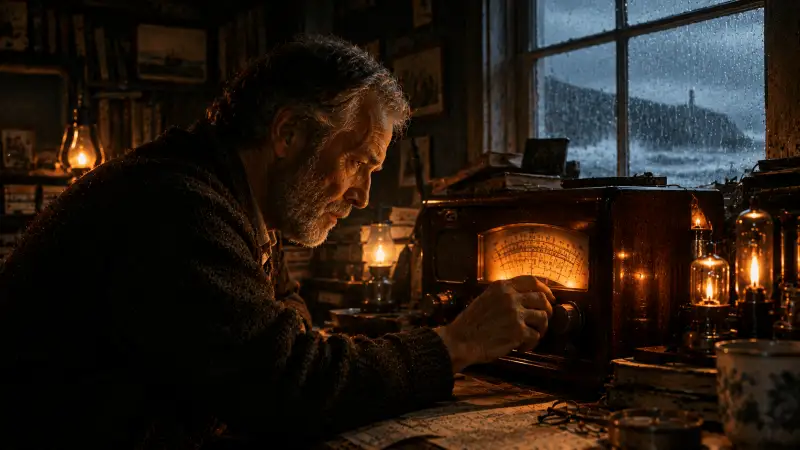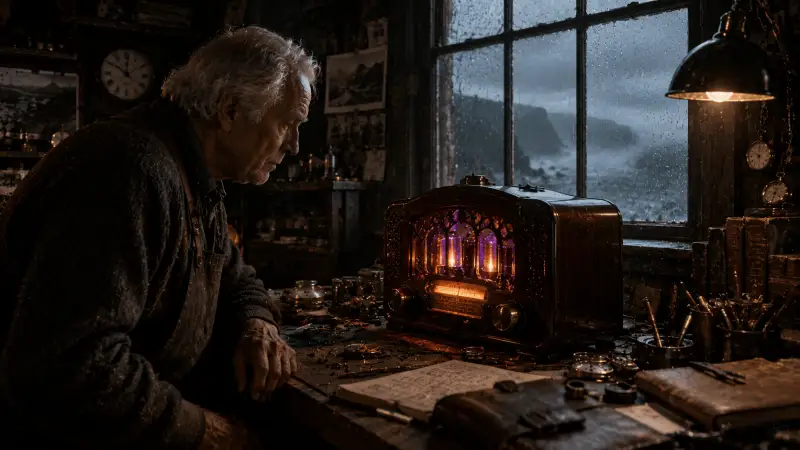
In a rain-soaked hollow where tides of fog swallow the hours, an elderly horologist repairs a battered bakelite radio that hums with impossible, never-before-heard melodies each song existing only once, vanishing the moment the brass toggle snaps back to silence.
Table of Contents
- Chapter 1: The Solder and the Sea-Glass (The Radio That Played a Different Song Every Time It Was Switched On Origins)
- Chapter 2: The Ledger of Vanishing Voices (The Radio That Played a Different Song Every Time It Was Switched On Discovery)
- Chapter 3: A Visitor at the Boundary (The Radio That Played a Different Song Every Time It Was Switched On Archives)
- Chapter 4: The Geometry of Longing (The Radio That Played a Different Song Every Time It Was Switched On Confrontation)
- Chapter 5: The Unsung Air (The Radio That Played a Different Song Every Time It Was Switched On Resolution)
Chapter 1: The Solder and the Sea-Glass (The Radio That Played a Different Song Every Time It Was Switched On Origins)
The mysterious tale of the radio that played a different song every time it was switched on began on a cold winter in Mallow Creek in 1951.
The damp was a patient creature in Mallow Creek. It crept under the warped thresholds of the cottages, blooming in faint velveteen patterns across the plaster and furring the brass pivots of Eamon Finch's grandfather clocks.
Eamon had spent forty years counting ticks in the marrow of walnut cases, but this winter the ticks felt heavy, like pebbles dropped into a cistern already brimming with cold water.
His workshop smelled of mutton tallow, flux paste, and dried chamomile. Outside the mullioned windows, the salt mist blew off the low grey tide, softening the outlines of gorse and barbed wire until the world looked like a half-remembered charcoal sketch.
It arrived inside a damp parcel wrapped in oilcloth, deposited on his workbench by the salt-crusted mailman who said only that it had been retrieved from the probate clearance of the drowned cottage at Black Sands.
The maker's plate was missing. Its casing was pressed from mottled tortoiseshell bakelite, curved at the shoulders like the shell of a deep-water turtle, and its dial face was not marked with kilocycles or cities, no Hamburg, no Athlone, no Hilversum, but rather with a faint archipelago of scratched silver notches.
Inside, where copper wire ought to have run in neat, shellac-insulated harness, there lay a nest of unbraided wire that resembled dried kelp.
Eamon set down his jeweller's eyeglass. His knuckles, swollen from decades of winter damp, throbbed as he used fine tweezers to seat a replacement twin-diode valve into the ceramic socket.
He did not expect it to receive anything. The transmitter mast out on the headland had collapsed during the gale of November, leaving the parish in an acoustic quarantine where the only news was carried by foot or whispered across stone walls.
Yet when his thumb found the knurled brass toggle switch beneath the frequency window, the mechanism engaged with an unusually heavy, bone-deep click, a sensation less like a mechanical contact and more like a heavy latch falling into an oiled groove.
For three seconds, nothing occurred save the slow, amber blooming of the valve heaters. Then the fabric cloth behind the fretwork shuddered.
It began not with static or the whistle of atmospheric interference, but with the dry, distinct rustle of river reeds brushing against an upturned skiff.
Out of that rustle came a flute, or an instrument carved from green willow that answered to the same family of breath, playing a six-note refrain that seemed to fall downward, step by step, through water.
It was accompanied by the rhythmic clinking of glass beads or cold pebbles being shaken in a sheepskin bag. The tune did not belong to the dance halls in Galway or the choir stalls of St. Jude's; it carried no meter that Eamon could tap his shoe against, yet it held an unbearable, crystalline symmetry.
His breath caught in his throat. His spectacles slipped down his nose as he leaned closer, inhaling the scent of hot phenolic resin and ancient, baked dust.
For four minutes, the room ceased to be his shop. The tick of twenty-four pendulum clocks fell away, swallowed by the solitary woodwind that rose into a high, unresolved cadence, trembling like thistle fluff before a draft.
And then, as Eamon reached out with trembling fingers to steady his magnifiers, his cuff caught the edge of the toggle. The switch snapped down.
The silence that rushed into the room was violent. It felt physically cold, like an iron door slamming shut against the sea.
Panic, childish and sharp, struck him between the ribs. He immediately flicked the switch upward again. The brass clicked. The valves flickered amber once more.
But the skiff was gone. The reeds were gone. Out from the cloth came a thundering chorus of brass horns and muffled percussion, played in a galloping, minor-key tempo that sounded like a cavalry charge stumbling through deep mud, backed by the low, wordless chanting of hundreds of deep, gravelly male voices.
Eamon stared at the dial, his heart hammering against his ribs. He turned the tuning knob three inches to the left, then four to the right; the horns did not alter their course or yield to radio hash.
They completed their sorrowful, triumphant march, paused upon a sustained note that shook the loose watchmaker's oil vials on his shelf, and then simply evaporated into a calm hiss.
When he switched it off and on again, an accordion played a solitary lullaby accompanied by the distant weeping of gulls. A different song. Every single time.
A world that gave birth to a melody, spent it completely, and refused to ever speak it again. Learn more about vintage radio broadcasting history and technology.
Chapter 2: The Ledger of Vanishing Voices (The Radio That Played a Different Song Every Time It Was Switched On Discovery)
Recording notes in his pigskin ledger, the horologist studying the radio that played a different song every time it was switched on realized every melody was an irreversible extinction.
By the fourth day of January, Eamon Finch had ceased rewinding the spring-driven clocks.
One by one, their weights reached the bottom boards of the cases with faint, hollow thuds, leaving the cottage in a stillness so thick that the scratch of his dip-pen sounded like beetles gnawing through wainscoting.
Upon his mahogany desk lay a butcher's ledger bound in pigskin, its blue-lined pages filling rapidly with erratic, desperate script.
He had established rules, though he could not say what authority had decreed them. First: he would only toggle the switch once every six hours, lest the valves exhaust whatever impossible spirit dwelt within their vacuum.
Second: he would write down everything he could identify before the memory faded into the grey wash of ordinary consciousness.
But his vocabulary was hopelessly small. How was one to classify music that possessed no scale known to Western staff paper?
For the seventeenth switch-on, he wrote: Noon. Two minutes forty seconds. Sounds resembling a hammered dulcimer made of slate. A girl's voice speaking syllables that feel like warm salt. The rhythm resembles a heart under exertion, then relaxes into the cadence of falling apples. Mood: Not grief, but the memory of having been warm.
For the eighteenth, he recorded only: Dusk. Five cellos bowing a single chord for three minutes while rain hits corrugated zinc. Devastatingly heavy.
He tried to capture them on wire. He dragged from the cellar his old Webster-Chicago wire recorder, its spools threaded with hair-thin stainless steel, and placed the dynamic microphone an inch before the radio's pierced grille.
He waited until midnight, when the wind died down and the only sound outside was the seep of bog-water through the gully.
He clicked the toggle. A sound like silver needles falling on a marble floor emerged, shifting slowly into an arrangement of acoustic strings that felt so intimately familiar it brought bile to the back of his dry throat. It was the harmony his late sister Martha used to hum when she rinsed salt-herring in the scullery forty years ago, but expanded into an orchestra of plucked gut and distant glass bells.
Tears blinded him as he watched the steel wire spool evenly between the reels, the tiny needle dancing in the volume meter.
He let the song conclude to its natural, breathy expiration. Then, his hands trembling so violently he dropped his pencil twice, he reversed the spool and struck the playback lever.
The wire whispered across the magnetic head. He held his breath.
But what came through the playback horn was not the melody. It was not even static.
It was an absolute, terrifying vacuum, a dead silence so complete that his own ear began to produce a phantom ringing to fill the void.
The machine could catch the hum of his own breath, the scuff of his leather slippers on the floorboards, but where the radio had sung, there was merely an unstitched hole in the air.
"It won't keep," he whispered to the empty room, looking down at his knuckles. "You cannot pocket the smoke, Eamon. You fool. You old fool."
He turned back to the radio. The bakelite was faintly warm beneath his palm, smelling not of burnt insulation, but of wet heather and ozone.
He realized with a tightening sensation in his throat that each piece of music was an extinction.
To turn the switch was to summon an entire world from the dark, its history, its instruments, its unnamed grief, and to toggle it off was to extinguish that world without a record.
The burden of being the sole witness was already bowing his spine. Explore our full archive of classic radio stories and mysterious audio broadcasts.
Chapter 3: A Visitor at the Boundary (The Radio That Played a Different Song Every Time It Was Switched On Archives)
When a county archivist arrived to inspect the radio that played a different song every time it was switched on, she wept as microtonal voices filled the quiet workshop.
Clara Thorne arrived with the salt on her wool coat and a ledger of her own.
She was thirty years younger than Eamon, an archivist from the county historical society whose task was to catalogue the remaining dialects and oral folk-songs of the dying coastal parishes before the new concrete highway bypassed them completely.
She had come for the sea-shanties of Mallow Creek, but the tavern-keeper had directed her up the ridge, muttering that if she wanted curiosities, she ought to visit the watchmaker who had stopped winding his clocks to listen to ghosts.
She did not knock as a stranger knocks; she gave three sharp, authoritative raps that rattled the dried lavender hanging beside the lintel.
When Eamon opened the door, squinting through the gloom, he saw her notebook clasped under her arm like a shield. "Mr. Finch? I'm told you possess an uncatalogued instrument. The local boys say you've got something singing up here that doesn't use the aerial."
Eamon wanted to shut the door. The fog was rolling over her boots, smelling of rotten kelp and cold peat, and his small fire was down to embers.
But the loneliness of the last two weeks had begun to rot his caution. Without speaking, he stepped aside, gesturing toward the wooden chair opposite his workbench.
Clara entered, her keen eyes instantly cataloguing the room: the halted clocks, the dust settling on the lathe, the scatter of charred matches, and the brown ledger filled with Eamon's frantic scribbles.
Her gaze fixed upon the bakelite radio sitting alone upon the center of the green baize cloth. "A pre-war chassis," she remarked, stepping toward it, her nose wrinkling at the strange, sharp aroma of heather-scented heat that hung about it. "American casing, perhaps? But the dial isn't domestic. Where is the earth wire?"
"There is no earth," Eamon said, his voice cracked from disuse. "Sit down, Miss Thorne. And promise me you will not touch the toggle."
She looked at him with that mild, patronizing skepticism common to educated people who believed everything could be reduced to a frequency or a tax receipt. She sat, resting her hands on her knees. "Play it then, Mr. Finch. I have a wax-cylinder recorder in my trap down at the gate if we need to take a trace."
"The cylinders will stay blank," he replied quietly. He stepped behind the radio. His fingers hesitated over the brass toggle.
His heart did its familiar, frantic flutter, what if this was the turn that yielded only dead air? What if the reservoir was dry? He took a breath and pushed the switch up.
Click.
The amber light woke slowly within the valves. A low, subterranean drone began to vibrate the table legs, so deep it was felt in the pelvic bone rather than heard.
Then came a voice. It was neither woman nor child; it was a chorus of three voices harmonizing in an interval so narrow, so microtonal, that it produced acoustic beats like the flutter of a moth's wings against a windowpane.
They sang in no tongue Clara had ever transcribed. The song possessed the architecture of an ancient lamentation, punctuated by the dull, rhythmic strike of an iron bell submerged in deep water.
Clara's pencil slipped from her hand. It rolled across the floorboards, coming to rest against Eamon's slipper, but she did not look down.
Her face grew completely white; her jaw dropped slightly as she leaned forward, her pupils dilated until her grey eyes looked almost black.
"What is that?" she breathed, her voice a fragile reed. "The scale it's thirty-one divisions to the octave. That hasn't been practiced since the Florentine experiments, no, this is older. Where are they broadcasting from?"
"Nowhere," Eamon said, watching her face. "Or everywhere that has already burned down."
The song crested. A single violin, strung with what sounded like coarse horsehair, cut through the voices, playing a soaring, heartbreaking melody that spoke of cold hills, abandoned fires, and people whose names had never been recorded in any church registry.
Clara was weeping openly now, without shame, the tears tracking through the dust on her cheeks. And then, as the last note hung like a suspended icicle in the warm air of the workshop, Eamon's hand moved.
"No!" Clara cried, lurching forward.
Snap.
The toggle fell. The silence descended like a suffocating blanket of wool.
Clara sat frozen, her hand outstretched, her breath coming in ragged gasps. "Why did you do that?" she whispered, fury and despair warring in her voice. "Turn it back! Put it back!"
"It doesn't go back," Eamon said softly, his voice trembling. "If I turn it on now, that song is gone. A new one will come. And we will never hear that voice again as long as the earth turns."
Chapter 4: The Geometry of Longing (The Radio That Played a Different Song Every Time It Was Switched On Confrontation)
As a vacuum tube began to fail on the radio that played a different song every time it was switched on, the pair debated whether to drain its final melody.
For three days, Clara did not leave the cottage. Her pony remained stabled in the lean-to, munching Eamon's dry clover, while she sat beside the workbench with her boots off, wrapped in one of Martha's old woollen shawls.
The skepticism that had armored her character was completely dissolved, replaced by a feverish, hollow-eyed hunger that Eamon recognized with dread, it was his own sickness, mirrored in a younger mind.
They had become gamblers who wagered only in departures. They sat across the table, debating for hours before allowing themselves the luxury of a single switch-on.
"Just one more," Clara would plead at two in the morning, her fingers twitching toward the bakelite case. "Only to see if the choral tradition returns. The one at noon, the one with the bronze horns, it had elements of sixteenth-century Picardy folk-dance, but the tempo was governed by tidal intervals. If we listen again, we might establish the cycle."
"There is no cycle," Eamon insisted, though his own thirst was just as gnawing. "It has played eighty-two times, Clara. We have heard desert bagpipes, iron lutes, voices singing from inside barrels, and songs that sound like the wind blowing through the ribs of a beached whale. It does not repeat. It cannot repeat. It is a well without a bottom, but every bucket we draw empties into the sand."
"Then why have it?" she shouted, her voice shrill in the silent room. "What cruelty created an instrument that demands you forget everything it gives you? If it cannot be preserved, if it cannot be studied, it is only a torment!"
"Perhaps it wasn't made for us," Eamon said softly, staring through the grimy window at the rain sweeping across the shale hills. "We are clockmakers and archivists. We think things only exist if they can be pinned to a board like dried beetles. But the tide doesn't leave an archive of every wave, Clara. It just washes the shingle and leaves it clean."
On the fifth evening, a storm slammed into the coast from the North Atlantic. The wind screamed through the chimney flue, throwing plumes of soot onto the baize cloth.
Inside the radio's cabinet, a new sound manifested, a faint, rhythmic crackle that was not part of the music, but the distinct, sickening odor of overheated shellac and burning mica.
One of the vacuum tubes was failing. Through the slotted grille, Eamon saw the glass bulb of the central triode glowing not with a soft cherry-red, but with a violent, violet luminescence that flared like a dying star.
Clara saw it too. She stood up, her shawl falling to the floor. "It's dying," she whispered.
"The cathode is stripping," Eamon said, his horologist's training piercing through his awe. "The vacuum is soft. Air is leaking in around the pins. It has perhaps thirty minutes of life left. Perhaps less."
They stood in the flickering candlelight, the roar of the sea outside matching the roar of the blood in their ears.
The radio sat before them, a small, dark reliquary on the verge of becoming ordinary junk, a box of dead wires and cold glass.
The desire to toggle it on, to hear one more miracle before the end, was an agony that pulled at the ligaments of Eamon's chest.
"Do it," Clara whispered. She was trembling from head to foot. "Turn it on and leave it on until the valve burns black. Let us have the whole thing, whatever it is. Even if it dies, let it die singing."
Eamon's hand hovered over the brass switch. He looked at his own reflection in the dark dial glass, an old man who had spent his life trying to govern time with escapements and pendulums, terrified of the dark space between the seconds.
He looked at Clara, whose youth was already being poisoned by the same desperate desire to trap the infinite in a net of ink.
If he toggled it now, the radio would sing its final song, and they would spend the remainder of their lives haunted by the one melody they had consumed to death.
Chapter 5: The Unsung Air (The Radio That Played a Different Song Every Time It Was Switched On Resolution)
Leaving the radio that played a different song every time it was switched on unpowered as its final tube died, the watchmaker returned to the ticking of ordinary clocks.
The violet light in the triode flared, casting ribbed shadows of the wooden fretwork against the whitewashed wall. The smell of burning mica was stronger now, sharp as vinegar.
The storm beat against the slate roof like an iron hammer, but inside the cottage, neither of them moved. Eamon's fingers touched the cold brass of the toggle, feeling the minute resistance of the leaf spring beneath the housing.
"No," Eamon said quietly.
Clara let out a sharp, ragged sob. "You can't leave it silent. Not now. We have to know what the last one is. What if it's the one that explains it all? What if it's the song that makes the rest make sense?"
"No song makes the rest make sense," Eamon said. His voice was no longer shaking; it had settled into the profound calm that sometimes comes to a craftsman when a delicate gear finally slips into its true pivot.
"It was never an explanation, Clara. It was an offering. And an offering isn't something you keep. If we burn out the valve just to gorge ourselves on the last drop, we turn it into our possession. It becomes our carcass."
He pulled his hand away from the switch. He took a step back, folding his arms into the sleeves of his woollen cardigan.
"Please," Clara wept, falling to her knees beside the table. Her fingers crept toward the toggle. She looked up at him, her face bathed in the dim, lavender glow of the leaking vacuum.
She wanted him to stop her; she wanted him to give her permission. But Eamon only watched her with gentle, sorrowful eyes, the eyes of a man who had watched his mother, his father, his sister, and the craft of his youth all slip through his fingers into the earth.
Her hand hovered an inch from the brass. For a long minute, the only sound was the wild percussion of the wind and the hiss of the dying tube's heater filaments fighting the creeping air.
Slowly, agonizingly, Clara's fingers curled into an empty fist. She dropped her hand to her lap.
Inside the cabinet, with a faint, crystalline ping that sounded like an icicle snapping off the eaves, the purple glow collapsed into a tiny blue spark, flared once, and went dark.
A curl of white smoke drifted lazily through the grille, smelled faintly of pine gum and sea-salt, and dissolved into the gloom of the ceiling.
The radio was dead.
Neither of them spoke for the remainder of the night. Clara sat on the floor, leaning her back against the table legs, while Eamon sat in his high-backed chair, watching the grey light of dawn slowly bleed the blackness out of the eastern window.
The storm died with the sun's rising, retreating out across the Atlantic, leaving the village in that shimmering, rinsed stillness that always follows a coastal gale.
When the light was strong enough to see the blue ink on the ledger pages, Clara stood up. Her limbs were stiff.
She looked down at the silent bakelite box, then at the ledger filled with descriptions of impossible horns, stone flutes, and voices that would never be named.
Without a word, she picked up her sheepskin coat and walked to the door. She paused on the threshold, looking back at the old watchmaker.
"I won't write it into the report," she said quietly. "They would only come with pry-bars and calipers, looking for the broadcast tower."
"There is nothing here to pry," Eamon replied. "Only old tin and burnt varnish."
She nodded once, stepped out into the damp morning air, and Eamon heard the steady, rhythmic crunch of her pony's hooves as she led it down the gravel lane toward the road.
When she was gone, Eamon did not throw the radio away, nor did he tear it apart for copper scrap.
He carried it to the high mantelpiece, placing it between an eight-day brass chronometer and an empty salt-glazed jar.
He took up his winding key, dusted the spiders from the weights of his grandfather clocks, and began to draw the chains.
One by one, the pendulums were set swinging, tick, tock, tick, tock, measuring the cold, ordinary seconds that belonged to everyone.
He never switched the radio on again, even though he had spare valves in his cabinet that might have coaxed another spark from the unbraided wire. He did not need to.
Sometimes, in the late afternoons when the tide was turning and the mist rose through the gorse, he would sit at his lathe without touching the treadle, listening to the vast, unwritten silence of the world, knowing that somewhere out in the dark, an infinite number of songs were playing to an empty room, lovely and unrecorded, needing no ears at all to be whole.