Decades after a fleeting melody sealed a forgotten choice, a man embarks on a quiet odyssey through the landscapes of his own memory, driven by the phantom echo of a song that reshaped his life, seeking not to change the past, but to finally understand it.
Chapter 1: The Ghost of a Melody
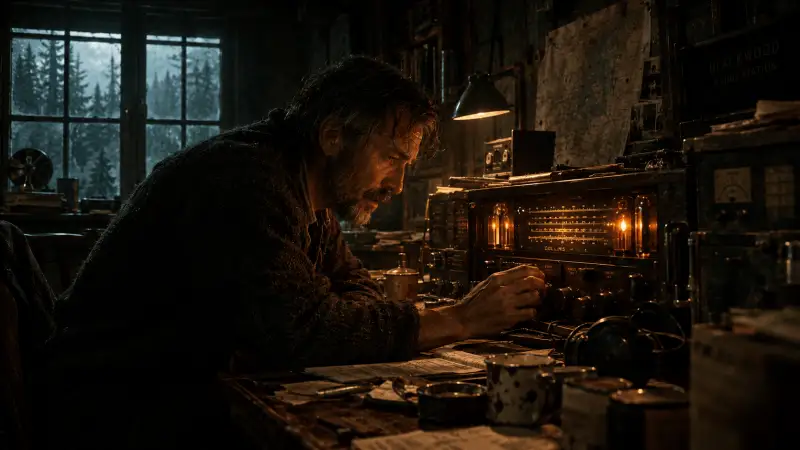
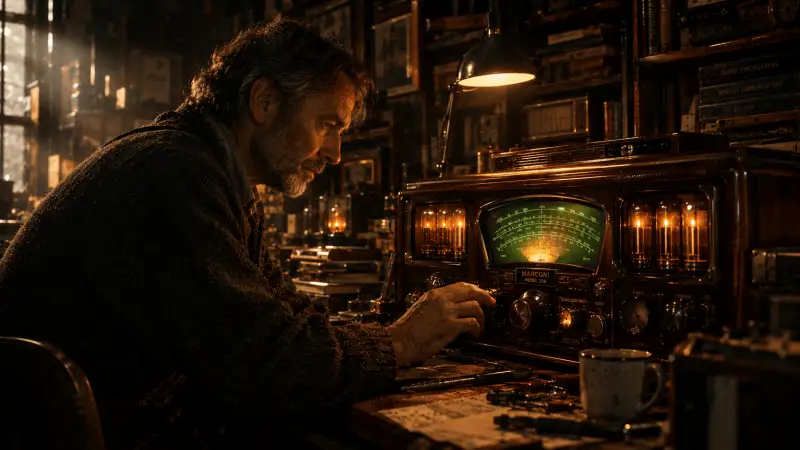
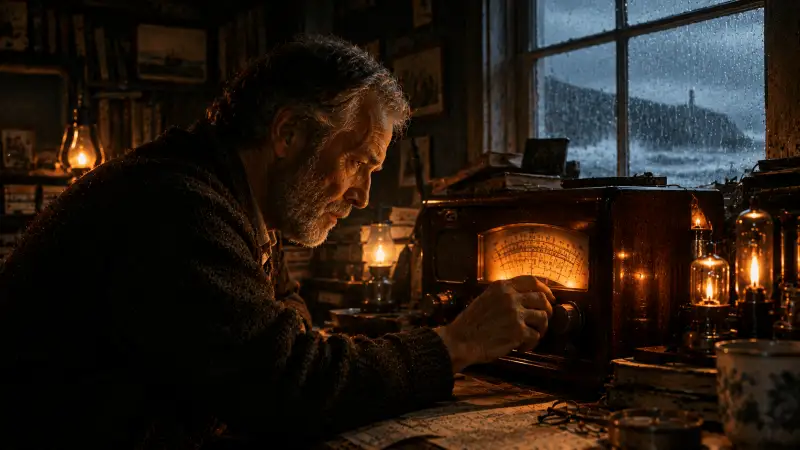
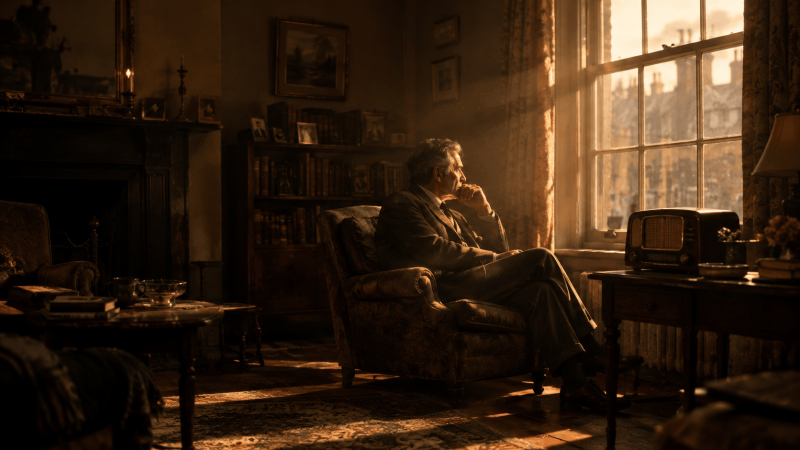
The rain began as a whisper against the windowpane, a soft, rhythmic patter that usually lulled Arthur into his afternoon slumber. But not today. Today, the world outside his living room, a landscape of greying skies and sodden autumn leaves, felt sharp and immediate, mirroring the sudden jolt within him. It was the radio, of course, that ancient, walnut-cased behemoth perched on the antique side table, its dial glowing with a faint, amber light. He hadn't bothered to replace it, preferring the rich, slightly distorted warmth of its tubes over any sterile modern device. And it was from this relic that the sound unfurled, unfurling not just into the quiet room, but directly into the deepest, most carefully guarded chambers of his memory.
"Summer Breeze" by Seals and Crofts. The acoustic guitar intro, delicate as spider silk, plucked at something raw and exposed. Arthur's breath caught, a physical constriction in his chest. His hand, gnarled with age and faintly trembling, tightened its grip on the worn armrest of his armchair. Seventy-two years old, and a simple song could still unravel him. He closed his eyes, the scent of old books and brewing tea suddenly cloying, the hum of the refrigerator a distant, buzzing drone against the overwhelming tide of sound and sensation that now swamped him.
It had been more than twenty years since he had last heard it with such raw, unbidden clarity. The song wasn't a rarity; it drifted through grocery stores and oldies stations, a pleasant, innocuous background hum for most. But for Arthur, it was a siren, a call from a past he had painstakingly buried under layers of routine, responsibility, and the quiet dignity of a life well-lived. Each strum, each gentle vocal harmony, was a key turning in a lock he thought long rusted shut. He felt the sudden, disorienting sensation of being pulled backward, not gently, but violently, as if an unseen hand had reached into his chest and yanked a tether taut.
His mind raced, a frantic kaleidoscope of images: a brilliant summer sky, the feel of sun-warmed skin, the distant roar of a V8 engine, and her laugh, a bright, bell-like sound that had once been the soundtrack to his world. Eleanor. Her name, unuttered for so long, formed silently on his lips, a ghost of a whisper in the echoing silence of his mind. How could a simple melody wield such power? How could the past, so meticulously compartmentalized and filed away, erupt with such force, demanding his attention, demanding to be re-lived?
The rain outside intensified, a drumming against the glass, mimicking the frantic beat of his own heart. He hadn't moved, hadn't opened his eyes, yet his vision was filled with the blinding glare of a summer sun, the dusty ribbon of a forgotten road, and the outline of a girl with wind-tousled hair. He could almost feel the humid air clinging to his skin, hear the cicadas' ceaseless chorus, smell the faint, sweet scent of honeysuckle carried on a gentle breeze. It was all there, vivid and unyielding, conjured by a song that had no right to still hold such sway over him. The decision he had made, or perhaps, the decision he had avoided, twenty years ago, no, closer to fifty, now pulsed with a fresh, aching clarity. The song wasn't just a memory; it was the precise moment, the fulcrum upon which his entire life had pivoted, an echo of the path not taken, a spectral hand reaching out from the mists of time to tap him on the shoulder and ask, "What if?" He knew, with a chilling certainty, that this time, he couldn't simply turn away. The song demanded an answer, and Arthur, suddenly, desperately, wanted to find it.
Chapter 2: Summer of '67
The summer of '67 had dripped with a heavy, golden sweetness. For twenty-two-year-old Arthur, freshly graduated and restless in his small Midwestern town, it felt like an endless expanse of possibility, stretching out before him like the cornfields that shimmered under the relentless sun. The air was thick with the scent of cut grass, gasoline, and the distant, metallic tang of rain promising to break the heat, a promise it rarely kept. Cicadas thrummed a ceaseless, hypnotic rhythm from the ancient oak trees, a backdrop to the crackle and hiss of transistor radios playing the latest hits. Life in Harmony Creek moved at a slower pace then, dictated by the sun's arc and the communal rhythm of harvest and church bells.
He had met Eleanor at the weekly Friday night dance at the town hall. The room, usually reserved for town meetings and bake sales, was transformed by a makeshift stage and the pulsing, slightly out-of-tune music of a local band. She had been a blur of bright cotton and vibrant laughter, her dark hair catching the dim lights as she spun across the floor. Arthur, typically reserved, found himself drawn to her incandescent energy. He remembered the feeling of her hand in his, surprisingly delicate yet firm, as they danced to a Motown beat, the air thick with sweat and teenage dreams.
Their courtship had been a sun-drenched montage. Long drives in his father's borrowed Ford Fairlane, the windows down, the wind whipping their hair as they chased the horizon on dusty backroads. Picnic lunches by the shimmering, glassy surface of Miller's Lake, where the water was cool and the silence was broken only by the chirping of crickets and their whispered conversations. He remembered the way she would tilt her head when she listened, her dark eyes reflecting the boundless sky, and the gentle curve of her smile when he made her laugh.
It was one of those evenings, sprawled on a faded picnic blanket by the lake as the sun bled crimson into the horizon, that "Summer Breeze" had first truly registered. The radio, small and portable, sat between them, its static-laced melodies weaving into the symphony of the evening. They had been talking about the future, about leaving Harmony Creek. Eleanor spoke of art schools in Chicago, of bright lights and bustling galleries. Arthur, ever practical, spoke of engineering, of a future building bridges, literal and metaphorical, in some far-off city. The song had played softly, a gentle counterpoint to their hopeful, slightly naive dreams. He remembered the exact moment: Eleanor had leaned her head on his shoulder, her hair tickling his ear, and hummed along to the chorus. He felt a warmth spread through him, a sense of belonging so profound it was almost dizzying. It was a perfect moment, a fragile bubble of "us" suspended in the vastness of that summer.
Later that week, the conversation had turned serious, heavier than the summer air. Arthur had received an acceptance letter from a good university, miles away, a chance to truly escape Harmony Creek. Eleanor had her own aspirations. The unspoken question hung between them, heavy and suffocating. "What about us, Arthur?" her eyes had asked, though her lips remained sealed. He remembered the feel of her hand in his, now hesitant, cool. The radio, ever-present, had been playing in the background of his garage as he fiddled with an engine, the same song gently filling the space. He had looked at the letter, then at the photo of Eleanor tucked into his wallet, and felt the weight of two futures pulling him in different directions. The melody, so sweet and innocent moments before, suddenly felt like a mournful dirge, a soundtrack to an impossible choice. The summer, once endless, now felt finite, its golden glow fading into the encroaching shadows of autumn, and the looming decision he had to make.
Chapter 3: The Unspoken Path
The decision, when it finally came, wasn't a grand, dramatic pronouncement, but a quiet, almost imperceptible shift, like the settling of dust after a summer storm. Arthur had packed his bags, driven away from Harmony Creek, and Eleanor. He told himself it was for the best, that their dreams were too divergent, that he couldn't ask her to follow him, nor could he abandon his own ambitions for hers. He reasoned with the cold logic of a twenty-two-year-old trying to be a man, believing he was making the mature choice, the practical one. But as the miles stretched between him and the town, between him and Eleanor, an emptiness began to settle in his chest, a hollow ache that no amount of practical reasoning could fill.
The immediate aftermath was a blur of new faces, new routines, and the relentless pursuit of his studies. He threw himself into engineering, into the intricacies of bridge design and structural integrity, hoping that the sheer volume of work would drown out the persistent hum of regret. But it was always there, a low frequency vibration beneath the surface of his new life. He would occasionally catch a glimpse of Eleanor's face in a crowd, a trick of the light, a fleeting shadow, and his heart would lurch. He never saw her again, not truly. A few letters, at first, filled with forced cheerfulness and polite inquiries, then fewer, then none. The thread, once so vibrant and strong, had frayed and snapped, leaving only loose ends.
And the song. "Summer Breeze." It became a trigger, a painful reminder of what he had relinquished. When he heard its opening chords on a dorm room radio, or drifting from a car window, a cold dread would wash over him. He would quickly change the station, walk away, anything to escape its gentle, accusatory melody. It wasn't just a song; it was the soundtrack to a pivotal moment, a vibrant, living monument to the path he had chosen not to walk. He remembered the faint, sweet scent of Eleanor's hair, the warmth of her hand in his, the unspoken promise in her eyes, and how he had, in his youthful ambition, let it all slip away.
Life, as it always does, continued. He built his career, designing soaring structures that spanned rivers and valleys, a stark contrast to the small-town life he had left behind. He met Martha, a kind, steady woman with a comforting laugh and an unwavering pragmatism. They married, built a home, raised two children. It was a good life, a full life, filled with the everyday joys and quiet contentment of domesticity. But in the quiet hours, in the space between wakefulness and sleep, a ghost would sometimes visit him. A whisper of "what if," a fleeting image of a different life, a life where Eleanor was there, her hand in his, her laughter echoing through a different kind of home.
He had rarely spoken of Eleanor, not to Martha, not to his children. She was a secret, a tender scar on the landscape of his past, too delicate to expose to the harsh light of present-day scrutiny. He had convinced himself that regret was a useless emotion, a waste of energy. His choices had led him to this good life, to this family he cherished. And yet, the song, when it unexpectedly resurfaced, proved the fragility of his defenses. It wasn't just about Eleanor; it was about the youthful Arthur, the man who stood at a crossroads, filled with boundless potential and a terrifying naivete. It was about the weight of a choice made, or rather, a path not chosen, and how that one decision, steeped in the gentle harmony of a summer song, had echoed through every subsequent year, a quiet, persistent ache in the chambers of his heart.
Chapter 4: Echoes Across Decades
The song's resurgence had fractured the carefully constructed calm of Arthur's present. The quiet domesticity, the predictable rhythms of his days, now felt brittle, transparent. He moved through his living room, touching the familiar surfaces, the cool ceramic of his coffee mug, the smooth wood of the old radio, yet felt utterly disconnected from them. It was as if a veil had been lifted, revealing a vibrant, aching past just beneath the surface of his mundane reality. The autumn light, usually a source of comfort, now seemed to mock him, highlighting the dust motes dancing in the air, each one a tiny, shimmering particle of forgotten time.
The next few days were a blur of restless energy. He found himself wandering into the attic, a space usually reserved for Martha's seasonal decorations and forgotten mementos. The air was thick with the scent of aged paper and dry wood, illuminated by a single bare bulb that cast long, dramatic shadows. He unearthed boxes, labeled in Martha's neat hand: "Christmas Decorations," "Tax Records," "Kids' School Projects." But it was the unlabeled wooden trunk, tucked away in a dusty corner, that drew him in. Its latch was stiff, protesting, but eventually gave way with a creak.
Inside, a trove of his younger self lay preserved: faded college textbooks, a leather-bound journal with his youthful, earnest scrawl, and a small, brittle photograph. It was a picture of Eleanor, taken by him, by Miller's Lake. She was laughing, her head thrown back, hair a dark halo against the summer sky. Beside it lay a pressed, dried honeysuckle blossom, its once vibrant color faded to a delicate brown. He remembered picking it for her, tucking it behind her ear. A shiver ran through him, not from the cold, but from the raw immediacy of the memory. The photograph was a physical anchor to a past he had thought was purely ethereal.
He tried a cautious, tentative search online. Eleanor Vance. The name felt strange on his tongue, a relic from another era. He found very little, a few common names, no definitive match. The internet, so vast and all-knowing, felt frustratingly opaque when confronted with the ghosts of the past. The fear of what he might find, or not find, was a constant companion. Would she be happy? Sad? Had she remembered him? Or had he, like the honeysuckle blossom, faded into an indistinct memory?
The urge to see Harmony Creek again became an insistent drumbeat in his mind. He told Martha he needed to "clear his head," a vague excuse she accepted with a knowing glance. The drive was long, the landscape familiar yet subtly changed. New subdivisions had sprouted where cornfields once stood, and familiar storefronts had been replaced by sterile chain businesses. The old diner, where he and Eleanor had shared countless milkshakes, was now a vape shop, its neon sign glaringly out of place. The lake, however, remained untouched, its surface still shimmering under a pale, autumnal sun.
He walked along the shore, the crunch of fallen leaves underfoot a mournful sound. The air was crisp, carrying the faint, earthy smell of decaying vegetation. He stood where they had once sat, the small portable radio between them, the world open and full of possibility. The vivid memory of Eleanor's head on his shoulder, her humming along to "Summer Breeze," was almost unbearable in its clarity. He closed his eyes, trying to conjure her presence, to feel the warmth of her hand. But the past remained elusive, a beautiful, painful mirage. The contrast between the vibrant, youthful memories and the faded, altered reality of Harmony Creek was a stark, sobering lesson. He had come seeking answers, but all he found was a deeper sense of longing, a profound realization of the irreversible march of time, and the quiet, persistent ache of a life lived, and a path not taken.
Chapter 5: A Different Harmony
Arthur returned from Harmony Creek not with answers, but with an intensified sense of his own emptiness. The old town, once a vibrant backdrop to his youth, now felt like a faded photograph, its colors muted, its details blurred by time. The quest for Eleanor, too, had yielded only dead ends, a collection of common names and no definitive thread to pull. He felt a profound weariness settle into his bones, a quiet resignation that perhaps some mysteries were meant to remain unsolved, some paths untrodden.
Yet the song continued to play in his mind, its melody no longer a torment, but a gentle, persistent hum. It was no longer just a trigger for regret; it had become an invitation to reflect, to truly listen to the echoes of his own past. He found himself, in the evenings, sitting in his armchair, not listening to the radio, but to the silence, to the unfolding narrative within his own heart. He thought of Eleanor, not with the sharp pang of loss, but with a tender, melancholic warmth. He imagined her life, full and vibrant, wherever she might be, hoping she had found the happiness she deserved, the happiness he, in his youthful ambition, had been unable to promise.
Then, a week later, a chance encounter. While helping Martha sort through old parish newsletters for a church event, a familiar surname caught his eye. A small obituary, tucked into the back of a 1990s issue: "Eleanor Vance, beloved wife of Robert Peterson, cherished mother of two." A brief, dignified account of a life lived fully, rich with family, community, and a passion for art. She had become a respected local artist in a town not far from Harmony Creek. The details were sparse, but enough. His breath hitched, a different kind of constriction this time. Not regret, but a profound, almost dizzying sense of closure. She had lived her life, found her happiness, pursued her passions. The imagined future, the one where she waited, forever young and unfulfilled, shattered into a thousand glittering pieces, replaced by the beautiful, solid reality of a life well-lived.
He read the obituary again, a faint smile touching his lips. There was no bitterness, no "what if." Only a quiet, profound acceptance. The song, when it drifted unbidden into his mind, no longer carried the weight of a missed opportunity, but the bittersweet beauty of a profound, defining moment. It was the soundtrack to a fundamental part of his story, a beautiful, painful, defining note. He had loved her, profoundly and intensely, in that golden summer, and that love had shaped him, guided him, even in its absence.
He looked around his own living room, at the worn armchair, the old radio, the framed photographs of his children and grandchildren. He thought of Martha, asleep upstairs, her steadfast love a quiet anchor in his life. He had built his own good life, a different harmony, perhaps, but one no less rich or meaningful. The song, once a symbol of his greatest regret, now transformed. It was a reminder, not a torment, of the intensity of youth, the boundless hope, and the beautiful, complex tapestry of choices that weave together to create a life. He understood now that the past wasn't something to be changed or even fully understood, but simply to be acknowledged, to be carried, a quiet, resonant melody in the symphony of his existence. He closed his eyes, and for the first time in a very long time, the song played in his mind, not as a ghost, but as a tender, cherished memory, a beautiful part of his own unique, unfolding harmony.